

Article details
A refrigeration system that's slowly losing charge rarely announces the problem clearly. Performance degrades gradually, pressures drift, and by the time someone notices, real refrigerant has already been lost to the atmosphere, along with the money and environmental cost that represents. Finding the actual leak, not just recognizing that one exists, is where leak detection method matters, and the three most common approaches genuinely differ in how they work, what they're good at, and where they fall short.
Electronic Leak Detectors: Fast and Sensitive, But Situational
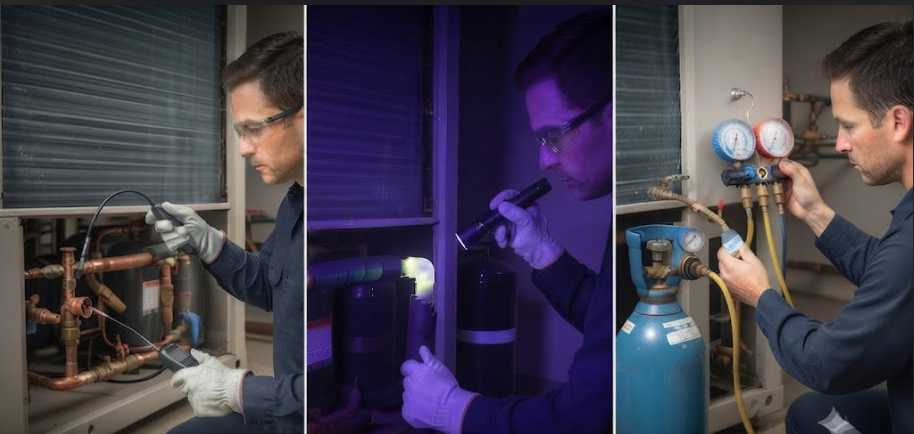
An electronic leak detector, often called a sniffer, uses a sensor tip that's passed slowly along suspect areas, joints, fittings, coils, valves, detecting trace amounts of refrigerant in the surrounding air and alerting the technician, typically through an audible tone or visual indicator that intensifies as the sensor gets closer to the actual leak source.
The genuine strength of this method is speed and sensitivity. A skilled technician can scan a large system relatively quickly, and modern electronic detectors are sensitive enough to catch quite small leaks that other methods might miss entirely. This makes electronic detection a strong first pass tool for routine inspection and general troubleshooting.
The real limitation is environmental interference. Air currents, whether from wind outdoors or a running fan indoors, can carry refrigerant vapor away from the actual leak point before the sensor detects it, or dilute the concentration enough that a real leak goes undetected. Background refrigerant contamination in an area with multiple systems, or where refrigerant has recently been handled, can also produce false positives that send a technician chasing a leak that isn't actually where the reading suggests. Electronic sensors also require periodic calibration and sensor replacement to remain reliably accurate over time, an ongoing cost that's easy to overlook when comparing methods purely on upfront simplicity.
UV Dye: Visual Confirmation That Persists
UV dye leak detection works differently entirely. A small amount of fluorescent dye is introduced into the system, typically mixed with the refrigerant oil, and circulates throughout the system during normal operation. At the site of a leak, the dye escapes along with the refrigerant and accumulates visibly around the leak point. Later, a technician uses an ultraviolet light to scan the system, and the dye fluoresces brightly wherever it's accumulated, visually pointing directly at the leak location.
The genuine strength here is persistence and visual certainty. Unlike an electronic sniffer's momentary reading, UV dye stays at the leak site, visible under UV light for an extended period, sometimes indefinitely, until the leak is repaired and the area cleaned. This makes it particularly useful for slow, intermittent leaks that might not be actively leaking enough vapor at the exact moment an electronic sniffer passes by, but have still left a visible dye trace over time. It's also a genuinely satisfying confirmation method, since a technician can see the leak directly rather than relying solely on an instrument reading.
The real limitation is time and preparation. Dye needs to be introduced into the system and given time to circulate and accumulate at a leak site before an inspection will actually show results, which means UV dye is often used as a diagnostic method planned in advance or as a follow up confirmation after another method has narrowed down a suspect area, rather than an immediate, on the spot diagnostic tool. Dye also needs to be compatible with the specific refrigerant and oil type in the system, an important detail that's easy to overlook when selecting a dye product.
Nitrogen Pressure Testing: Confirming Integrity Before Refrigerant Ever Enters
Nitrogen pressure testing takes an entirely different approach, and it happens at a different point in a system's life than the other two methods. Rather than detecting a leak using refrigerant already circulating in an operating system, dry nitrogen is used to pressurize a system, typically to a level specified by the equipment manufacturer, before any refrigerant is introduced at all. The system is then monitored, either by applying a soap bubble solution at joints and fittings to visually spot escaping bubbles, or by simply observing whether the system holds pressure steady over time.
The genuine strength of this method is that it verifies the physical integrity of the entire system before refrigerant, an expensive and environmentally regulated substance, is ever introduced. This makes nitrogen pressure testing the standard practice for new installations and after any repair involving brazing or opening the refrigerant circuit, precisely because it catches a leak at joints or connections before charging, rather than discovering the same leak later through slow refrigerant loss during operation.
The real limitation is that nitrogen testing only works before charging, or requires the system to be evacuated of refrigerant first if testing an existing system, which makes it impractical as a routine diagnostic method for a system that's already operating and simply needs its existing leak located. It's a construction and commissioning practice more than an ongoing maintenance diagnostic tool.
How These Methods Actually Complement Each Other
These three methods aren't really competing alternatives so much as tools suited to different stages and situations. Nitrogen pressure testing belongs at installation and after any brazing or repair work, confirming the system is sound before refrigerant is ever introduced. Electronic sniffing is the practical first pass for an operating system suspected of leaking, quickly narrowing down a general area. UV dye works well either as a planned, ongoing diagnostic for systems prone to slow or intermittent leaks, or as a follow up confirmation once electronic detection has narrowed a suspect area down but hasn't pinpointed the exact source with full certainty.
A technician relying on only one of these methods across every situation is likely leaving real diagnostic capability on the table. Understanding what each method actually verifies, system integrity before charging, active vapor presence during operation, or persistent visual evidence of a slow leak, is what allows choosing the right tool for the actual diagnostic situation in front of you, rather than defaulting to whichever method happens to be most familiar.
EveryEng. For everyone in Engineering.