

Article details
1. Introduction: The Shift Toward Formwork-Free Construction
Traditional concrete construction relies heavily on temporary timber or steel formwork to shape and support wet concrete until it achieves sufficient structural strength. Formwork is often one of the most labor-intensive, costly, and resource-wasteful phases of a project, generating massive volumes of temporary waste timber and requiring extensive manual labor.
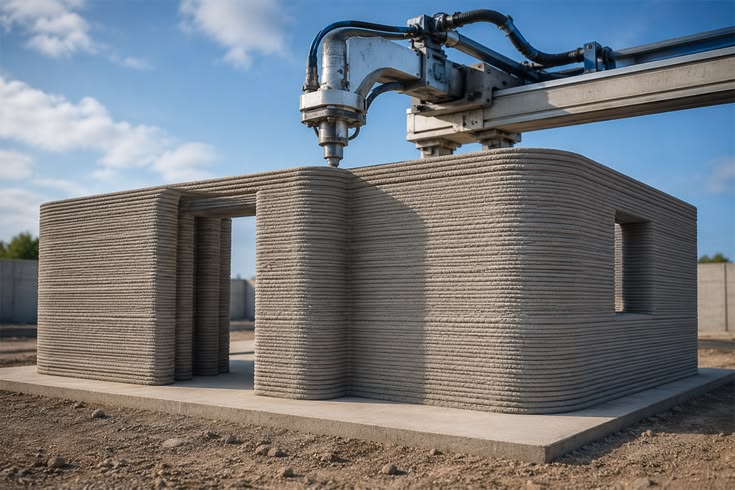
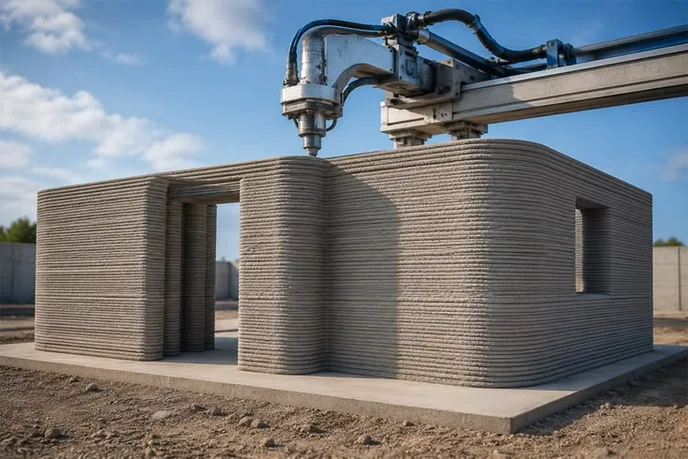
To overcome these limitations, the construction industry is rapidly adopting robotic 3D concrete printing (3DCP). By utilizing automated gantry systems or robotic arms to extrude specialized cementitious mortars layer by layer directly according to digital CAD and BIM paths, on-site modular construction can proceed entirely without physical formwork.
2. Technical Mechanism: Rheology, Extrusion, and Toolpath Generation
Successful 3D concrete printing requires a delicate balance between material science and robotic automation.
A. Material Rheology: The Triple Challenge
The cementitious mortar mix design must simultaneously satisfy three critical rheological properties:
Pumpability: The ability of the wet mix to flow smoothly through delivery hoses and pumps without segregation or blocking.
Extrudability: The capacity of the mortar to flow cleanly through the print nozzle under pressure and form a continuous, uniform filament.
Buildability: The green strength of the freshly extruded layers, allowing them to support the weight of subsequent layers without structural slumping or collapse.
B. Automated Toolpath Generation
Robotic arms and automated gantry systems follow precise digital toolpaths generated directly from 3D Building Information Models (BIM). By utilizing topological optimization, algorithms instruct the robot to deposit structural material only where mechanical stress demands it, creating complex hollow walls, intricate lattice infills, and curved geometries that would be impossible with traditional formwork.
3. Practical Applications in On-Site Modular Construction
Deploying robotic 3D concrete printing directly on job sites transforms structural execution and modular manufacturing:
A. Rapid On-Site Wall and Core Construction
Automated robotic systems can be deployed directly on foundation slabs to print load-bearing walls, stair cores, and exterior building envelopes on-site. This drastically accelerates construction schedules, reduces the required on-site labor workforce, and eliminates formwork erection and stripping cycles.
B. Sustainable Material Efficiency
Because 3D printing removes the need for custom timber formwork and enables hollow or lattice-structured wall designs, it significantly reduces total concrete consumption and embodied carbon per square meter of construction.
Conclusion
Robotic 3D Concrete Printing in on-site modular construction represents a transformative leap forward for civil engineering and building technology. By mastering printable material rheology and utilizing automated CAD-driven toolpaths, construction teams can achieve formwork-free structural execution. This innovation cuts labor costs, minimizes material waste, and opens new possibilities for sustainable, geometrically complex infrastructure.