

Article details
A traditional desiccant wheel needs two separate air streams to function, a process stream being dehumidified and a regeneration stream driving moisture back out of the desiccant material. Sourcing that second regeneration stream, often building exhaust air, and heating it enough to actually regenerate the wheel, adds real complexity and energy cost. Series regeneration solves this differently, using the same single air stream for both jobs by cleverly positioning the wheel relative to the cooling coil already in the system.
The Traditional Two Stream Approach, and Its Real Cost
In a conventional parallel desiccant wheel arrangement, one air stream, often outdoor air being brought in for ventilation, passes through the process side of the rotating wheel and gets dehumidified. A separate regeneration air stream, commonly exhaust air leaving the building, gets deliberately heated and passed through the opposite side of the same rotating wheel, driving absorbed moisture back out and restoring the desiccant material's capacity before that section of the wheel rotates back around to the process side again.
This works, but it requires a genuinely separate regeneration air path and a real heat source to warm that regeneration air enough to be effective, both adding equipment, ductwork, and ongoing energy cost to the system. There's also a real design trade off worth naming plainly, removing moisture at the process side adds sensible heat to that air stream, which means a cooling coil is often still required downstream just to bring the now dehumidified but warmer air back down to a usable supply temperature.
How Series Regeneration Actually Works
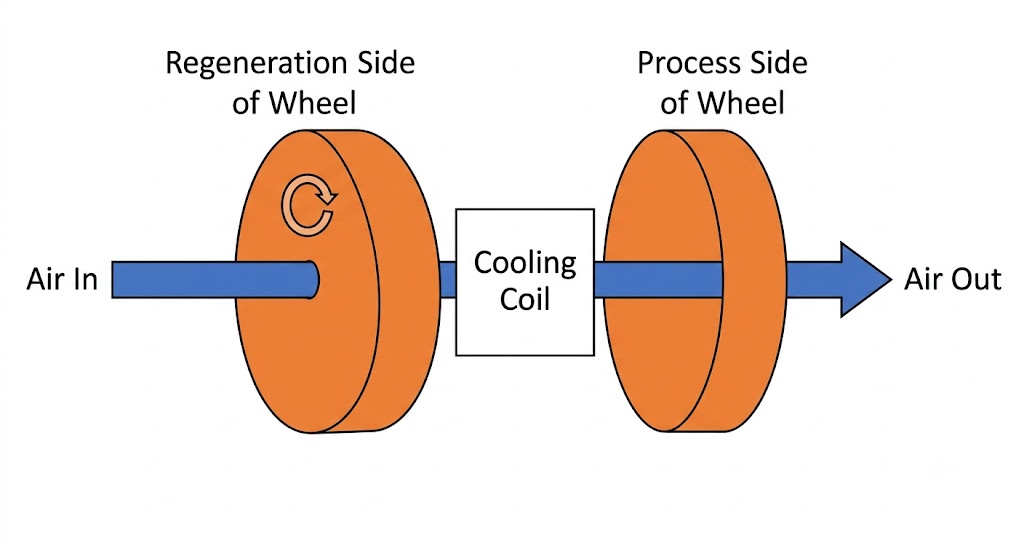
Series regeneration takes a genuinely different approach, positioning the desiccant wheel's regeneration side upstream of the cooling coil, and the same wheel's process side downstream of that same cooling coil, both sections working on the identical air stream rather than two separate ones.
Here's the sequence that makes this work. Air first passes through the cooling coil, where it's cooled and already partially dehumidified through conventional condensation, exactly the mechanism covered in why refrigeration based dehumidification fails at low humidity. That now cold air then passes through the process side of the desiccant wheel, positioned downstream of the coil, where the wheel adsorbs additional moisture directly out of this already cool air, pulling out further moisture the cooling coil alone couldn't efficiently remove.
As that same wheel rotates, the desiccant material that just absorbed moisture downstream moves into position upstream of the cooling coil, where it now sits in the path of warmer, entering air before that air ever reaches the coil. The warmth of this entering air, along with the temperature differential built into the wheel's rotation, drives the moisture the wheel picked up downstream back out, regenerating that section of the wheel, and in the process adding that released moisture and heat into the air just before it reaches the cooling coil.
Why This Doesn't Need a Second Air Stream
The genuinely clever part of this configuration is that regeneration happens using heat and moisture transfer occurring within the same single air stream, entering air upstream of the coil, leaving air downstream of the coil, rather than requiring a separate, independently heated regeneration air stream sourced from somewhere else in the building. The temperature difference between the warmer entering air and the cooler, already coil treated leaving air is what drives the regeneration process, the same basic principle of using an existing temperature differential covered in heat pipe run around systems, just applied through a rotating desiccant wheel instead of a sealed refrigerant loop.
Why This Configuration Genuinely Improves Dehumidification
This series arrangement doesn't just avoid needing a second air stream, it directly improves the cooling coil's effective dehumidification performance. Because the desiccant wheel pulls additional moisture out of the air after it leaves the cooling coil, the overall system can reach a meaningfully lower final dew point than the cooling coil could achieve working alone, without needing to drive the coil itself to an increasingly extreme, energy intensive operating point to chase that same lower humidity target.
Real world performance data for this type of configuration commonly cited in manufacturer engineering literature shows meaningful improvement in dehumidification capacity along with a genuinely lower achievable dew point compared to the same cooling coil operating without the desiccant wheel at all, alongside a real reduction in combined cooling and reheat energy, since the system needs less aggressive over cooling and correspondingly less reheat to reach the same final delivery condition.
Where This Configuration Makes the Most Sense
Series regeneration configurations show up specifically in dedicated outdoor air systems handling significant latent load, applications where a genuinely low dew point is required but a separate regeneration air source, or the ductwork and control complexity that comes with one, isn't practical or cost justified. This connects directly to the broader theme covered in why refrigeration based dehumidification fails at low humidity, series regeneration is essentially a practical, single air stream way of extending a conventional cooling coil's effective reach into low humidity territory it couldn't efficiently handle unassisted, without the added complexity of a fully separate liquid desiccant or dual air stream desiccant system.
The Practical Takeaway
Series regeneration solves a genuinely specific problem, extending a cooling coil's dehumidification performance further into low humidity conditions than the coil could reach efficiently alone, without requiring a separate regeneration air stream or an independent heat source to drive that regeneration. By positioning the same rotating desiccant wheel both upstream and downstream of the existing cooling coil, the system uses temperature differences already present within a single air stream to regenerate itself continuously, turning what would otherwise require significant additional equipment and energy into a genuinely elegant enhancement of a cooling coil that's already there.
EveryEng. For everyone in Engineering.