


Article details
Imagine kinks in a garden hose or a tight nozzle on a spray bottle. You are forcing fluid through a narrow restriction, altering its flow behavior. In engineering and thermodynamics, this process is known as throttling, and the components that do it are called throttling devices.
Unlike turbines or pumps, which use moving blades to extract or add energy, a throttling device has no moving parts and does absolutely no work. Yet, it is the magic component that allows your kitchen refrigerator to stay freezing cold and your home air conditioner to survive scorching summers.
What is a Throttling Device?
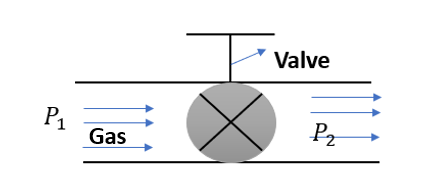
A throttling device is any mechanical restriction that introduces a significant obstruction to a flowing fluid, causing a drastic drop in pressure.
Common examples include:
Capillary Tubes: Long, incredibly thin copper tubes used in small refrigerators.
Thermostatic Expansion Valves (TXVs): Variable-opening valves used in automotive and home AC units.
Porous Plugs / Orifice Plates: Plugs with tiny holes used in industrial piping.
The Thermodynamic Golden Rule: Isenthalpic Process
To understand how these devices work, we look at the steady-flow energy equation. Because a throttling device is tiny and the fluid passes through it incredibly fast, there is no time for heat to enter or leave the system (Q = 0). Furthermore, there are no spinning shafts, so no work is done (W = 0).
This simplifies the energy equation to a beautiful, fundamental truth:
h_1 = h_2
A throttling process is isenthalpic—the total enthalpy (h) of the fluid remains constant from the inlet to the outlet.
The Tug-of-War Between Energies
Enthalpy is the sum of internal energy (u) and flow energy (P.v):
h = u + Pv
Because the pressure (P) drops massively across the restriction, the "flow energy" side of the equation plummets. To keep the total enthalpy (h) perfectly balanced, the internal energy (u) and specific volume (v) must change to compensate. This brings us to how throttling manipulates temperature.
The Joule-Thomson Effect: Hot or Cold?
You might think that dropping the pressure of a fluid always cools it down. In reality, whether a fluid gets hotter or colder during throttling depends entirely on its initial state and a property called the Joule-Thomson (J-T) coefficient (μ_{JT}):

If μ_{JT} > 0 (Cooling): The temperature drops as pressure drops. This is what happens to most everyday gases (like air, CO_2, and refrigerants) at room temperature.
If μ_{JT} < 0 (Heating): The temperature actually rises as pressure drops. Exceptional gases like hydrogen, helium, and neon will actually warm up if throttled at room temperature.
Real-World Applications
Throttling devices are essential components in massive industrial and domestic thermal systems:
1. The Refrigeration Cycle (The Cooling Step)
In a standard refrigerator or air conditioner, a compressor pumps up a refrigerant gas to a high-pressure, hot liquid. This liquid travels to the expansion valve (a throttling device).
As the liquid is forced through the tiny valve opening into a low-pressure zone, it undergoes flash evaporation. It satisfies its constant-enthalpy requirement by dropping drastically in temperature—often plummeting by tens of degrees in a split second. This freezing cold fluid is what absorbs heat from inside your fridge.
2. Gas Liquefaction
To create liquid nitrogen or oxygen for medical and industrial use, gases are compressed to intense pressures, cooled down past their "inversion temperature," and then repeatedly throttled. The cumulative cooling effect from the pressure drops eventually turns the gas into a liquid.
3. Flow Measurement
Industrial pipelines use thin plates with a precise hole in the middle, called orifice plates. By forcing fluid to throttle through the hole and measuring the exact pressure drop across it, engineers can use Bernoulli's equation to calculate the exact velocity and flow rate of the fluid moving through the pipe.