

Article details
Introduction
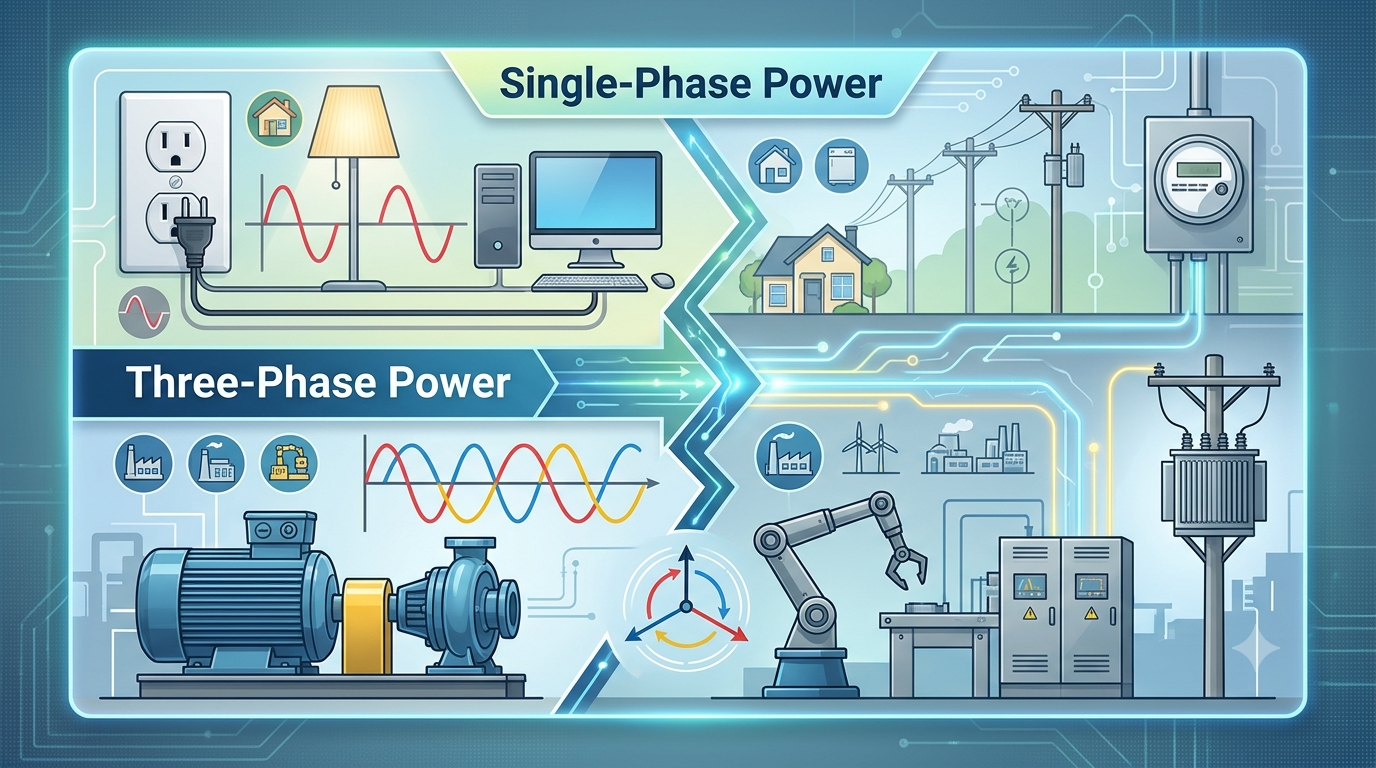
Electrical power systems are essential for residential buildings, commercial facilities, and industrial operations. Two common types of alternating current (AC) power supplies are single-phase power and three-phase power. Both supply electricity to electrical equipment, but they differ in their voltage waveforms, current distribution, power capacity, and applications.
Understanding the difference between these systems helps electrical engineers, technicians, and facility managers select suitable power supplies, calculate electrical current, and improve energy efficiency.
Single-phase power is commonly used for household appliances and small electrical loads, while three-phase power is widely used in industrial machinery, large motors, commercial buildings, and heavy electrical equipment.
What Is Single-Phase Power?
Single-phase power is an AC electrical supply that uses one alternating voltage waveform. The voltage periodically changes its magnitude and direction, allowing current to flow through a connected load.
A typical single-phase circuit uses a live wire and a neutral wire. A protective earth conductor may also be provided for electrical safety.
Single-phase systems are generally easier to install and maintain because their wiring arrangements are relatively simple. They are suitable for applications that do not require large amounts of electrical power.
Applications of Single-Phase Power
Single-phase power is commonly used in:
Residential lighting and ceiling fans.
Televisions, computers, and other household electronics.
Refrigerators, washing machines, and small appliances.
Small pumps and electrical tools.
Small offices, shops, and residential heating systems.
The supply voltage depends on the country and local electrical standards. Common examples include 120 V and 230 V systems.
Advantages of Single-Phase Power
Single-phase systems offer several practical benefits. Their simple wiring arrangement makes installation relatively economical for small loads. Electrical components and appliances designed for single-phase supplies are widely available.
They are also suitable for locations where electricity demand is moderate and large industrial machinery is not required.
Limitations of Single-Phase Power
Single-phase systems have limited power-delivery capability compared with appropriately designed three-phase systems. High-power equipment may draw substantial current, requiring larger conductors and suitable protective devices.
Single-phase power delivery also fluctuates during each AC cycle. Additionally, many single-phase induction motors require starting arrangements such as capacitors or auxiliary windings.
What Is Three-Phase Power?
Three-phase power is an AC electrical supply that uses three voltage waveforms of the same frequency, separated from one another by 120 electrical degrees.
These three phases work together to deliver power more consistently than a single-phase system under balanced operating conditions. The arrangement is particularly suitable for equipment that requires high power and reliable motor operation.
Three-phase systems typically use three line conductors. Depending on the configuration and application, a neutral conductor may also be included.
Applications of Three-Phase Power
Three-phase power is widely used in:
Industrial motors and manufacturing machinery.
Pumps, compressors, and large fans.
HVAC systems and refrigeration plants.
Commercial buildings and data centres.
Industrial heating equipment and production lines.
Power generation, transmission, and distribution systems.
It is especially useful in facilities where several large electrical loads operate simultaneously.
Advantages of Three-Phase Power
Three-phase power can deliver more electrical power for a given system voltage and current arrangement. This makes it suitable for heavy electrical loads and large industrial installations.
Its balanced power delivery supports smooth operation of three-phase motors. These motors are generally self-starting and often provide good efficiency and performance.
Three-phase distribution can also reduce conductor requirements for transmitting a given amount of power under comparable design conditions. This can help reduce cable material and electrical losses.
Limitations of Three-Phase Power
Three-phase installations generally require more complex distribution equipment and protection arrangements. Installation and maintenance may involve higher initial costs, particularly when the connected equipment does not require a large power supply.
Correct phase sequencing, load balancing, insulation, earthing, and protection are important for safe and reliable operation.
Key Differences Between Single-Phase and Three-Phase Power
Although both systems use alternating current, their electrical characteristics and practical applications differ.
Feature | Single-Phase Power | Three-Phase Power |
|---|---|---|
Voltage waveforms | One | Three, separated by 120° |
Typical conductors | Live and neutral | Three line conductors, with neutral where required |
Power delivery | Fluctuates during each cycle | More consistent under balanced conditions |
Power capacity | Generally suited to smaller loads | Well suited to larger loads |
Motor operation | Many motor types require starting assistance | Three-phase induction motors are generally self-starting |
Installation | Relatively simple | More complex |
Common applications | Homes and small offices | Industries and large commercial facilities |
Current distribution | Current flows through the single-phase circuit | Load is distributed across three phases |
The most suitable system depends on the equipment rating, available supply, operating conditions, installation cost, and local electrical requirements.
Understanding Current in Single-Phase and Three-Phase Systems
Electrical current, measured in amperes (A), indicates the rate at which electric charge flows through a conductor. The current required by an electrical load depends on its power rating, supply voltage, and power factor.
The current calculation differs between single-phase and three-phase systems because their electrical arrangements are different.
Single-Phase Current Formula
For a single-phase AC load, the current can be calculated using:
I = P / (V × PF)
Where:
I = Current in amperes (A)
P = Real power in watts (W)
V = Supply voltage in volts (V)
PF = Power factor
For a purely resistive load, the power factor is approximately 1. For other AC loads, the power factor must be considered when calculating current from real power.
Three-Phase Current Formula
For a balanced three-phase load, the line current can be calculated using:
I = P / (√3 × V × PF)
Where:
I = Line current in amperes (A)
P = Total real power in watts (W)
V = Line-to-line voltage in volts (V)
√3 = Approximately 1.732
PF = Power factor
For motor calculations, efficiency must also be considered when the given power rating represents mechanical output rather than electrical input.
These formulas are useful for estimating current and planning electrical distribution. Final cable and protective-device selection must also consider applicable electrical codes, installation conditions, and equipment specifications.
Example: Comparing Single-Phase and Three-Phase Current
Consider an electrical heater with a power rating of 10 kW connected to a 230 V supply. Assume the load is balanced where applicable and has a power factor of 1.
For single-phase power:
[
I=\frac{10,000}{230\times1}=43.48\text{ A}
]
The required current is approximately 43.5 A.
For three-phase power:
[
I=\frac{10,000}{\sqrt{3}\times230\times1}
]
[
I=\frac{10,000}{398.37}=25.10\text{ A}
]
The line current is approximately 25.1 A.
This comparison shows that a balanced three-phase supply can deliver the same total power at a lower line current under the stated voltage and power-factor assumptions. Actual current and installation requirements depend on the supply configuration and load characteristics.
Three-Phase Connections: Star and Delta
Three-phase electrical systems commonly use two connection arrangements: star (wye) and delta. Each arrangement has different characteristics and is selected according to the voltage requirements and application.
Star Connection
In a star connection, one end of each phase winding is connected to a common point. This point can serve as the neutral when the system is designed for it.
Star connections are commonly used in distribution systems where both line-to-line and line-to-neutral voltages are required.
For a balanced star-connected system:
Line voltage is √3 times the phase voltage.
Line current equals phase current.
Delta Connection
In a delta connection, the three phase windings are connected in a closed loop. Each winding is connected between two line conductors.
Delta connections are commonly used in motors and other three-phase equipment, depending on their design and rated voltage.
For a balanced delta-connected system:
Line voltage equals phase voltage.
Line current is √3 times phase current.
Understanding these relationships is important when calculating current, selecting equipment, and interpreting motor nameplate information.
Factors to Consider When Selecting a Power Supply
Selecting between single-phase and three-phase power requires an assessment of the electrical load and operating requirements.
1. Total power demand: Small appliances and light loads can generally operate on single-phase power, whereas large motors and industrial machinery often require three-phase power.
2. Equipment specifications: Always check the rated voltage, current, frequency, and phase requirements stated on the equipment nameplate.
3. Installation cost: Single-phase systems may be more economical for small installations. Three-phase systems can offer advantages for larger loads, although the overall cost depends on the equipment and installation design.
4. Energy efficiency: Three-phase motors and distribution systems can offer operational and conductor-efficiency advantages when correctly designed and loaded.
5. Future expansion: Commercial and industrial facilities should consider future machinery additions and increased electrical demand when planning their distribution systems.
6. Safety and protection: Both systems require suitable circuit breakers, earthing, conductor sizing, and protection against overloads and short circuits.
Common Mistakes in Phase and Current Calculations
Electrical calculations must use the correct voltage and power relationships. Common mistakes include:
Using line-to-neutral voltage instead of line-to-line voltage in the three-phase current formula.
Forgetting to include the power factor for AC loads.
Ignoring motor efficiency when calculating input current from mechanical output power.
Assuming that all three-phase loads are balanced.
Selecting cables based only on calculated current without considering installation conditions and applicable standards.
Checking these factors helps improve calculation accuracy and reduces the risk of equipment overheating or electrical faults.
Conclusion
Single-phase and three-phase power systems serve different electrical requirements. Single-phase power is suitable for household appliances, small offices, and moderate electrical loads because of its simple installation and widespread availability.
Three-phase power is better suited to industrial machinery, large motors, commercial facilities, and other applications requiring higher power capacity and consistent power delivery.
Understanding their differences, connection arrangements, and current calculation formulas helps engineers select appropriate electrical systems and design reliable installations. By considering load demand, voltage, power factor, efficiency, and safety requirements, electrical professionals can make informed decisions about power distribution and equipment selection.
