

Article details
For more than a century, cooling has meant essentially the same thing: compress a refrigerant gas, let it expand and absorb heat, repeat. Compressors, chemical refrigerants, moving parts — it's a mature, reliable technology, but it's also mechanically complex and dependent on substances that carry real environmental cost.
A different category of cooling technology skips all of that. It's called solid-state caloric cooling, and instead of cycling a refrigerant through a compressor, it uses certain solid materials that heat up or cool down when exposed to an external field — electric, magnetic, or mechanical stress. No refrigerant. No compressor. In some designs, no moving parts at all.
The Core Physics: The Caloric Effect
Certain materials exhibit what's called a caloric effect — their temperature changes measurably when exposed to an external stimulus, and that change can be harnessed to move heat from one place to another, the same fundamental job a refrigerant does inside a compressor-based system.
There are a few variants, distinguished by what triggers the effect:
Electrocaloric materials change temperature under an applied electric field
Magnetocaloric materials change temperature under an applied magnetic field
Elastocaloric materials change temperature when mechanically stretched or compressed (this is the mechanism behind shape-memory alloy cooling devices, a related but distinct category)
Of these, electrocaloric systems are notable for being mechanically the simplest to implement — since applying an electric field requires no magnets and no physical actuators, the surrounding system architecture can be considerably less complex than magnetocaloric or elastocaloric designs.
Building a Cooling Cycle Around a Solid
Having a material that changes temperature under a field is only half the problem. To actually function as a cooling system, that heating and cooling effect needs to be turned into a repeatable cycle that continuously moves heat from a cold side to a hot side.
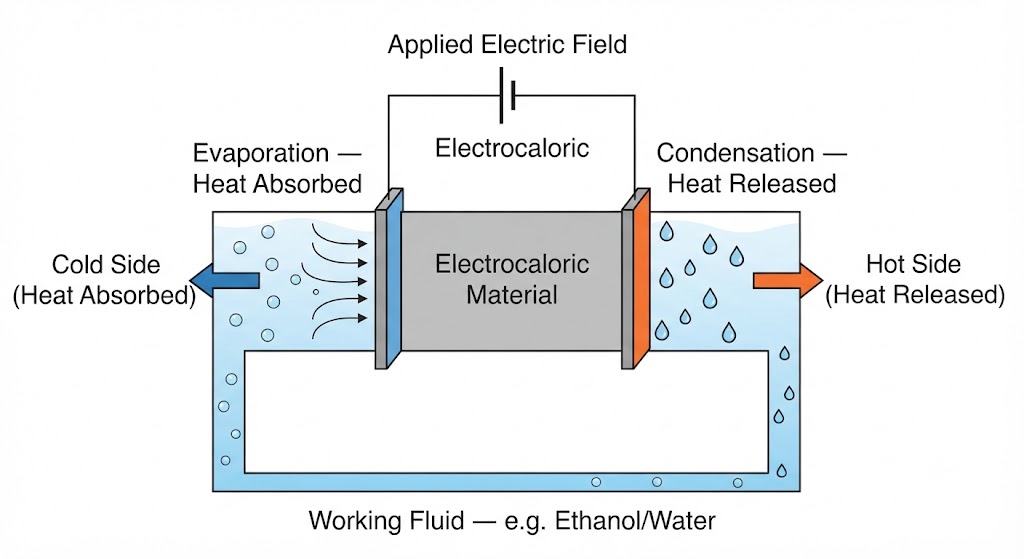
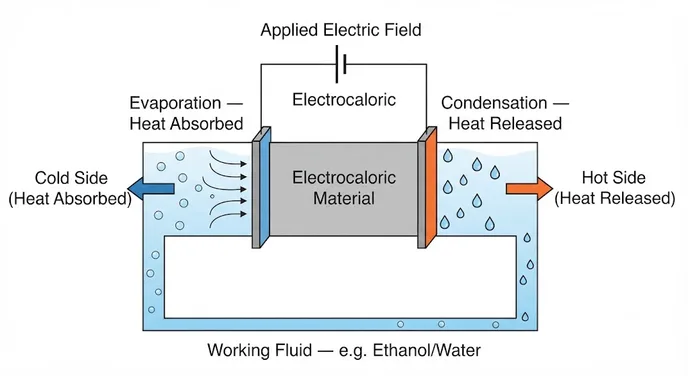
One approach to this — developed through research at Germany's Fraunhofer Institute for Physical Measurement Techniques (IPM), and now being commercialized by a spinout called Qurie GmbH — uses what's referred to as an Active Electrocaloric Heat Pipe. The concept pairs the electrocaloric material with a working fluid, such as ethanol or water, that evaporates and condenses rapidly against the material's surface. This evaporation-condensation cycle allows the latent heat transfer to happen quickly, which is essential for making an electrocaloric device efficient enough to be practically useful rather than just a laboratory curiosity.
Why This Matters Beyond "No Refrigerant"
The environmental case for solid-state cooling is straightforward: no chemical refrigerant means no risk of high-Global-Warming-Potential gas leaks, a real and ongoing liability with conventional systems even as the industry shifts toward lower-GWP refrigerant options.
But the mechanical case matters just as much for long-term reliability. Compressor-based systems have a well-known failure mode: mechanical wear on moving parts, seals, and bearings over years of operation. A solid-state system built around a static material and an electric field has fundamentally fewer components that can wear out — which is part of why this category is often described as enabling ultra-quiet, low-maintenance cooling, alongside its environmental benefits.
Where This Technology Currently Stands
It's worth being clear-eyed about maturity here. Solid-state caloric cooling is an active, promising area of applied research, not yet a mainstream replacement for compressor-based systems. Companies like Qurie are still in the early stages of turning a decade of institutional research into a commercial product — this is closer to where liquid cooling for data centers was several years ago than to a proven, widely deployed technology today.
That said, the direction is clear enough that it's worth understanding now rather than later. As caloric materials and heat pipe designs continue to mature, solid-state cooling is a strong candidate to become a meaningful category within refrigeration — particularly for smaller-scale, precision cooling applications where mechanical simplicity and low noise carry real value.
Further Reading: www.coolingindia.in/advanced-desiccant-regeneration-methods/, ACHR News