


Article details
Heat added to a substance can do two different things: raise its temperature or change its phase (solid ↔ liquid ↔ gas). These effects are described by specific heat and latent heat.
Specific Heat
Specific heat is the amount of heat required to raise the temperature of unit mass of a substance by 1°C (or 1 K) without changing its phase.
Q = m,c,\Delta T
Where:
(Q) = heat added,
(m) = mass,
(c) = specific heat,
(\Delta T) = temperature change.
Units
J/kg·K (SI)
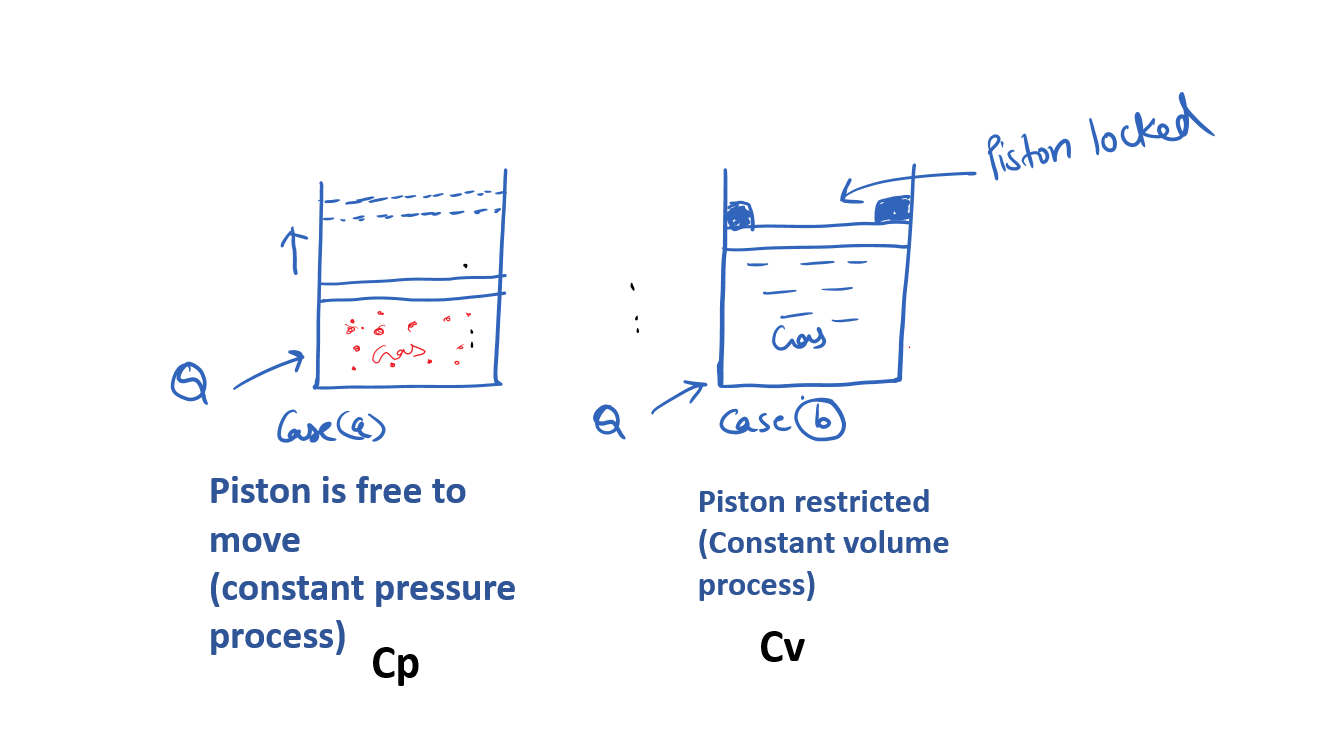
Types of Specific Heat
At constant pressure ((c_p))
At constant volume ((c_v))
For gases, (c_p > c_v) because extra heat is needed for expansion work.
Examples
Water has a high specific heat, which is why it is used as a coolant.
Metals generally have low specific heat and heat up quickly.
Latent Heat
Latent heat is the heat required to change the phase of unit mass of a substance without any change in temperature.
Q = m,L
Where:
(L) = latent heat.
Types of Latent Heat
Latent Heat of Fusion – solid to liquid (melting)
Latent Heat of Vaporization – liquid to vapor (boiling)
During phase change, temperature remains constant while heat is absorbed or released.
Examples
Ice melting into water absorbs latent heat of fusion.
Water converting to steam absorbs large latent heat of vaporization.
Key Differences
Aspect | Specific Heat | Latent Heat |
|---|---|---|
Effect | Changes temperature | Changes phase |
Temperature change | Yes | No |
Formula | (Q = mc\Delta T) | (Q = mL) |
Units | J/kg·K | J/kg |
Example | Heating water | Boiling water into steam |
Engineering Significance
Coolants and heat exchangers rely on high specific heat.
Refrigeration and air conditioning depend on latent heat during evaporation and condensation.
Steam power plants utilize large latent heat of vaporization for energy transfer.