


Article details
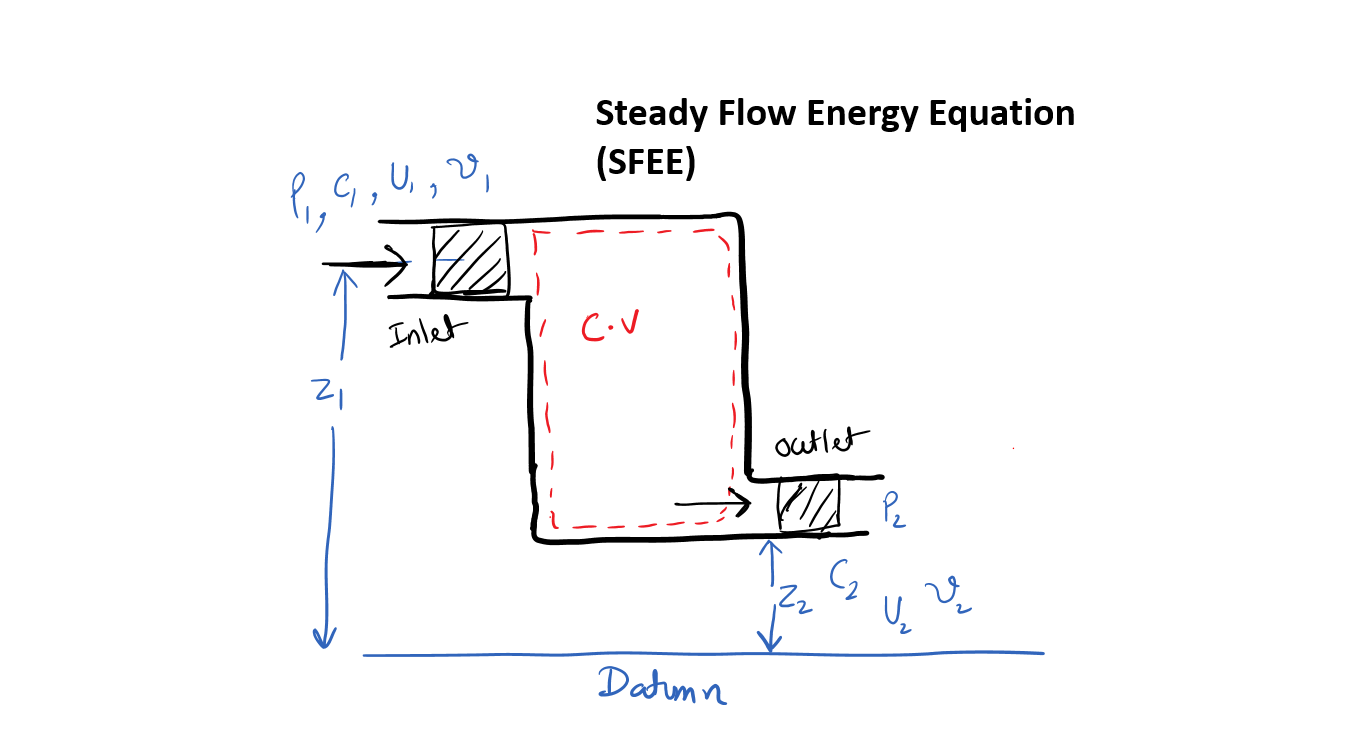
The Steady Flow Energy Equation (SFEE) is an application of the First Law of Thermodynamics to open systems (control volumes) operating under steady-state conditions. It relates heat transfer, work transfer, and the energy carried by mass as it flows through devices like turbines, compressors, boilers, nozzles, and heat exchangers.
What “Steady Flow” Means
A process is steady when, with time:
Properties at any point do not change
Mass flow rate remains constant
Energy within the control volume does not accumulate

General Form of SFEE (Single Inlet, Single Outlet)

Where:
( \dot{Q} ) = Heat transfer rate to the system
( \dot{W} ) = Work transfer rate from the system
( \dot{m} ) = Mass flow rate
( h ) = Specific enthalpy
( V ) = Velocity of fluid
( z ) = Elevation
( g ) = Gravitational acceleration
Energy Terms Explained
Enthalpy (h) – Flow energy + internal energy
Kinetic Energy term – Due to fluid velocity
Potential Energy term – Due to elevation difference
Simplified SFEE for Common Devices
1. Turbine
Produces work
Heat transfer often negligible
KE and PE negligible

2. Compressor / Pump
Work supplied to fluid

3. Boiler / Heater
No work interaction

4. Condenser

5. Nozzle
No heat, no work
Change in velocity is significant

6. Throttling Valve
No heat, no work
Negligible KE and PE

Assumptions in SFEE
Steady-state operation
One-dimensional flow
Uniform properties at inlet and outlet
Negligible energy storage within control volume
Applications
Steam and gas turbines
Pumps and compressors
Boilers and condensers
Nozzles and diffusers
Refrigeration and HVAC components
Power plant cycle analysis