


Article details
Strain Energy
Strain energy is the energy stored in a material due to deformation or strain. When a material is subjected to external forces, it deforms, and its internal forces resist this deformation. The energy absorbed by the material during deformation is called strain energy.
Strain energy is a measure of the material's capacity to absorb energy without failing. It is an important concept in solid mechanics and is used to analyze the behavior of materials under various types of loading, such as tension, compression, shear, and torsion.
Derive the expression of strain energy.
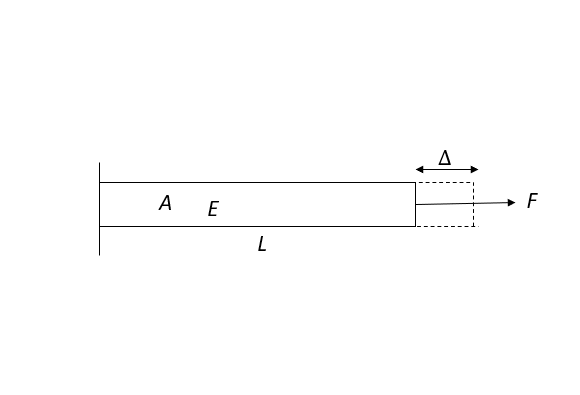
Consider a wire whose original length is L and cross-sectional area is A stretched by a force F acting along its length. The wire gets stretched and elongation is produced in it.


Since, the restoring force is varying from 0 to F during the elongation of the wire. During the process of extension f be the restoring force and x be corresponding distance.


Strain energy for axially loaded prismatic bar, 
Its unit is N-m or Joule.
The strain energy density (U) is the energy stored per unit volume of the material and is calculated as:

Strain energy density can be expressed as:

Case-I: Strain energy of prismatic bars with varying sections
Total strain energy of prismatic bar, 
Case-II: Strain energy of non-prismatic bar with varying axial load

Total strain energy,

Case-III: Strain energy due to the shear force

Where, is the reduced shear area, is the shear force at any section, G is the shear modulus.
Case-IV: strain energy in terms of principal stresses

Case-V: Strain energy due to bending moment

Here, I is the moment of inertia.
Case-VI: Strain energy stored due to torque

Here, is the polar moment of inertia.