


Article details
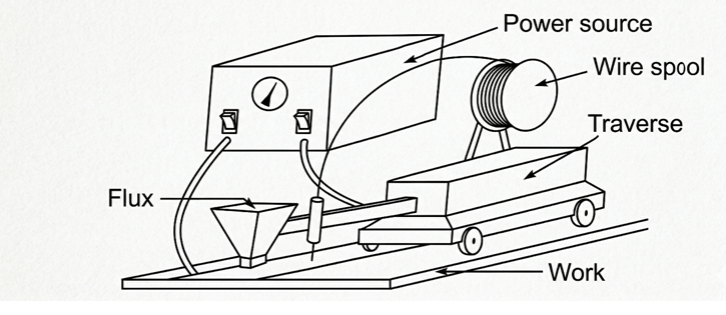
Submerged Arc Welding (SAW) is a highly efficient fusion welding process characterized by its use of a granular, fusible flux blanket that completely obscures the electric arc. This "submerged" operating condition fundamentally alters the thermal and metallurgical dynamics of the weld, distinguishing it from open-arc processes.

Operation and Flux Dynamics
In the SAW process, a continuous, consumable bare wire electrode is fed automatically into the weld joint. Simultaneously, a gravity-fed hopper dispenses a thick layer of granular flux—typically a specifically formulated compound of silica, calcium fluoride, manganese oxide, and other stabilizing elements—directly over the weld zone.
The flux blanket serves several critical engineering functions:
Atmospheric Protection: As the flux melts into slag, it provides a physical and chemical barrier that shields the molten weld pool from oxygen and nitrogen contamination.
Thermal Management: The thick layer acts as an exceptional thermal insulator. By trapping the heat generated by the arc, it promotes deeper weld penetration into the base metal.
Environmental Control: The submerged nature of the arc completely suppresses the intense ultraviolet radiation, sparks, and spatter typically associated with arc welding, creating a safer and cleaner operating environment.
Metallurgical Alloying: The flux can be engineered to contribute specific alloying elements to the weld pool, refining the final microstructure of the joint.
Technical Parameters
SAW is engineered for heavy-duty fabrication and high deposition rates. The standard operating parameters highlight its industrial capacity:

Electrode Specifications: Bare round wire coils ranging from 1.5 mm to 10 mm in diameter.
Electrical Inputs: Heavy power requirements with currents operating between 300 A and 2000 A. Power sources are typically connected to standard single or three-phase lines with primary ratings up to 440 V.
Travel Speeds: Due to high automation, travel speeds can reach up to 5 m/min, significantly outpacing manual welding methods.
Operational Capabilities and Constraints
The primary constraint of SAW is gravity. Because the granular flux relies on gravity to maintain coverage over the weld pool, the process is predominantly restricted to flat or horizontal welding positions.
Despite this limitation, SAW is highly economical for large-scale production. Excess, unfused flux is routinely recovered via vacuum systems, treated, and reused. Furthermore, while flat plates are the most straightforward application, cylindrical components like pipes and pressure vessels can be seamlessly welded by mechanically rotating the workpiece under a stationary welding head.
Industrial Applications
SAW yields exceptionally high-quality welds characterized by excellent ductility, uniform mechanical properties, and superior toughness. It is extensively deployed for joining carbon steels, alloy steels, and stainless steels in heavy manufacturing sectors.
Key applications include:
Fabrication of thick plates for shipbuilding.
Construction of high-integrity pressure vessels and nuclear reactor components.
Heavy structural engineering, including bridge girders.
High-volume manufacturing of LPG cylinders and large-diameter welded pipes.


 2 Hrs
2 Hrs 


