

Article details
Cascade Refrigeration System
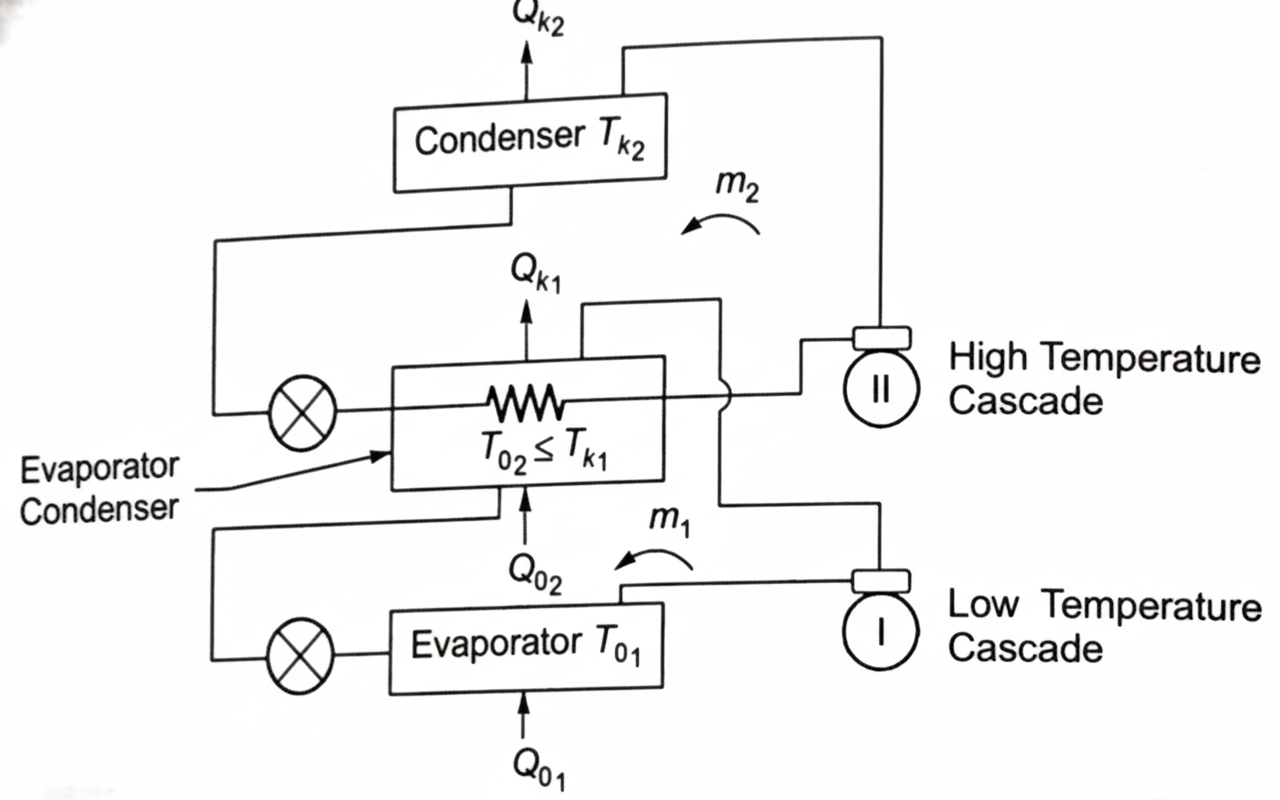
A cascade refrigeration system is used when extremely low temperatures (below −40 °C and even down to −80 °C or lower) are required—conditions where a single vapour compression cycle becomes inefficient or impractical. The system achieves these temperatures by connecting two or more refrigeration cycles in series, each using a different refrigerant suited to a specific temperature range.
This arrangement is common in ultra-low temperature freezers, pharmaceutical storage, environmental test chambers, and gas liquefaction labs.
1. Why Cascade Refrigeration Is Needed
In a single-stage vapour compression system operating at very low evaporator temperatures:
Compression ratio becomes very high
Discharge temperature rises excessively
COP drops sharply
Lubrication and compressor reliability suffer
Cascade systems split the temperature lift into stages, improving efficiency and reliability.
2. Basic Working Principle
Two independent vapour compression cycles operate together:
Low Temperature (LT) Cycle – produces very low temperature
High Temperature (HT) Cycle – rejects heat to the atmosphere
They are thermally connected through a cascade condenser, which acts as:
Condenser for LT cycle
Evaporator for HT cycle
3. Main Components
Low Temperature Cycle
LT compressor
LT evaporator (provides cooling at very low temp)
Cascade condenser (as condenser)
Expansion device
High Temperature Cycle
HT compressor
Air/water cooled condenser
Cascade condenser (as evaporator)
Expansion device
4. Refrigerants Used
Different refrigerants are selected based on boiling points:
Cycle | Typical Refrigerants | Purpose |
|---|---|---|
LT Cycle | R-23, R-170 (ethane), CO₂ | Very low temperature |
HT Cycle | R-134a, R-404A, R-22 | Heat rejection to atmosphere |
5. Working Sequence
LT evaporator absorbs heat from the space at very low temperature.
LT refrigerant is compressed and sent to cascade condenser.
In cascade condenser, LT refrigerant condenses by transferring heat to HT refrigerant.
HT refrigerant evaporates in cascade condenser.
HT compressor compresses and sends refrigerant to its condenser to reject heat outside.
Cycles repeat.
6. Temperature Ranges Achieved
−40 °C to −90 °C commonly
Even lower in multi-stage cascade systems
7. Advantages
Achieves ultra-low temperatures efficiently
Lower compression ratio per stage
Improved COP compared to single-stage system
Lower discharge temperature
Better compressor life
Flexible refrigerant selection
8. Limitations
Higher initial cost
Complex design and controls
Requires careful refrigerant pairing
More maintenance due to two systems
9. Applications
Biomedical freezers (−80 °C storage)
Vaccine and plasma storage
Environmental test chambers
Chemical processing
Gas liquefaction research
10. Comparison with Single-Stage System
Feature | Single Stage | Cascade System |
|---|---|---|
Lowest temperature | Limited | Very low (−80 °C) |
COP | Low at low temp | Higher |
Compressor stress | High | Lower |
Complexity | Simple | Complex |
11. Key Design Considerations
Proper selection of refrigerant pair
Efficient cascade heat exchanger design
Accurate control of intermediate temperature
Oil management in both cycles


 Aug 29, 2026