

Article details
Section 1: Leadership & Strategy
1. From a director’s perspective, how is Lummus Technology positioning itself in the evolving global energy and petrochemical landscape?
Global energy and petrochemicals are experiencing a complex, multi pathway evolution. The reality is that global demand for fuels and chemicals continues to grow, even as expectations around carbon intensity increase. So we have positioned Lummus to help clients navigate that reality responsibly and profitably.
Today, Lummus is an enabler of sustainability, efficiency, flexibility, and long term asset competitiveness across refining and petrochemicals, low carbon fuels, circular solutions, and digitalization. Rather than betting on a single outcome, we design technologies and solutions that allow operators to adapt as markets, regulations and feedstocks evolve. In our view, resilience and flexibility are becoming just as important as capacity and scale.
2. What are the key strategic priorities for Lummus Technology in the next 5–10 years, especially considering energy transition pressures?
Over the next decade, our strategic priorities are centered on developing technologies that materially reduce carbon intensity while remaining deployable in real operating environments. In the energy transition, breakthrough ideas alone are not enough. Technologies must be economical, scalable and flexible for all types of new and existing infrastructure.
That is why Lummus focuses heavily on partnerships and portfolio expansion rather than pursuing decarbonization in isolation. No single company can solve the energy transition by itself. By collaborating with technology innovators in areas such as sustainable fuels, green hydrogen, plastics circularity, and tire pyrolysis, we accelerate commercialization while managing technical and execution risk.
3. How do you balance profitability with sustainability-driven innovation?
The path to profitable sustainability requires a pragmatic approach that balances ambition with reality and aligns solutions with long term value.
Our efforts to boost sustainability offer a complete roadmap in decarbonization. And these efforts are evaluated through the same rigorous lens as any other technology: capital efficiency, operating cost, safety, reliability and long term competitiveness of the asset. If a solution does not strengthen the business case over the full lifecycle, it will not achieve meaningful adoption.
Section 2: Technology & Licensing
4. Lummus Technology has a strong legacy in process technologies — how do you ensure continuous innovation in licensed technologies?
To have a strong legacy, a company must continually challenge itself. And we do that in many ways, especially innovation.
Innovation at Lummus is structured, deliberate and closely tied to how our technologies are deployed. We don’t innovate for novelty. We innovate to solve real operational and commercial problems at scale.
Continuous innovation is enabled by our licensing focused business model. Technologies are developed through a disciplined, stage gated process that aligns R&D with market demand, scalability and long term operability. This approach ensures that new concepts mature into licensable, bankable solutions rather than remaining theoretical. Just as importantly, strategic partnerships allow us to accelerate development, reduce risk, and bring differentiated technologies to market faster than we could alone. In this way, innovation remains both technically rigorous and commercially relevant.
5. What differentiates Lummus Technology from competitors in terms of efficiency, operability, and lifecycle value?
Lummus’s differentiation lies in how we design technologies with the full asset lifecycle in mind, from design through decades of future operation and revamps. Efficiency is not treated as a single design objective, but as a balance among energy use, reliability, feedstock flexibility, maintenance demands, and long term adaptability.
Our broad and diversified technology portfolio allows us to take a systems level view rather than optimizing one unit operation in isolation. This enables smarter integration, better operability, and more resilient plant designs that perform under real world conditions, not just in simulation. Lifecycle value is further strengthened by combining process technologies with catalysts, digital tools, and lifecycle services, ensuring that assets continue to improve rather than degrade over time.
6. How do you see the role of digitalization in enhancing licensed process technologies?
The impact of digitalization on process technologies and our industry cannot be overlooked. It is clear how digitalization boosts operations, design, safety, performance and production. Optimized plants can also produce fewer emissions, extend value throughout the full plant lifecycle and help meet regulatory requirements.
Digitalization enhances Lummus’s licensed technologies by closing the gap between design and operational reality. By embedding advanced simulation, predictive analytics and AI driven optimization into assets, operators can improve energy efficiency, reduce downtime, enhance safety and maintain consistent product quality. Digital tools also support workforce continuity by capturing and transferring operational knowledge, extending asset life while reducing emissions and overall operating risk.
These capabilities are delivered through Lummus Digital, our joint venture with TCG Digital, which combines deep process engineering expertise with data science to enable predictive insights, anomaly detection, and real world operator training through consequence free simulation. The recent acquisition of Neste’s NAPCON digital portfolio further strengthens this offering, adding advanced process control and AI driven optimization to create an integrated, end to end digital lifecycle solution.
Section 3: EPC & Project Execution Interface
7. From your experience, what are the biggest challenges when transferring licensed technology to EPC contractors?
One of the biggest challenges in transferring licensed technology to EPCs is maintaining alignment on design intent, assumptions and operating philosophy as a project moves through execution. If these elements are not consistently understood, licensors, EPCs and end clients can be exposed to execution risk as the project progresses.
These risks most often emerge during major phase transitions, when licensed technology moves from concept and basic engineering into FEED, detailed design, and construction.
So successful transfer requires ongoing dialogue and engagement, rather than a one time handover of documentation.
8. How can EPC companies better align with licensors to avoid design gaps and execution delays?
Early and sustained alignment between the licensor and EPC is critical. Open lines of communication, clearly defined roles and a shared commitment to resolving issues jointly are what ultimately prevent design gaps and downstream delays.
. Typically, this is best accomplished by integrating BEP and FEED, which reduces duplication, verification loops and schedule risk, especially when the FEED contractor carries through into EPC execution.
9. What best practices would you recommend for smoother collaboration between licensors, EPCs, and clients?
Successful projects are those where collaboration is established as a working principle from the beginning. This starts with regular alignment, structured design reviews and direct engineer to engineer engagement help ensure continuity from design through construction. Maintaining consistency between design, minimizing late changes and preserving the integrity of the original technology intent are also essential.
Ultimately, smoother collaboration comes from treating all parties as long term partners focused on delivering a safe, operable and competitive asset.
Section 4: Energy Transition & Sustainability
10. How is Lummus Technology adapting its portfolio toward low-carbon technologies (e.g., hydrogen, CCUS, circular economy)?
The energy transition is an extension of Lummus’ process technology legacy and excellence, not a departure from it. As a result, our broad portfolio spans clean fuels, renewables, petrochemicals, water and wastewater, polymers, gas processing, catalysts, proprietary equipment, digitalization and lifecycle services. This allows us to integrate our technologies and solutions, rather than silo them.
Over the past five years, Lummus has added more than 40 new technologies to its portfolio, with the majority focused on lowering carbon intensity, enabling circular feedstocks and improving overall asset efficiency. This includes hydrogen related solutions, plastics circularity, PFAS destruction and advanced process pathways that allow clients to decarbonize while preserving flexibility as markets and regulations evolve.
11. What role do licensors play in helping clients meet ESG and decarbonization targets?
Licensors play a foundational role in shaping a client’s long term ESG and decarbonization performance because large opportunities are defined at the process design stage. Core technology choices determine energy intensity, emissions profiles, operability, safety and the ability to accommodate future upgrades or retrofits.
So at Lummus, we support ESG goals by embedding lower carbon, sustainable design options from the outset, including energy efficient process configurations, electrification readiness or circular feedstock integration. By addressing decarbonization early and systematically, we can help clients avoid costly redesigns later and ensure that assets remain competitive, compliant, and adaptable throughout their operating life.
12. Are you seeing increased demand for retrofit/revamp projects vs. grassroots plants?
Yes, there is a clear and growing shift toward retrofit and revamp projects. Many operators recognize that the most effective and economical pathway to near term emissions reduction lies in improving existing assets rather than waiting for new grassroots developments. Aging infrastructure, tightening regulations, and capital discipline are all reinforcing this trend.
Clients are increasingly pursuing staged solutions such as energy efficiency upgrades, electrification, circular feedstock integration, and CCS readiness to extend asset life while reducing carbon intensity. These projects require careful engineering to balance operational continuity with incremental decarbonization, and licensors play a key role in defining solutions that are both technically feasible and economically sound.
Section 5: Market Outlook & Opportunities
13. Which regions or sectors do you see as high-growth areas for licensed technologies?
High growth in licensed technologies is concentrated mostly in India, China and the Middle East, where demographics, industrialization and energy demand converge. Population growth, rapid urbanization and rising disposable incomes are increasing demand for fuels, polymers and advanced materials, making these markets central to growth and new capacity development.
At Lummus, we design both new facilities and existing assets in these regions with greater efficiency, flexibility, and lower carbon intensity in mind. This reinforces the critical role of licensors like Lummus, who can deliver technologies that support growth while enabling decarbonization and long term asset competitiveness.
14. How do geopolitical and supply chain uncertainties impact licensing business decisions?
Geopolitical tensions and supply chain disruptions introduce near term uncertainty in project timing and execution, particularly in regions exposed to conflict or trade restrictions. However, these same uncertainties are also reshaping long term investment priorities across the industry.
Customers are increasingly focused on energy security, regionalization of supply chains, and localized downstream capacity closer to end markets. This shift is creating new opportunities for technology licensing, especially for solutions that offer feedstock flexibility, resilience, and the ability to upgrade or repurpose existing assets. In this environment, licensors that can help clients manage risk while enabling adaptable, future ready facilities play an increasingly strategic role in investment decision making.
Closing
15. One piece of advice for companies or engineers aiming to work closely with global licensors like Lummus Technology?
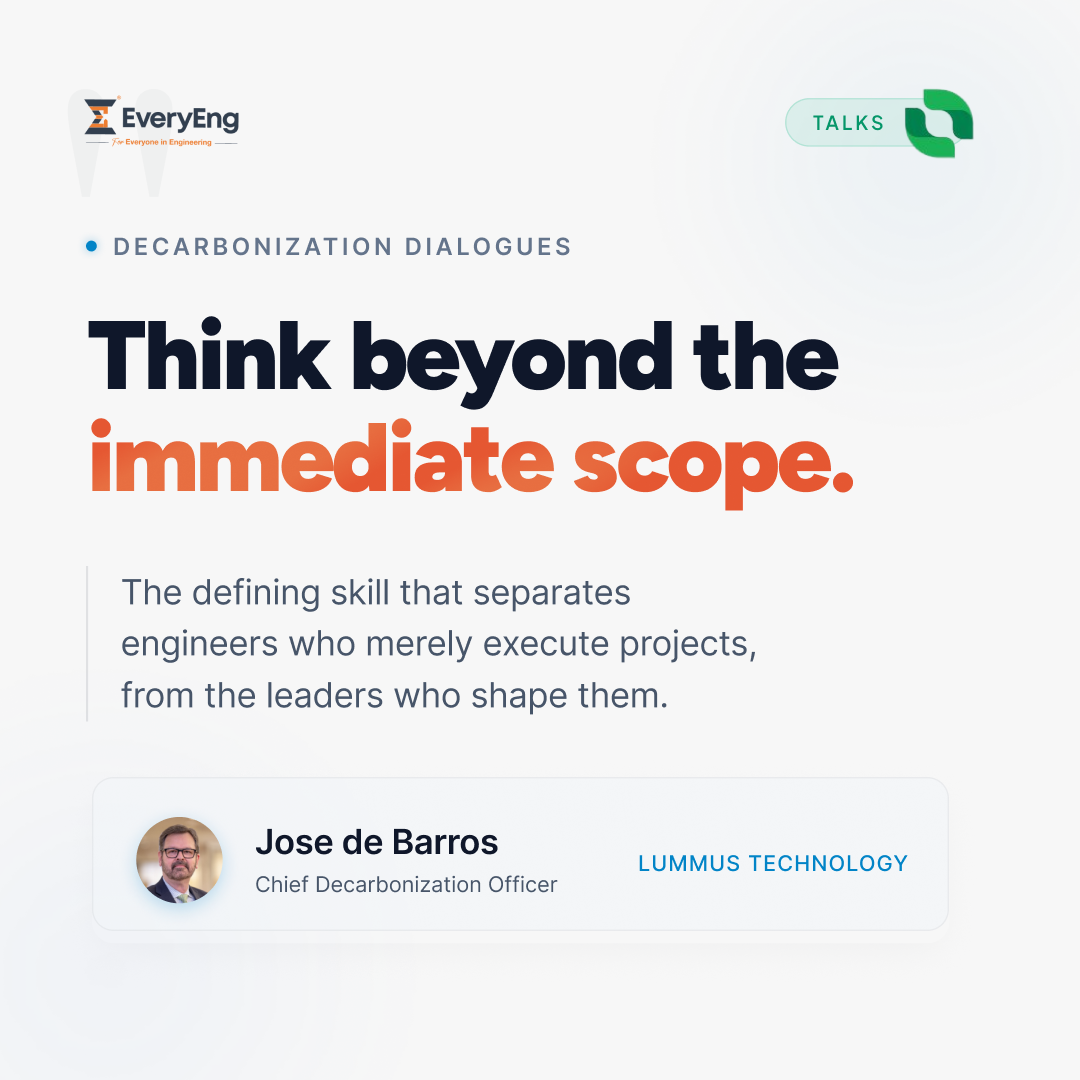
Think beyond the immediate scope. By this, I mean companies and engineers who work effectively with licensors are those who understand why a technology is being applied, not just how it is implemented. Understand the economic drivers, design intent, limitations and future adaptability of a technology.


 Aug 29, 2026

