

Article details
Electrolux Refrigerator
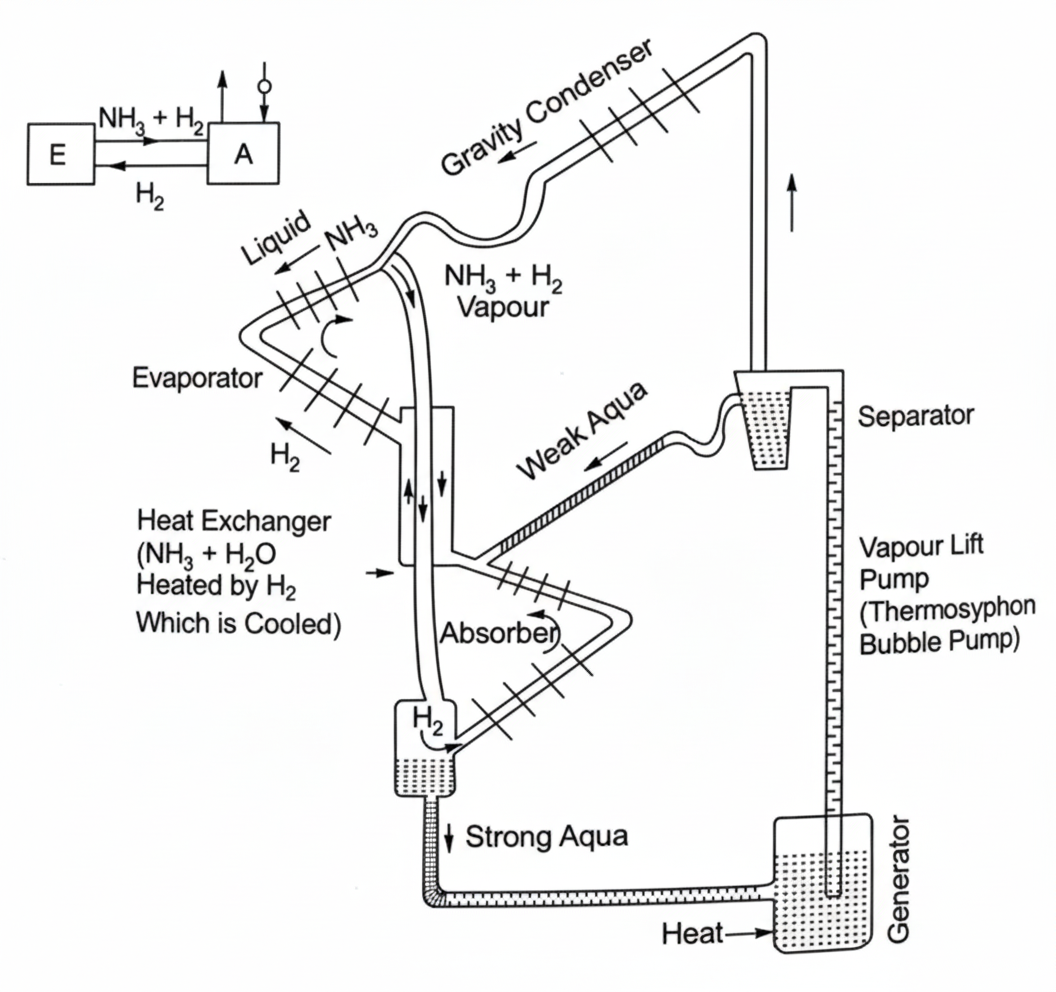
The Electrolux refrigerator is a classic example of a diffusion–absorption refrigeration system that operates without any moving parts such as a compressor or pump. Developed in the 1920s by Swedish engineers and later commercialized by Electrolux, this refrigerator works using heat energy as the driving force instead of mechanical work.
Because it is silent, reliable, and can run on gas, kerosene, or electricity, the Electrolux (absorption) refrigerator is widely used in hotels, caravans, remote areas, and minibars.
1. Principle of Operation
The system works on the absorption refrigeration principle using three working fluids:
Ammonia (NH₃) – refrigerant
Water (H₂O) – absorbent
Hydrogen (H₂) – inert gas to reduce partial pressure
Cooling is produced by evaporation of ammonia at low partial pressure in the presence of hydrogen.
2. Main Components
Generator (boiler)
Separator (rectifier)
Condenser
Evaporator
Absorber
Gas heat exchanger
No compressor, no pump, no moving parts.
3. Working Cycle
Step 1: Generation
A heat source (electric heater or gas flame) heats the ammonia–water solution in the generator. Ammonia vapor separates from water.
Step 2: Condensation
Ammonia vapor flows to the condenser, rejects heat, and becomes liquid ammonia.
Step 3: Evaporation
Liquid ammonia enters the evaporator where hydrogen gas is present. Hydrogen reduces ammonia’s partial pressure, causing it to evaporate at low temperature and produce cooling.
Step 4: Absorption
Ammonia vapor is absorbed back into water in the absorber, forming strong solution again.
Step 5: Return to Generator
The strong solution flows back to the generator by gravity, and the cycle repeats.
4. Role of Hydrogen Gas
Hydrogen does not react chemically. Its function is to:
Reduce partial pressure of ammonia
Enable low-temperature evaporation
Maintain continuous diffusion process
5. Heat Source Options
Electrical heater
LPG / natural gas flame
Kerosene burner
Solar heat (in remote designs)
6. Advantages
Completely silent operation
No moving parts → very low maintenance
Can operate without electricity
Long service life
Reliable in remote locations
7. Limitations
Low COP compared to vapour compression systems
Slow cooling rate
Bulky system
Requires careful leveling for proper operation
8. Applications
Hotel minibars
Caravans and RVs
Remote rural refrigeration
Vaccine storage in off-grid areas
Laboratory cooling
9. Comparison with Vapour Compression Refrigerator
Feature | Electrolux (Absorption) | Vapour Compression |
|---|---|---|
Driving energy | Heat | Mechanical work |
Noise | Silent | Noisy (compressor) |
Moving parts | None | Compressor, fan |
COP | Low | High |
Maintenance | Very low | Moderate |
10. Why It Is Called a Diffusion–Absorption System
Because:
Refrigerant diffuses in hydrogen gas in evaporator
Refrigerant is absorbed in water in absorber


 Aug 29, 2026