


Article details
If you’ve ever driven a traditional petrol car, ridden a lawnmower, or heard the rumble of a motorcycle, you have experienced the Otto Cycle in action. Formulated by German engineer Nikolaus Otto in 1876, this thermodynamic cycle is the theoretical blueprint behind the common four-stroke internal combustion engine.
While the Law of Gearing handles how that power smoothly transfers to the wheels, the Otto Cycle is what creates the power in the first place.
The Real-World Four-Stroke Engine
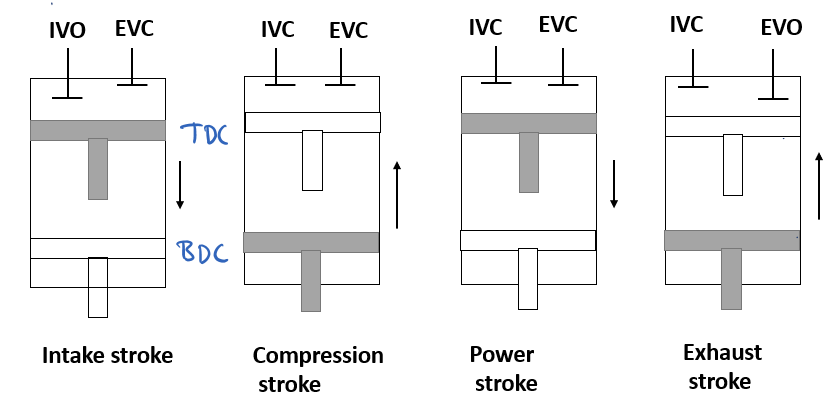
In reality, a standard car engine brings this thermodynamic theory to life through four physical strokes of a piston moving up and down inside a cylinder.
As seen in the engine diagram above, the process moves sequentially:
Intake: The intake valve opens, the piston slides down, and a fresh mixture of air and fuel is drawn into the cylinder.
Compression: The valves close, and the piston flies upward, tightly compressing that air-fuel mixture into a tiny space.
Power: The spark plug fires, igniting the fuel. The miniature explosion forces the piston violently downward, turning the engine's crankshaft.
Exhaust: The exhaust valve opens, and the piston sweeps back up to push the spent gases out of the tailpipe.
The Thermodynamic Ideal: The P-V Diagram
To analyze and optimize engines, engineers strip away the messy reality of valves and chemistry and look at the ideal, closed-loop thermodynamics. This is plotted on a P-V (Pressure-Volume) diagram.
The ideal loop consists of four distinct, reversible processes (tracing points 1->2->3->4->1 on the P-V diagram):
1. Isentropic Compression (1->2)
The air-fuel mixture is compressed as the piston moves from bottom dead center (V_1 to top dead center (V_2). In an ideal cycle, this happens adiabatically (no heat is gained or lost to the cylinder walls) and reversibly, meaning entropy (S) remains constant (S_1 = S_2). Pressure spikes dramatically while volume shrinks.
2. Constant-Volume Heat Addition (2->3)
This represents the spark plug firing. Because the explosion happens incredibly fast, the fuel burns completely before the piston even has a chance to move down. Therefore, heat (Q_{in}) is added instantaneously at a constant volume (V_2 = V_3). This drives the pressure and temperature up to their absolute peaks (Point 3).
3. Isentropic Expansion (3->4)
The high-pressure gas pushes the piston back down, performing useful work on the system. Like the compression stroke, this power stroke is modeled as adiabatic and reversible (S_3 = S_4). The volume expands back out to V_1 as the pressure drops.
4. Constant-Volume Heat Rejection (4->1)
Before the piston travels back up, the exhaust valve opens, and heat (Q_{out}) is dumped into the atmosphere. The pressure drops instantly back down to the starting point while the volume remains fixed (V_4 = V_1).
Thermal Efficiency of the Otto Cycle
The primary goal of studying the Otto Cycle is to figure out how much of the chemical energy in the fuel actually turns into mechanical work. The thermal efficiency (η) of the ideal Otto Cycle is calculated using this formula:

Where variables represent:
r (Compression Ratio): The ratio of the maximum volume to the minimum volume ({V_1}/{V_2}).
γ (Specific Heat Ratio): The ratio of specific heats for the working fluid, which is roughly 1.4 for ambient air.
The Compression Catch-22: According to the math, if you increase the compression ratio ($r$), the efficiency goes up. However, if you compress a gasoline-air mixture too tightly, it gets so hot that it ignites prematurely before the spark plug fires. This is called engine knocking or pre-ignition, and it can destroy an engine. This limitation is why gasoline cars usually top out at a compression ratio around 10:1 to 12:1.


 Aug 29, 2026


