


Article details
In the world of thermal engineering, accurate prediction of heat transfer is essential for designing efficient heat exchangers. While the basic energy balance equations provide a solid foundation, real-world systems often require more nuanced tools—enter the Log Mean Temperature Difference (LMTD) method. This technique refines our understanding of temperature gradients and enables engineers to size and optimize exchangers with greater precision.
The LMTD method is rooted in an analogy to Newton’s law of cooling, which states:

Where:
Q: Rate of heat transfer
U: Overall heat transfer coefficient
A: Heat transfer surface area
Delta Tm : Mean temperature difference between fluids
Unlike simple arithmetic averages, the temperature difference in heat exchangers varies along the length of the device. The LMTD method accounts for this variation using a logarithmic formulation.
Temperature Variation in Parallel-Flow Heat Exchangers
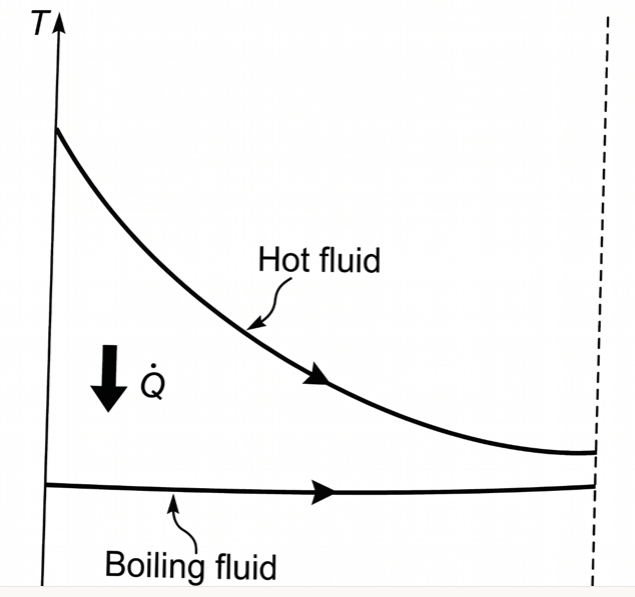
Consider a parallel-flow double-pipe heat exchanger. As hot and cold fluids flow in the same direction, their temperature difference decreases along the length. An energy balance on a differential section yields:

Solving for the differential temperature changes:

Taking the difference:

This equation shows how the temperature difference between fluids evolves along the exchanger.
Deriving the LMTD Equation
To express heat transfer in terms of local temperature difference:

Substituting into the differential equation and integrating from inlet to outlet:

After rearrangement and substitution, we arrive at the LMTD-based heat transfer expression:

Here:
Delta T1: Temperature difference at the inlet
Delta T2: Temperature difference at the outlet
This logarithmic average captures the true thermal gradient across the exchanger.
Why LMTD Matters in Engineering Practice
The LMTD method is especially useful when:
Designing shell-and-tube or plate heat exchangers
Comparing counterflow vs. parallel-flow configurations
Evaluating performance under varying inlet/outlet conditions
It allows engineers to:
Accurately size exchangers for desired heat loads
Select appropriate materials and geometries
Optimize surface area and flow arrangements