


Article details
Human comfort in an air-conditioned space is not determined by temperature alone. True thermal comfort depends on a combination of environmental and personal factors that govern how the human body exchanges heat with its surroundings. In HVAC design, understanding these parameters is essential to maintain occupant well-being, productivity, and health.
International comfort guidelines are defined by ASHRAE and widely referenced in building design practice.
1. What Is Thermal Comfort?
Thermal comfort is:
“That condition of mind which expresses satisfaction with the thermal environment.”
The human body must maintain a core temperature of ~37 °C. Comfort exists when heat generated by metabolism equals heat lost to the environment.
2. Major Environmental Parameters
A) Air Temperature (Dry Bulb Temperature)
Most influential factor
Typical comfort range: 23–26 °C
Affects sensible heat exchange between body and air
B) Relative Humidity (RH)
Comfort range: 40–60%
High RH → sweating ineffective → discomfort
Low RH → dryness of skin, throat, eyes
RH governs the latent heat loss from the body.
C) Air Velocity (Air Movement)
Recommended: 0.15–0.25 m/s
Helps evaporative cooling from skin
Too high → draft discomfort
Too low → stuffiness
D) Mean Radiant Temperature (MRT)
Average temperature of surrounding surfaces (walls, ceiling, glass)
Hot surfaces radiate heat to occupants even if air is cool
Important near glass façades and roofs
E) Air Quality and Fresh Air
Adequate ventilation removes CO₂, odors, contaminants
Poor IAQ causes fatigue and headaches despite correct temperature
3. Personal (Human) Parameters
A) Metabolic Rate (Activity Level)
Measured in met units.
Activity | Met Value |
|---|---|
Sleeping | 0.7 |
Sitting (office work) | 1.0 |
Walking | 2.0 |
Higher activity → more heat generated → lower comfort temperature required.
B) Clothing Insulation (Clo Value)
Clothing | Clo Value |
|---|---|
Light summer wear | 0.5 |
Office wear | 1.0 |
Winter clothing | 1.5 |
More clothing reduces heat loss.
4. Heat Exchange Mechanisms of Human Body
The body loses heat by:
Convection (to air)
Radiation (to surfaces)
Evaporation (sweat)
Respiration
Comfort exists when these balance metabolic heat.
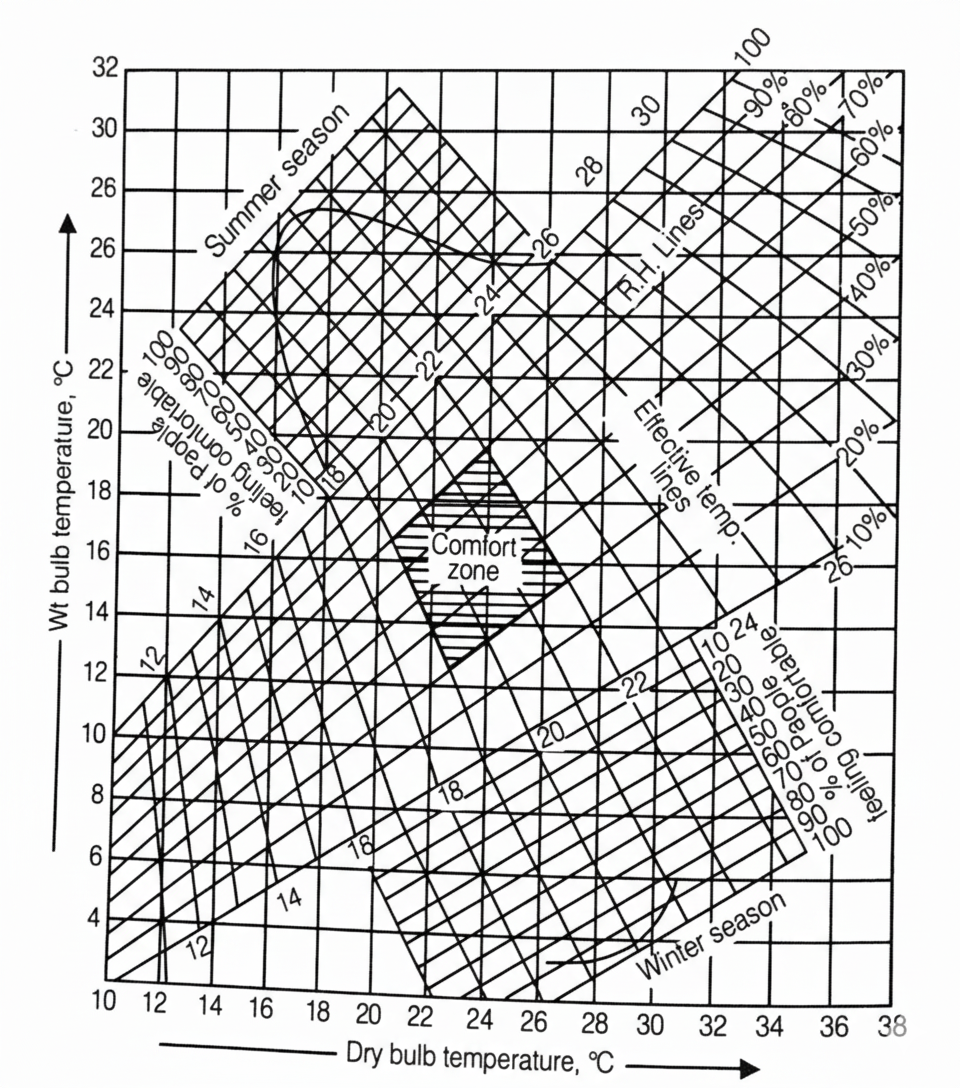
5. Effective Temperature (ET)
Effective Temperature combines:
Air temperature
Humidity
Air velocity
It represents the combined effect of these factors on comfort.
6. Comfort Zone
The comfort zone is the range of conditions where most people feel comfortable:
Temperature: 23–26 °C
RH: 40–60%
Air velocity: 0.2 m/s
This zone is plotted on a psychrometric chart.
7. Other Influencing Factors
Age and health
Acclimatization to climate
Occupancy density
Exposure time
Floor and wall temperatures
8. Why These Parameters Matter in HVAC Design
Improper control results in:
Sweating or shivering
Fatigue and reduced productivity
Complaints from occupants
Higher energy consumption
9. Practical HVAC Guidelines
Maintain RH below 60% in summer
Avoid drafts from diffusers
Provide adequate fresh air
Insulate walls and roofs to control MRT
Design air distribution uniformly