

Article details
The Vapour Absorption Refrigeration (VAR) cycle is a refrigeration system that produces cooling primarily by using heat energy rather than mechanical work. Unlike the vapour compression system that relies on an electrically driven compressor, the VAR system replaces the compressor with a combination of absorber, pump, and generator, enabling refrigeration using low-grade heat sources such as steam, exhaust gases, solar heat, or waste heat from industrial processes.
This makes the VAR cycle especially valuable in locations where electricity is costly or unreliable but thermal energy is readily available.
Historical Background
The foundation of absorption refrigeration dates back to the early 19th century. The first practical absorption refrigerator was developed by Ferdinand Carré in 1858 using an ammonia–water system. Later, the concept was refined and popularized in domestic refrigerators by Albert Einstein and Leó Szilárd in the 1920s with a design that had no moving parts.
Working Principle
The VAR cycle is based on two key phenomena:
Absorption of a refrigerant vapour by a suitable liquid absorbent.
Separation of the refrigerant from the absorbent using heat in a generator.
A refrigerant with a strong affinity for an absorbent is selected. The two most common working pairs are:
Ammonia–Water (NH₃–H₂O) → Ammonia is the refrigerant, water is the absorbent.
Water–Lithium Bromide (H₂O–LiBr) → Water is the refrigerant, lithium bromide is the absorbent.
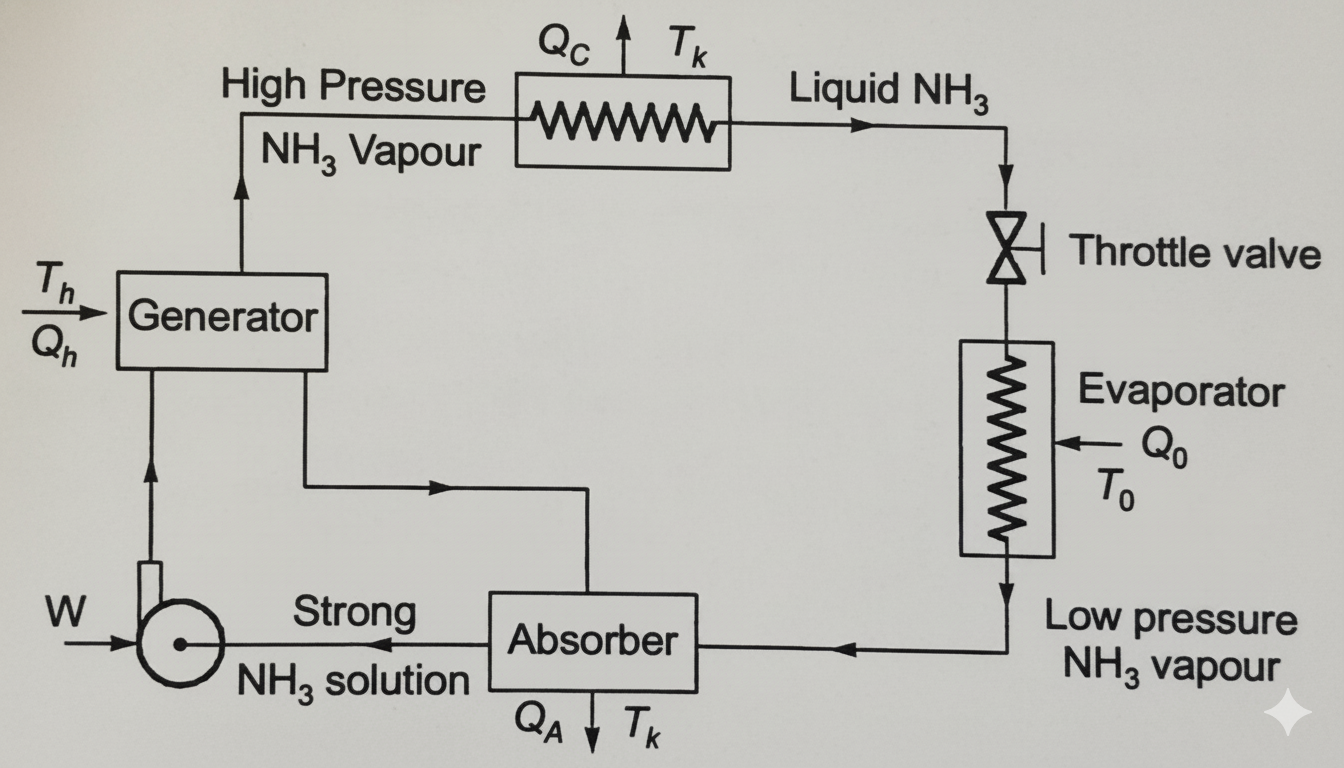
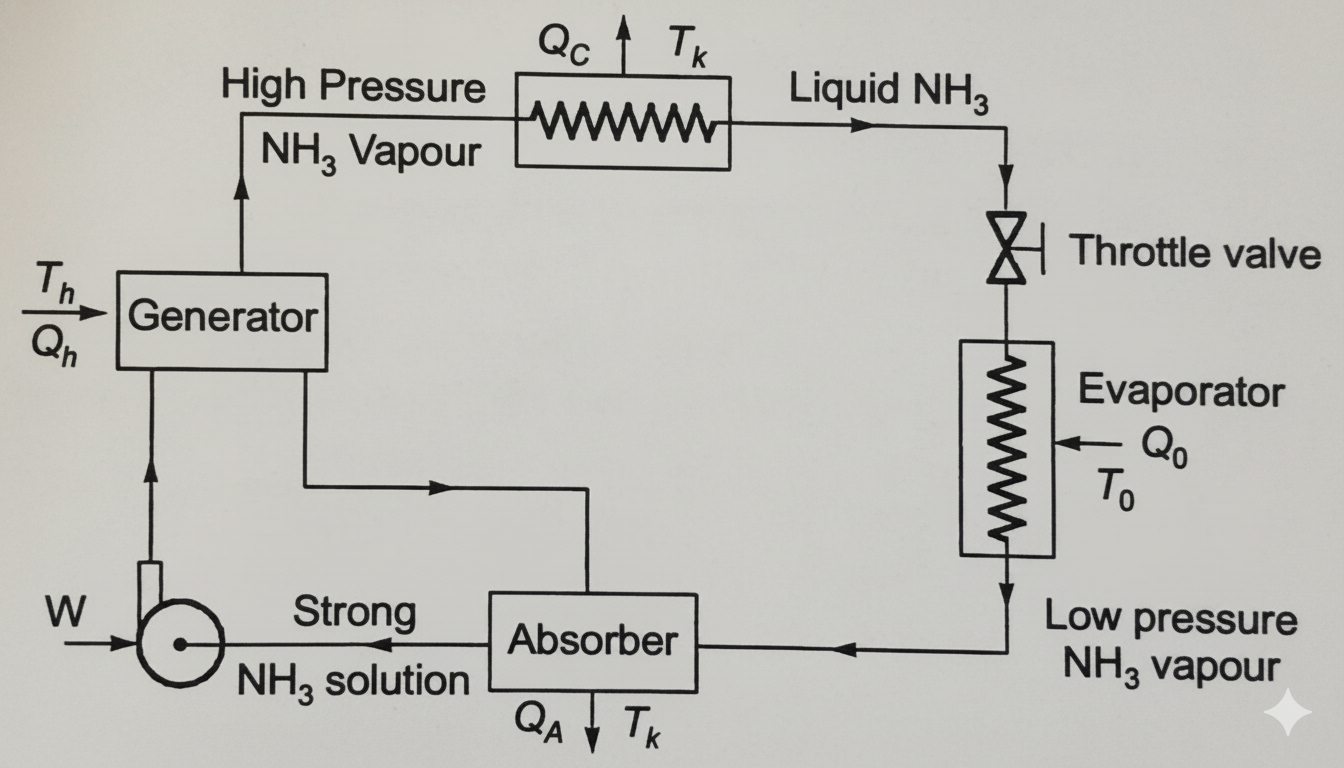
Main Components of VAR System
Generator – Heat is supplied to separate refrigerant vapour from the solution.
Condenser – Refrigerant vapour condenses into liquid by rejecting heat.
Expansion Valve – Pressure of liquid refrigerant is reduced.
Evaporator – Refrigerant absorbs heat from the refrigerated space and evaporates.
Absorber – Refrigerant vapour is absorbed by the absorbent, forming a strong solution.
Pump – Pumps the strong solution back to the generator (requires very little work).
Basic Working Steps
In the evaporator, low-pressure refrigerant absorbs heat and evaporates.
Vapour enters the absorber, where it is absorbed by the absorbent, releasing heat.
The strong solution is pumped to the generator.
Heat supplied to the generator separates the refrigerant vapour.
Vapour flows to the condenser and becomes liquid.
Liquid refrigerant passes through the expansion valve and returns to the evaporator.
Thus, the cycle repeats without the need for a mechanical compressor.
Why Pump Work is Negligible
In VAR systems, the pump handles liquid solution, not vapour. Since the specific volume of liquid is very small compared to vapour, the mechanical work required is negligible compared to the compressor work in vapour compression systems.
Key Advantages of Vapour Absorption Refrigeration
Can operate on waste heat, solar heat, or steam.
Very low electrical power requirement.
Silent operation with minimal moving parts.
Low maintenance and long service life.
Ideal for remote or industrial locations.
Limitations
Lower Coefficient of Performance (COP) compared to vapour compression.
Bulky equipment due to multiple components.
Requires careful handling of working fluids like ammonia or lithium bromide.
Slower response to load changes.
Applications
Industrial plants with excess steam or waste heat.
Solar refrigeration systems.
Large air-conditioning plants.
Refrigeration in areas with limited electricity.
Conclusion
The Vapour Absorption Refrigeration cycle is a thermally driven refrigeration system that offers a practical alternative where heat energy is abundant and electricity is limited. By intelligently replacing the compressor with absorber–pump–generator components, the system achieves cooling with minimal mechanical work. Though its COP is lower than vapour compression systems, its ability to utilize waste heat and operate silently makes it highly valuable in industrial and sustainable refrigeration applications.


 Aug 29, 2026


