


Article details
A thermodynamic system is a specified quantity of matter or a region in space chosen for analysis, separated from everything else (the surroundings) by a real or imaginary boundary. The system is the focus of study for energy, mass, and property interactions.
The concept of a system is fundamental to applying the laws of thermodynamics to engines, compressors, turbines, refrigerators, boilers, and many other devices.
System, Surroundings, and Boundary
System: The part under study (e.g., gas in a cylinder)
Surroundings: Everything outside the system
Boundary: The surface separating system and surroundings (fixed or movable)
The boundary may allow energy and/or mass to cross it.
Types of Thermodynamic Systems
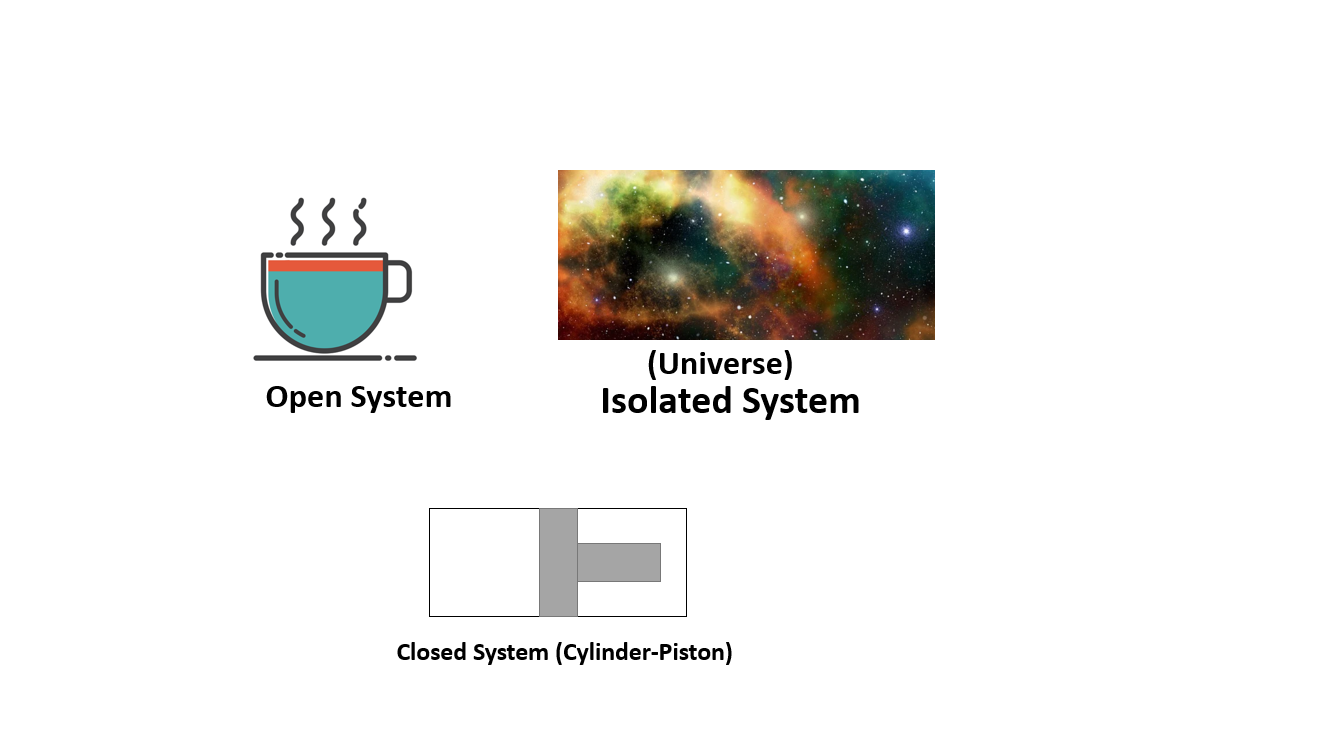
1. Open System (Control Volume)
An open system allows both mass and energy to cross the boundary.
Examples:
Steam Turbine
Air Compressor
Pumps, boilers, condensers
Mass enters and leaves continuously.
2. Closed System (Control Mass)
A closed system allows energy transfer but no mass transfer across the boundary.
Examples:
Gas in a piston-cylinder arrangement
Sealed pressure cooker
Energy can cross as heat or work.
3. Isolated System
An isolated system allows neither mass nor energy transfer.
Examples:
A perfectly insulated thermos flask (ideal case)
The universe (theoretical example)
Properties of a Thermodynamic System
Properties describe the state of the system.
Pressure (P)
Temperature (T)
Volume (V)
Internal Energy (U)
Enthalpy (H)
Entropy (S)
These properties help define the state of the system.
State and Process
State: Condition of a system at an instant, defined by properties
Process: Change from one state to another due to heat/work interaction
Importance in Engineering
Understanding thermodynamic systems helps engineers:
Analyze engines and refrigerators
Evaluate energy efficiency
Design heat exchangers and turbines
Apply the laws of thermodynamics correctly
Comments
interesting