

Article details
What Is Three-Phase Power?
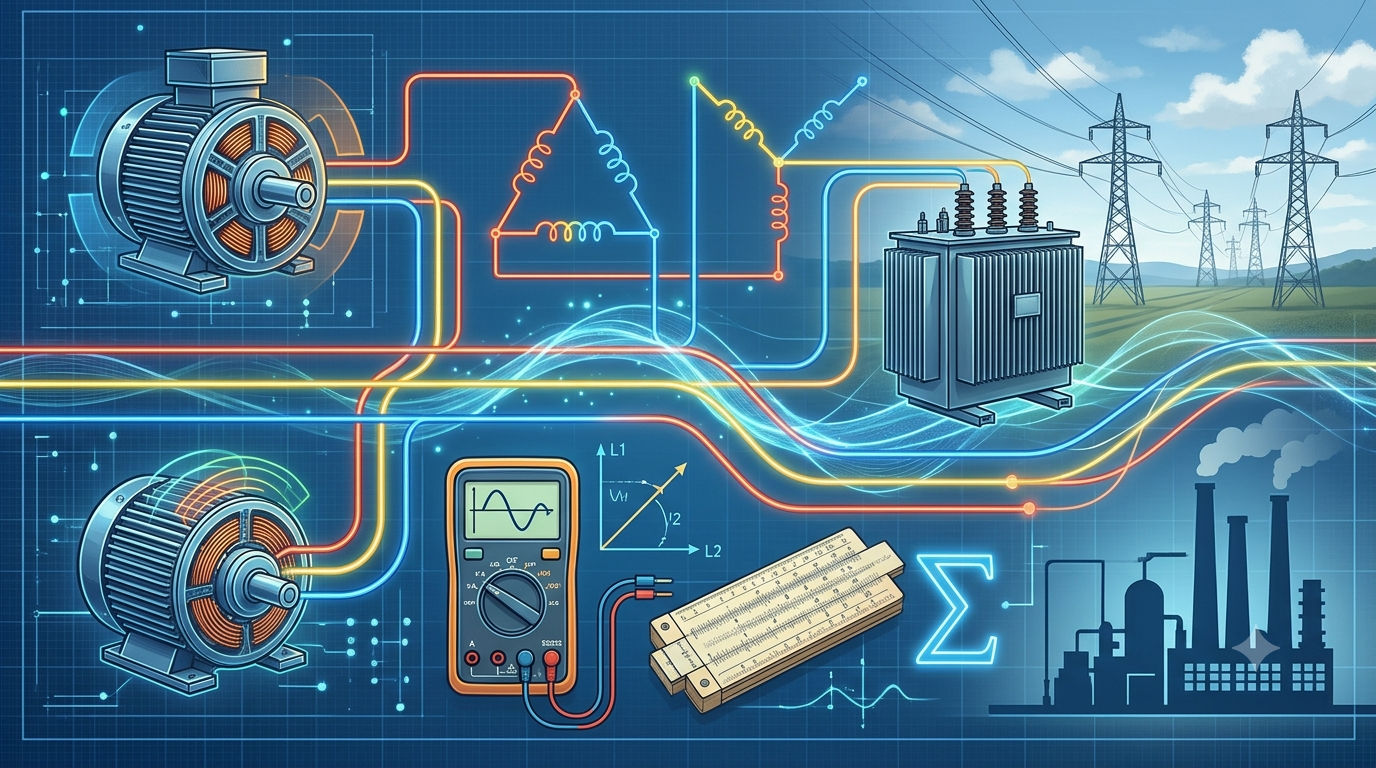
Three-phase power is an electrical power system that uses three alternating currents (AC) with the same frequency and a phase difference of 120 degrees. It is widely used in industrial facilities, commercial buildings, manufacturing plants, and large electrical installations.
Compared with single-phase power, three-phase systems can deliver more power efficiently and provide a steady supply of electricity. They are commonly used to operate electric motors, pumps, compressors, HVAC equipment, and other heavy electrical loads.
Three-Phase Power Calculation Formula
The power in a three-phase electrical system depends on voltage, current, and power factor. The formula varies depending on whether the system is balanced and whether the required value is real, apparent, or reactive power.
For a balanced three-phase system, the main formulas are:
1. Real Power (P)
Real power is the actual power consumed by electrical equipment to perform useful work. It is measured in watts (W) or kilowatts (kW).
[ P=sqrt{3} times V_L times I_L times PF ]
Where:
(P) = Real power in watts
(V_L) = Line-to-line voltage in volts
(I_L) = Line current in amperes
(PF) = Power factor
(sqrt{3}) = Approximately 1.732
2. Apparent Power (S)
Apparent power represents the total electrical power supplied to the system. It is measured in volt-amperes (VA) or kilovolt-amperes (kVA).
[ S=sqrt{3}\times V_L times I_L ]
3. Reactive Power (Q)
Reactive power supports the magnetic and electric fields required by equipment such as motors and transformers. It is measured in volt-amperes reactive (VAR).
[ Q=sqrt{3}times V_Ltimes I_L times sin phi ]
Here, \(\phi\) is the phase angle between voltage and current, and the power factor is \(PF=\cos\phi\).
Three-Phase Power Calculation Example
Consider an industrial machine operating with the following electrical parameters:
Line voltage = 400 V
Line current = 30 A
Power factor = 0.85
Using the real power formula:
[ P=frac{1.732\times400\times30\times0.85}{1000} ]
[ P=17.67 text{ kW} ]
Therefore, the machine consumes approximately 17.67 kW of real electrical power under these operating conditions.
This calculation is useful for estimating electrical loads and understanding the power requirements of industrial equipment.
Applications of Three-Phase Power Calculations
Three-phase power calculations are important in many engineering applications.
Industrial motors: Determine electrical power requirements for pumps, compressors, and production machinery.
Electrical distribution: Estimate loads on distribution panels, cables, and transformers.
HVAC systems: Evaluate power consumption for chillers, air-conditioning units, and ventilation equipment.
Manufacturing plants: Assess electrical demand for machinery and production lines.
Energy management: Monitor power consumption and identify opportunities to improve electrical efficiency.
Common Mistakes in Three-Phase Power Calculations
Incorrect input values can lead to inaccurate power estimates. Engineers should avoid these common mistakes:
Using phase-to-neutral voltage instead of line-to-line voltage in the standard three-phase formula.
Ignoring the power factor when calculating real power.
Confusing kilowatts (kW) with kilovolt-amperes (kVA).
Applying balanced-load formulas directly to significantly unbalanced systems.
Using calculated current alone to select cables, circuit breakers, or other protective equipment without considering applicable electrical codes and installation conditions.
Always verify the equipment nameplate, operating conditions, and measured electrical values before making engineering decisions.
Conclusion
Three-phase power calculation is an essential skill for electrical engineers, technicians, and maintenance professionals. By understanding the relationship between voltage, current, and power factor, they can estimate electrical loads, assess equipment requirements, and support reliable power distribution.
The fundamental formula \(P=\sqrt{3}\times V_L\times I_L\times PF\) provides a practical method for calculating real power in a balanced three-phase system. Applying it correctly helps improve electrical planning, equipment performance, and energy management across industrial and commercial applications.
