


Article details
In a vapour compression refrigeration (VCR) system, the throttling device is the critical component that connects the high-pressure side (condenser) to the low-pressure side (evaporator). Its primary function is to reduce the pressure of the liquid refrigerant from condenser pressure to evaporator pressure and regulate the flow rate into the evaporator to ensure effective heat absorption and stable operation.
This pressure reduction occurs through a throttling (isenthalpic) process, where the refrigerant experiences a sharp drop in pressure and temperature without any external work interaction.
Purpose of a Throttling Device
Maintain the pressure difference between condenser and evaporator.
Control refrigerant flow into the evaporator.
Produce low temperature by pressure drop.
Ensure complete evaporation inside the evaporator.
Protect the compressor from liquid slugging.
Thermodynamic Principle (Throttling Process)
Throttling is an adiabatic, irreversible, constant enthalpy (h₁ = h₂) process. When high-pressure liquid refrigerant passes through a restriction:
Pressure drops suddenly.
Temperature falls due to flash evaporation.
A mixture of liquid and vapour enters the evaporator.
Types of Throttling Devices
1. Capillary Tube
A capillary tube is a long, narrow tube of constant diameter used widely in small refrigeration units like domestic refrigerators and window ACs.
Characteristics:
Fixed flow device (no control).
Cheap, simple, and reliable.
Used for small capacity systems.
Limitations:
Cannot adjust to load variations.
Requires exact sizing.
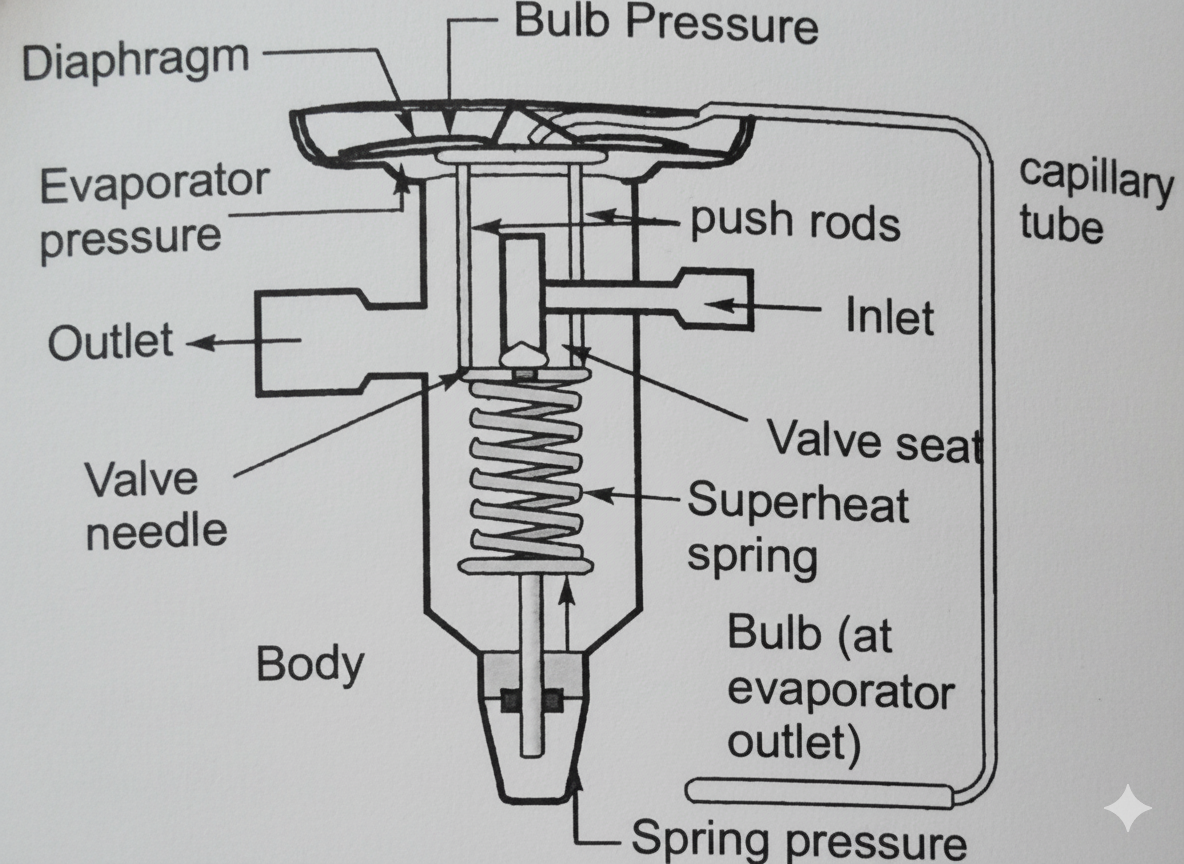
2. Thermostatic Expansion Valve (TXV / TEV)
The TXV controls refrigerant flow based on evaporator superheat using a sensing bulb.
Working:
The bulb senses evaporator outlet temperature and adjusts the valve opening to maintain constant superheat.
Advantages:
Adapts to varying loads.
Prevents liquid refrigerant from entering compressor.
Improves system efficiency.
3. Automatic Expansion Valve (AEV)
The AEV maintains constant evaporator pressure by adjusting flow.
Limitations:
Does not respond to load changes effectively.
Mostly outdated in modern systems.
4. Float Valve
Used in flooded evaporators, it maintains a constant liquid level.
Types:
High-side float
Low-side float
Applications:
Large industrial refrigeration plants.
5. Electronic Expansion Valve (EEV)
An advanced throttling device controlled by sensors and a microcontroller.
Advantages:
Precise control.
Best energy efficiency.
Ideal for VRF/VRV and modern HVAC systems.
Comparison of Throttling Devices
Device | Control Type | Cost | Load Adaptability | Application |
|---|---|---|---|---|
Capillary Tube | Fixed | Low | Poor | Domestic fridge, small AC |
TXV | Superheat based | Medium | Good | Commercial AC, refrigeration |
AEV | Pressure based | Low | Poor | Old systems |
Float Valve | Level based | High | Good | Industrial plants |
EEV | Sensor based | High | Excellent | VRF, modern HVAC |
Why Throttling is Necessary Instead of an Expander
Although an expander could recover work during pressure drop, throttling devices are preferred because:
Expanders are costly and complex.
Refrigerant flow rate is small.
Simplicity and reliability are more important.
Maintenance of expanders is difficult.
Effects of Improper Throttling
Overfeeding → liquid floodback to compressor.
Underfeeding → poor cooling, low COP.
Frosting of evaporator.
Compressor overheating.
Selection Criteria for Throttling Devices
System capacity.
Type of evaporator (dry/flooded).
Load variation.
Cost considerations.
Required control accuracy.