


Article details
Total Productive Maintenance (TPM): The Path to Zero Losses
In today’s competitive manufacturing and industrial landscape, organizations are under constant pressure to improve productivity, reduce costs, enhance quality, and deliver products faster than ever before. Traditional maintenance approaches that focus only on repairing equipment after breakdowns are no longer enough. Companies need a proactive system that involves everyone in the organization and aims for operational excellence. This is where Total Productive Maintenance (TPM) becomes a game-changing strategy.
TPM is more than a maintenance program—it is a company-wide philosophy focused on maximizing equipment effectiveness, eliminating losses, and creating a culture of continuous improvement. Organizations that successfully implement TPM often achieve dramatic improvements in equipment reliability, production efficiency, employee engagement, and profitability.
This blog explores TPM in depth, including its principles, pillars, benefits, implementation process, challenges, and how it leads organizations toward the ultimate goal: zero losses.
What is Total Productive Maintenance (TPM)?
Operations Management
Total Productive Maintenance (TPM) is a maintenance and operational strategy designed to maximize the effectiveness of equipment throughout its entire lifecycle. TPM combines preventive maintenance, employee involvement, continuous improvement, and systematic problem-solving to reduce downtime and eliminate inefficiencies.
The concept originated in Japan and became widely recognized through the work of the Japan Institute of Plant Maintenance during the 1970s. TPM later became a foundational element of Lean Manufacturing and world-class manufacturing systems.
The primary goal of TPM is simple yet powerful:
Achieve perfect production by eliminating breakdowns, defects, accidents, and losses.
TPM transforms maintenance from the responsibility of a single department into a shared responsibility across the organization.
Understanding the Meaning of “Total” in TPM
The word “Total” in Total Productive Maintenance has multiple meanings:
1. Total Participation
Everyone in the organization participates in equipment care—from top management to machine operators.
2. Total Equipment Effectiveness
The focus is on maximizing equipment productivity and performance.
3. Total Maintenance System
TPM covers the entire lifecycle of equipment, from design and installation to operation and replacement.
Why TPM is Important
Modern industries depend heavily on machinery, automation, and production systems. Even a minor equipment failure can result in:
Production delays
Quality defects
Increased costs
Missed customer deadlines
Safety hazards
Reduced customer satisfaction
Traditional maintenance methods are reactive. Machines are repaired only after they fail. This approach creates unpredictable downtime and high operational costs.
TPM changes this mindset by focusing on prevention, continuous monitoring, and operator ownership.
Organizations implementing TPM often experience:
Reduced machine breakdowns
Higher production output
Lower maintenance costs
Improved product quality
Increased employee morale
Safer workplaces
The Core Objective of TPM: Zero Losses
TPM aims to eliminate all forms of production loss. These losses are commonly categorized into the “Six Big Losses.”
The Six Big Losses in TPM
1. Equipment Failures (Breakdowns)
Unexpected machine stoppages reduce productivity and increase repair costs.
2. Setup and Adjustment Losses
Time wasted during changeovers and machine adjustments.
3. Idling and Minor Stops
Small interruptions that may seem insignificant but collectively reduce efficiency.
4. Reduced Speed Losses
Machines operating below their designed speed.
5. Quality Defects and Rework
Defective products requiring correction or disposal.
6. Startup Losses
Losses occurring during machine startup before stable production begins.
By systematically targeting these losses, TPM helps organizations move toward operational excellence.
Overall Equipment Effectiveness (OEE): The Heart of TPM
Overall Equipment Effectiveness
One of the most important metrics in TPM is Overall Equipment Effectiveness (OEE). It measures how effectively equipment is utilized.
OEE is calculated using three factors:
1. Availability
Measures downtime losses.

2. Performance
Measures speed losses.

3. Quality
Measures defect losses.

The complete OEE formula is:

A world-class OEE score is generally considered to be around 85% or higher.
The Eight Pillars of TPM
TPM is built on eight foundational pillars that work together to achieve zero losses.
1. Autonomous Maintenance
Autonomous Maintenance
Autonomous Maintenance empowers machine operators to perform routine maintenance activities such as:
Cleaning
Inspection
Lubrication
Tightening
Minor repairs
This increases operator ownership and allows maintenance teams to focus on complex issues.
Benefits
Early detection of problems
Reduced breakdowns
Improved equipment knowledge
Increased accountability
2. Planned Maintenance
Planned Maintenance involves scheduling maintenance activities based on:
Machine condition
Usage history
Failure patterns
Predictive analytics
The goal is to prevent unexpected failures before they occur.
Types of Planned Maintenance
Preventive maintenance
Predictive maintenance
Condition-based maintenance
Scheduled maintenance
3. Focused Improvement (Kaizen)
Kaizen
Focused Improvement targets specific operational losses using structured problem-solving techniques.
Small teams analyze equipment inefficiencies and implement improvements continuously.
Common Tools
Root cause analysis
Fishbone diagrams
5 Whys
Pareto analysis
4. Quality Maintenance
Quality Maintenance aims to eliminate defects by controlling equipment conditions that affect product quality.
The focus is on:
Error prevention
Process stability
Defect reduction
Standardization
5. Early Equipment Management
This pillar applies TPM knowledge during equipment design and installation.
The objective is to create machines that are:
Easier to maintain
More reliable
Safer
Faster to operate
6. Training and Education
Employees must have the necessary skills to support TPM activities.
Training focuses on:
Technical skills
Equipment knowledge
Problem-solving abilities
Safety awareness
A skilled workforce is essential for successful TPM implementation.
7. Safety, Health, and Environment
Occupational Safety and Health
TPM promotes a safe and healthy workplace by eliminating hazardous conditions and unsafe practices.
The goal is:
Zero accidents
Zero health risks
Zero environmental incidents
8. Office TPM
TPM principles are also applied to administrative processes such as:
Procurement
Planning
Scheduling
Inventory management
This reduces inefficiencies across the entire organization.
TPM Implementation Process
Implementing TPM requires long-term commitment and cultural transformation.
Step 1: Management Commitment
Senior leadership must actively support TPM initiatives by:
Providing resources
Setting goals
Encouraging participation
Leading by example
Without leadership commitment, TPM efforts often fail.
Step 2: Awareness and Training
Employees need to understand:
TPM principles
Their responsibilities
Equipment basics
Improvement techniques
Training builds engagement and confidence.
Step 3: Initial Equipment Assessment
Organizations identify:
Critical machines
Current losses
Breakdown history
Performance gaps
This creates a baseline for improvement.
Step 4: Establish TPM Teams
Cross-functional teams are formed involving:
Operators
Maintenance staff
Engineers
Supervisors
Collaboration is central to TPM success.
Step 5: Launch Autonomous Maintenance
Operators begin basic maintenance activities and develop ownership of equipment.
This often starts with:
Cleaning campaigns
Inspection checklists
Lubrication schedules
Step 6: Improve Equipment Effectiveness
Teams focus on eliminating the Six Big Losses using continuous improvement techniques.
Step 7: Standardization
Successful practices are documented and standardized across the organization.
Step 8: Continuous Improvement
TPM is not a one-time project. Continuous monitoring and improvement are necessary to sustain gains.
TPM Tools and Techniques
Several methodologies support TPM implementation.
5S Workplace Organization
5S Methodology
The 5S system includes:
Sort
Set in Order
Shine
Standardize
Sustain
5S creates clean, organized workplaces that support TPM.
Root Cause Analysis
Problems are solved permanently by identifying and eliminating root causes rather than symptoms.
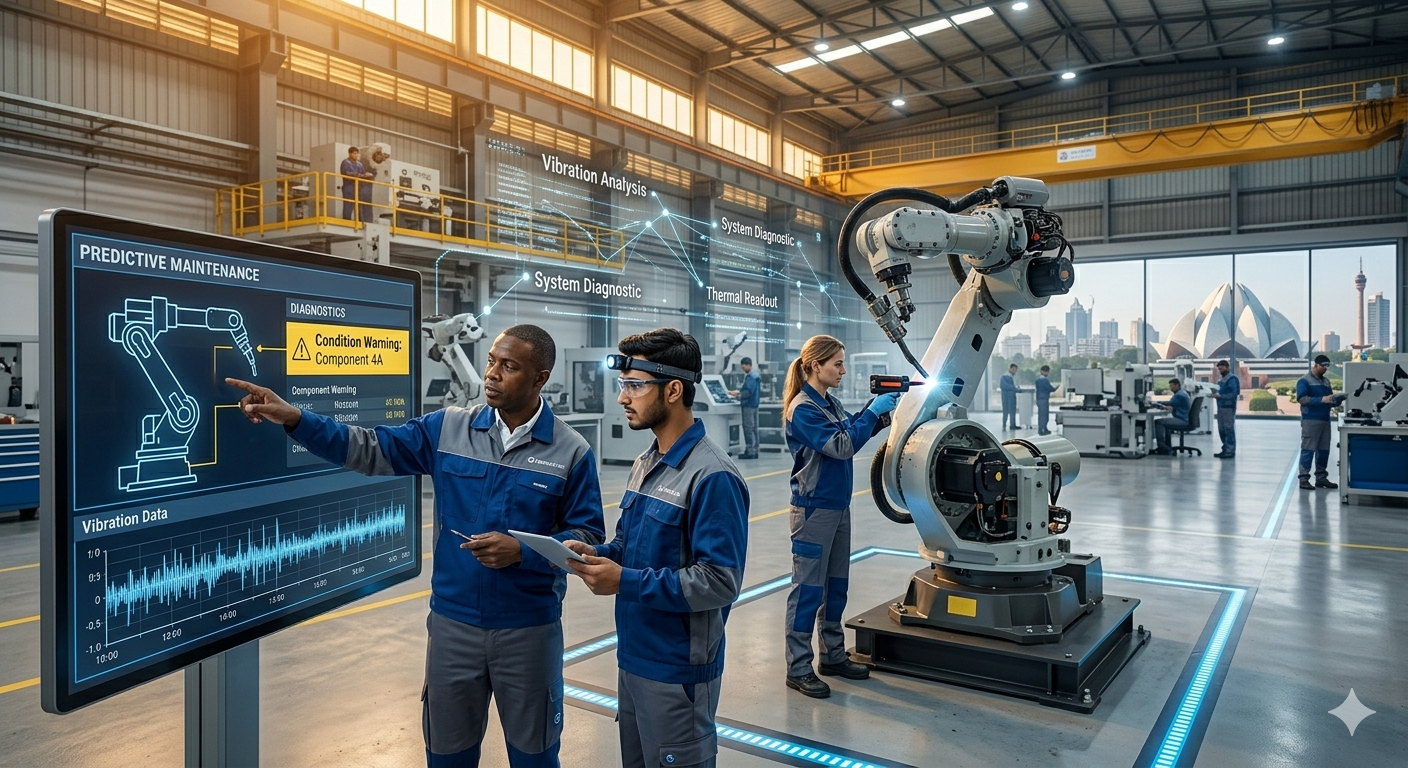
Predictive Maintenance Technologies
Modern TPM uses technologies such as:
Vibration analysis
Thermal imaging
Oil analysis
IoT sensors
AI-based monitoring
These technologies help predict failures before they occur.
Benefits of TPM
Organizations implementing TPM effectively achieve significant operational improvements.
1. Reduced Equipment Downtime
Machines become more reliable, leading to uninterrupted production.
2. Increased Productivity
Higher machine availability results in greater production output.
3. Improved Product Quality
Stable equipment conditions reduce defects and rework.
4. Lower Maintenance Costs
Preventive maintenance is less expensive than emergency repairs.
5. Better Employee Engagement
Employees feel more responsible and connected to operational success.
6. Enhanced Workplace Safety
Regular inspections and maintenance reduce workplace hazards.
7. Longer Equipment Life
Proper maintenance extends machine lifespan and delays replacement costs.
TPM in Different Industries
Although TPM originated in manufacturing, it is now used across multiple industries.
Manufacturing
Automotive
Electronics
Food processing
Pharmaceuticals
Healthcare
Hospitals use TPM concepts to maintain critical medical equipment reliability.
Logistics
Warehouses use TPM to improve conveyor and automation systems.
Energy
Power plants apply TPM to reduce equipment failures and improve safety.
Common Challenges in TPM Implementation
Despite its benefits, TPM implementation is not always easy.
1. Resistance to Change
Employees may resist new responsibilities or processes.
Solution
Strong communication and training programs are essential.
2. Lack of Management Support
Without leadership commitment, TPM initiatives lose momentum.
Solution
Executives must actively participate and monitor progress.
3. Inadequate Training
Employees cannot contribute effectively without proper knowledge.
Solution
Continuous education programs should be implemented.
4. Short-Term Thinking
Some organizations expect immediate results.
Solution
TPM should be viewed as a long-term strategic investment.
TPM and Lean Manufacturing
Lean Manufacturing
TPM and Lean Manufacturing work together to improve operational efficiency.
While Lean focuses on eliminating process waste, TPM focuses on eliminating equipment-related losses.
Together, they create:
Faster production
Better quality
Lower costs
Greater customer satisfaction
TPM in the Age of Industry 4.0
Industry 4.0
Modern TPM is evolving through digital technologies.
Smart TPM Technologies
Industrial IoT
Artificial Intelligence
Machine learning
Digital twins
Predictive analytics
These technologies allow organizations to monitor equipment in real time and predict failures with greater accuracy.
The future of TPM lies in combining human expertise with intelligent automation.
Real-World Example of TPM Success
Many world-class manufacturers have achieved remarkable improvements through TPM.
For example, automotive companies implementing TPM have reported:
Significant reductions in machine breakdowns
Improved OEE scores
Lower production costs
Better product consistency
Organizations adopting TPM often see cultural transformation alongside operational improvement.
TPM Best Practices
To maximize TPM success, organizations should:
Build a Strong Culture
TPM must become part of daily operations rather than a temporary initiative.
Focus on Employee Involvement
Operators should feel ownership of their equipment.
Use Data Effectively
Track KPIs such as:
OEE
Downtime
MTBF (Mean Time Between Failures)
MTTR (Mean Time To Repair)
Celebrate Small Wins
Recognizing improvements motivates teams and sustains momentum.
The Future of TPM
As industries become more automated and connected, TPM will continue evolving.
Future TPM systems will likely include:
AI-driven predictive maintenance
Autonomous inspection robots
Cloud-based maintenance platforms
Real-time analytics dashboards
Smart sensors integrated with ERP systems
Despite technological advancements, the core philosophy of TPM will remain the same:
People, processes, and equipment working together to eliminate losses and maximize value.
Conclusion
Total Productive Maintenance is far more than a maintenance strategy—it is a transformational approach to operational excellence. TPM empowers organizations to achieve higher productivity, improved quality, lower costs, safer workplaces, and stronger employee engagement.
By focusing on proactive maintenance, continuous improvement, and company-wide participation, TPM helps organizations move toward the ambitious yet achievable goal of zero losses.
In an era defined by global competition, automation, and rising customer expectations, companies that embrace TPM position themselves for long-term success.
The journey to zero losses is not easy, but with commitment, discipline, and collaboration, TPM provides a proven roadmap toward sustainable operational excellence.
Frequently Asked Questions (FAQs)
What is the main goal of TPM?
The main goal of TPM is to maximize equipment effectiveness by eliminating breakdowns, defects, accidents, and production losses.
What are the eight pillars of TPM?
The eight pillars are:
Autonomous Maintenance
Planned Maintenance
Focused Improvement
Quality Maintenance
Early Equipment Management
Training and Education
Safety, Health, and Environment
Office TPM
What is OEE in TPM?
Overall Equipment Effectiveness (OEE) measures equipment productivity based on availability, performance, and quality.
Is TPM part of Lean Manufacturing?
Yes. TPM is a key component of Lean Manufacturing and supports waste elimination and operational efficiency.
Which industries use TPM?
TPM is widely used in manufacturing, healthcare, logistics, energy, pharmaceuticals, and many other sectors.