


Article details
There's a strange tension at the heart of engineering right now. The same century that's mastered planet-scale destruction is also producing scientists working, often quietly, to undo the damage. Nowhere is that more visible than in HVAC-R — an industry that keeps the world comfortable, but has historically done it at the planet's expense.
Two recent breakthroughs suggest that's starting to change.
Cooling AI's Hunger for Heat
AI data centers are becoming some of the hottest real estate on Earth — literally. Dense GPU clusters generate extreme heat, and keeping them stable is now a genuine engineering bottleneck.
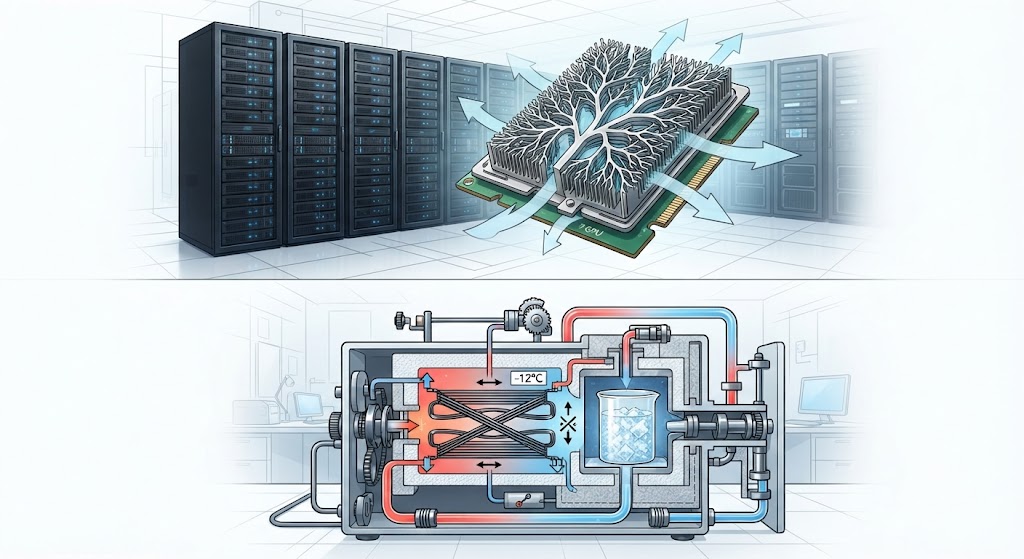
Hadi Ghasemi, a Distinguished Professor of Mechanical & Aerospace Engineering at the University of Houston, may have found an elegant answer: thin films shaped like tree branches. Using AI-driven topology optimization, Ghasemi's team discovered that structures roughly 50% solid and 50% empty space — mimicking natural branching patterns — dissipate heat at least three times more effectively than current best-in-class methods, all while running at lower temperatures than traditional systems.
It's a quiet reminder that some of the best engineering solutions are already written into nature; we just needed better tools to see them.
A Freezer That Breaks the Rules
Meanwhile, researchers at Hong Kong University of Science and Technology have hit a milestone that's eluded solid-state cooling for years: sub-zero freezing without a single drop of harmful refrigerant.
Their elastocaloric device — built on shape-memory nickel-titanium alloys that heat and cool as they're mechanically stretched and released — reached temperatures as low as -12°C, using a specially engineered alloy, a freeze-resistant heat transfer fluid, and a cascaded tubular architecture strong enough to withstand serious compressive stress. In outdoor testing, it cooled a chamber to -4°C in under an hour and froze water solid in two.
Global refrigerant emissions from freezing alone are estimated in the hundreds of millions of tons of CO2 equivalent, every year. A viable, zero-emission alternative isn't a footnote — it's a real shot at bending that curve.
Why This Matters for Engineers Like You
These aren't just lab curiosities. They're signals of where the discipline is heading — toward materials science, AI-assisted design, and refrigerant-free systems becoming core HVAC-R competencies, not niche specialties.
If you're building a career in mechanical or HVAC engineering, this is the direction worth positioning yourself toward.
Read the full technical deep-dive by P. K. Chatterjee, originally published in Cooling India Monthly Business Magazine → Decarbonising the Cooling Sector
https://www.coolingindia.in/decarbonising-the-cooling-sector/