

Article details
A beam is a structural element that resists loads applied perpendicular to its length, causing bending and deflection. Beams are commonly used in building construction, bridges, and other structures to support loads and maintain shape.
A beam is typically a horizontal or sloping member that:
1. Resists vertical loads (weight, gravity, etc.)
2. Resists lateral loads (wind, seismic forces, etc.)
3. Supports other structural elements (floors, roofs, walls, etc.)
Types of Beams
1. Simple beams: Supported at both ends
2. Cantilever beams: Supported at one end, free at the other
3. Overhanging beams: Extended beyond support points
4. Continuous beams: Span multiple supports
5. Composite beams: Made from multiple materials (e.g., steel and concrete)
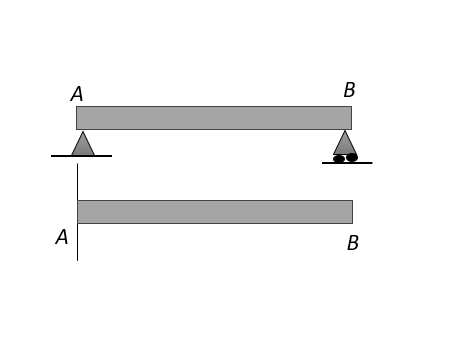
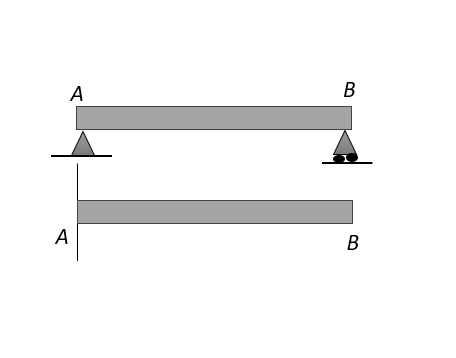
Simply Supported Beam
A simply supported beam is a type of beam that is supported at both ends, with no fixed or rigid connections. It is free to rotate and move horizontally at both supports, and is only restrained from moving vertically. This type of beam is also known as a "simple beam" or "freely supported beam".

The characteristics of a simply supported beam are:
1. Supported at both ends (left and right)
2. No fixed or rigid connections at the supports
3. Free to rotate and move horizontally at both supports
4. Only restrained from moving vertically
5. Can deflect (bend) under load
6. Can rotate at the supports
The advantages of simply supported beams include:
1. Simple to analyze and design
2. Can span long distances
3. Can carry moderate to heavy loads
4. Allows for some flexibility and movement
The disadvantages of simply supported beams include:
1. May deflect excessively under load
2. May not be suitable for very heavy loads or long spans
3. May require additional support or bracing
Simply supported beams are commonly used in building construction, bridges, and other structures, such as:
1. Floor joists
2. Roof rafters
3. Bridge decks
4. Building frames
Cantilever Beam
A cantilever beam is a type of beam that is supported at one end, with the other end free to overhang. It is a structural element that projects out from a support, such as a wall or column, without additional support at the other end.

Cantilever beams are used to:
1. Provide support for floors, roofs, or other structural elements
2. Create overhanging structures, such as balconies, canopies, or eaves
3. Support heavy loads, like weight of a building or bridge
4. Resist lateral loads, like wind or seismic forces
The characteristics of cantilever beams include:
1. One end is fixed (supported)
2. The other end is free (unsupported)
3. The beam is subjected to bending and shear stresses
4. The beam deflects (bends) under load
Cantilever beams are commonly used in:
1. Building construction (balconies, canopies, etc.)
2. Bridge construction (overhanging sections)
3. Aircraft and aerospace engineering (wing structures)
4. Mechanical engineering (levers, arms, etc.)
The advantages of cantilever beams include:
1. Aesthetically pleasing designs
2. Increased clearance below the beam
3. Reduced need for additional supports
4. Ability to resist lateral loads
However, cantilever beams also have limitations, such as:
1. Higher stresses and deflections
2. Increased risk of collapse if not properly designed
3. Limited span length due to deflection and stability concerns
Propped cantilever beam
A propped cantilever beam is a type of cantilever beam that has an additional support, known as a prop, at the free end. This prop provides additional support to the beam, reducing the deflection and stress in the beam.

In a propped cantilever beam:
1. One end is fixed (supported)
2. The other end is free (unsupported), but with a prop or additional support
3. The prop can be a column, wall, or another beam
4. The beam is subjected to bending and shear stresses, but the prop helps to reduce these stresses
The prop in a propped cantilever beam:
1. Reduces the deflection of the beam
2. Increases the stiffness of the beam
3. Helps to resist lateral loads and vibrations
4. Can be designed to be removable or permanent
Propped cantilever beams are commonly used in:
1. Building construction (balconies, canopies, etc.)
2. Bridge construction (overhanging sections)
3. Aircraft and aerospace engineering (wing structures)
4. Mechanical engineering (levers, arms, etc.)
The advantages of propped cantilever beams include:
1. Increased stability and stiffness
2. Reduced deflection and stress
3. Improved resistance to lateral loads and vibrations
4. Design flexibility and aesthetic appeal
In summary, propped cantilever beams offer additional support and stability to cantilever beams, making them suitable for applications where higher loads and stresses are expected.
Fixed Beam
A fixed beam is a type of beam that is supported at both ends and is fixed in place, meaning it is unable to rotate or move horizontally at either support. This type of beam is also known as a "fixed-fixed" or "encastre" beam.

The characteristics of a fixed beam include:
1. Supported at both ends
2. Fixed in place, unable to rotate or move horizontally at either support
3. Resists loads and moments (torques) at both ends
4. Has zero deflection (no bending) at the supports
5. Has a constant slope (angle) between the supports
Fixed beams are commonly used in:
1. Building construction (foundation beams, roof beams)
2. Bridge construction (main beams, pier caps)
3. Machine frames and bases
4. Shipbuilding (hull frames, deck beams)
The advantages of fixed beams include:
1. High stiffness and resistance to deflection
2. Ability to resist high loads and moments
3. Provides a rigid structure
4. Can be used in applications where high precision is required
However, fixed beams also have some limitations, such as:
1. Higher stresses and loads at the supports
2. Requires more complex analysis and design
3. May be more difficult to construct and install
In summary, fixed beams offer high stiffness and resistance to deflection, making them suitable for applications where high loads and precision are required.
Continuous beam
A continuous beam is a type of beam that spans across multiple supports, with no gaps or interruptions in the beam. It is a structural element that extends over several supports, such as columns, piers, or walls, and is designed to resist loads and stresses across its entire length.

The characteristics of a continuous beam include:
1. Spans across multiple supports
2. No gaps or interruptions in the beam
3. Resists loads and stresses across its entire length
4. Can be subjected to various types of loads, such as point loads, uniform loads, and moment loads
5. Can be designed to be statically determinate or indeterminate
Continuous beams are commonly used in:
1. Building construction (floor beams, roof beams, foundation beams)
2. Bridge construction (main beams, deck beams)
3. Highway construction (bridge beams, road beams)
4. Industrial construction (machine frames, conveyor beams)
The advantages of continuous beams include:
1. Increased stiffness and strength
2. Reduced deflection and stress
3. Ability to resist higher loads and moments
4. Improved structural integrity
5. Aesthetically pleasing designs
However, continuous beams also have some limitations, such as:
1. More complex analysis and design
2. Higher construction costs
3. May require special connections and details
In summary, continuous beams offer increased stiffness, strength, and structural integrity, making them suitable for applications where high loads and stresses are expected.


 Aug 29, 2026


