


Article details
In the manufacturing and foundry industries, "moulding" (or molding) refers to the process of shaping liquid or pliable raw material using a rigid frame called a mold. The specific technique chosen by an engineer or artisan depends heavily on the size of the object being created, the materials involved, and the volume of production required.
Based on standard foundry practices, there are four distinct classifications of molding methods.
1. Bench Moulding
As the name suggests, this technique is conducted on a raised workbench or platform rather than on the ground. This method is specifically designed for the convenience of the molder, allowing them to work at a comfortable standing height.
Best Application: Bench molding is exclusively used for producing small-sized molds.
The Process: Because the casting flasks (the frames holding the sand) and the patterns are small and lightweight, they can be easily handled by a single person on a table. This allows for higher precision on intricate, small parts.
2. Floor Moulding
When the size of the casting increases to the point where the mold is too heavy or bulky to be handled on a workbench, the process moves to the foundry floor.
Best Application: This method is standard for medium-sized molds.
The Process: The molding sand is rammed around the pattern directly on the shop floor. While small cranes or hoists might be used to flip the flasks, much of the finishing work is done by molders kneeling or bending over the molds on the ground level.
3. Pit Moulding
Pit molding is reserved for the largest category of manufacturing tasks. When a casting is so colossal that standard flasks cannot contain it, or it is unsafe to construct it above ground, a "pit" is dug into the foundry floor.
Best Application: This is used strictly for large-sized molds (e.g., huge machine beds, turbine casings).
The Process: The mold is prepared inside a reinforced concrete or sand-lined pit.
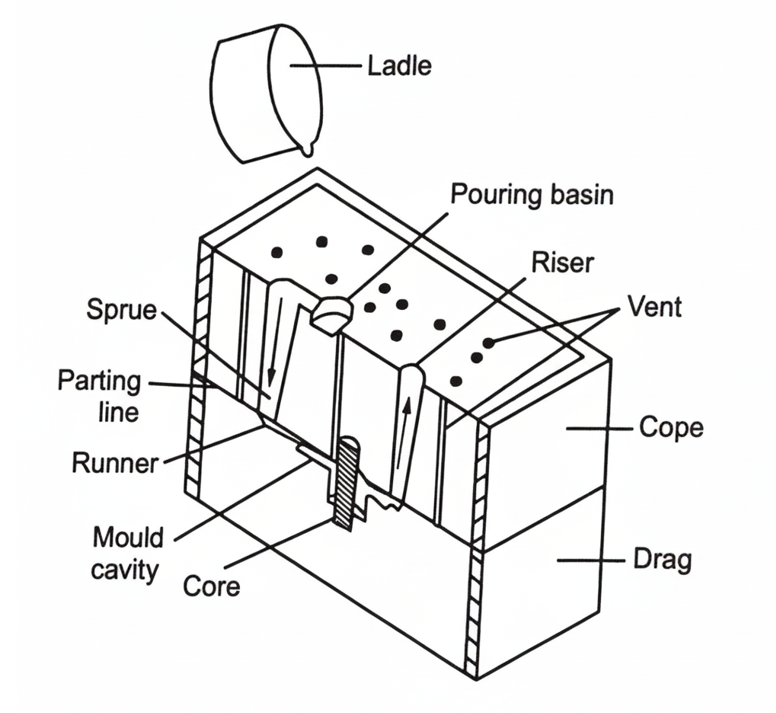
Unique Feature: In this method, a traditional "drag" box (the bottom half of a molding flask) is often not used. Instead, the molding sand available at the bottom of the pit acts as the drag, providing the necessary support for the molten metal.
4. Machine Moulding
While the first three methods rely heavily on manual labor and sand casting techniques, machine molding represents a shift toward automation and mass production, particularly involving modern materials like plastics.
Best Application: Used for creating hollow, three-dimensional articles and mass-produced components.
The Process: This method utilizes machinery to process thermoplastic materials, which usually come in the form of granules or powders. The machine heats and forces the material into the mold, ensuring consistent wall thickness and rapid production rates compared to manual methods.


 Oct 2, 2026
