

Article details
Solidification is the phase transformation by which molten metal turns into solid inside a mould cavity. This stage governs the microstructure, mechanical properties, soundness, and defect formation in castings. The manner in which heat is extracted and the way the solid–liquid interface advances determine the type of solidification that occurs.
In metal casting, solidification is broadly classified based on thermal gradient, nucleation behavior, and movement of the solidification front.
1) Directional Solidification
In directional solidification, the metal solidifies progressively from one end to another, ideally from the farthest point toward the riser.
Characteristics:
Controlled heat flow in one direction
Promotes feeding of liquid metal from riser
Minimizes shrinkage cavities
Benefits:
Produces sound castings
Preferred in riser design and gating practice
Applications:
Turbine blades, high-integrity structural castings.
2) Progressive (Normal) Solidification
Here, solidification starts at the mould walls and progresses inward toward the center from all directions.
Characteristics:
Heat extracted uniformly from all sides
Central region solidifies last
Risk:
Formation of central shrinkage cavity if not fed properly
Common in:
Sand castings of simple geometry.
3) Simultaneous Solidification
In this type, the entire casting solidifies almost at the same time.
Characteristics:
Occurs in thin sections
Very small temperature gradients
Little feeding possible
Risk:
High chances of shrinkage porosity throughout
Typical in:
Thin-walled castings and small components.
4) Chilled Solidification
Occurs when a metal chill is placed in the mould to increase the rate of heat extraction at specific locations.
Characteristics:
Rapid solidification near chill
Fine grain structure
Increased hardness at chilled region
Used for:
Controlling grain structure and improving surface hardness.
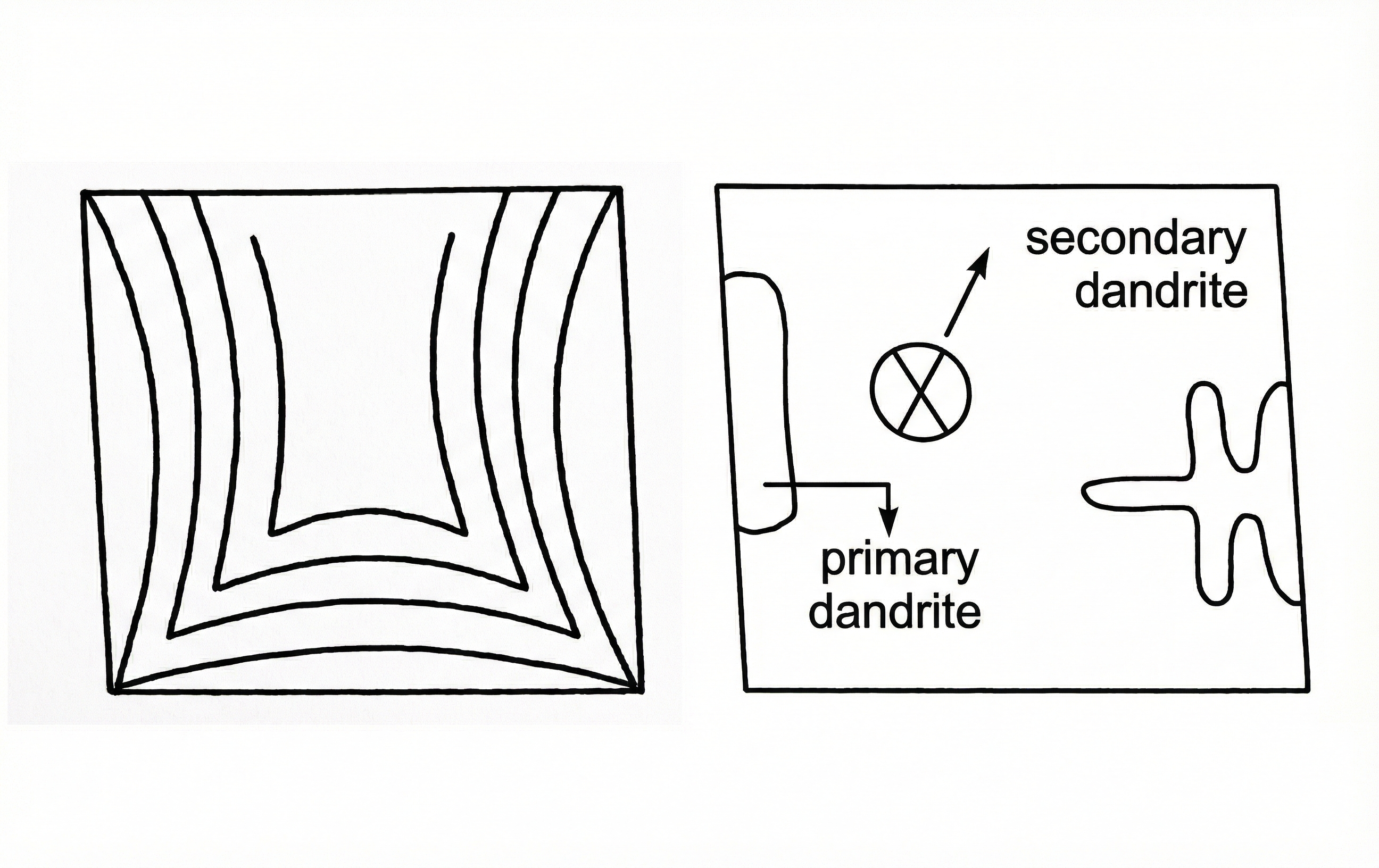
5) Dendritic Solidification
Most metals solidify in a tree-like (dendritic) structure due to constitutional supercooling.
Characteristics:
Primary and secondary dendrite arms
Segregation of alloying elements between dendrites
Influences mechanical properties
Common in:
All alloy castings.
6) Equiaxed Solidification
Solid grains form uniformly in all directions without preferred orientation.
Characteristics:
Occurs when cooling is uniform
Fine, uniform grain structure
Good mechanical properties
7) Columnar Solidification
Grains grow in a particular direction opposite to heat flow.
Characteristics:
Long column-like grains
Occurs under steep thermal gradient
Lower transverse strength
Seen in:
Large castings and ingots.
8) Skin Formation Solidification
A thin solid skin forms immediately after pouring due to contact with cold mould walls.
Characteristics:
Rapid initial solid layer
Inner metal remains liquid longer
Affects feeding and shrinkage behavior
Factors Affecting Type of Solidification
Thermal gradient between mould and molten metal
Cooling rate
Presence of chills
Alloy composition
Mould material
Pouring temperature
Importance in Casting Design
Understanding solidification type helps in:
Proper riser placement
Avoiding shrinkage defects
Controlling grain structure
Improving casting quality


 Aug 29, 2026