


Article details
In the metal casting process, the transformation from molten liquid to a solid component is defined by how the metal freezes. This phase change does not happen instantly; it is a progressive action that dictates the final microstructure and mechanical integrity of the part.
Generally, solidification occurs through two distinct mechanisms: Skin Forming and Dendritic Growth. Understanding the difference is crucial for predicting casting defects like shrinkage and porosity.
1. Skin Forming (Planar Solidification)

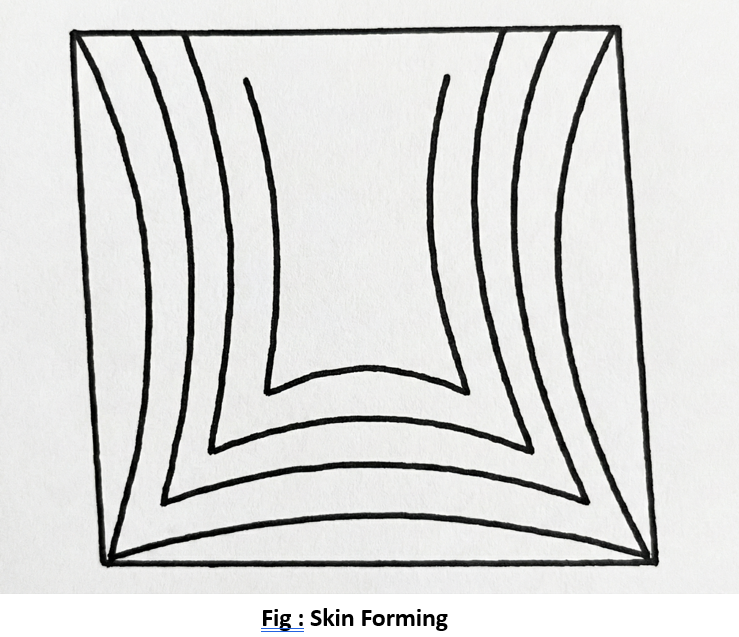
Fig : Skin Forming
This mode of solidification is characterized by a smooth, well-defined interface between the liquid metal and the solidifying front. It is often referred to as "planar growth."
When Does It Occur?
Skin forming is typically observed in pure metals (like pure aluminum or copper) and alloys with a eutectic composition. These materials freeze at a single, constant temperature rather than across a temperature range.
The Mechanism
Exterior Initiation: The process begins at the mold walls, which are the coolest points of contact. A solid shell (or "skin") forms almost immediately.
Inward Progression: As heat is extracted through the mold, the solidification front advances progressively from the exterior toward the thermal center of the casting.
Layered Growth: The material solidifies in successive layers, much like the rings of a tree, but moving inward.
The Result
Because the solid wall moves smoothly inward, the final liquid to freeze is concentrated at the very center. This typically results in a large, centralized shrinkage void (piping) if not properly fed by a riser.
2. Dendritic Growth (Mushy Zone Solidification)

Fig : Dendritic Growth
Dendritic growth is a more complex phenomenon that results in a tree-like crystalline structure. This is the most common solidification mode for industrial alloys.
When Does It Occur?
This occurs in alloys (solid solutions) that possess a wide freezing range—meaning there is a significant difference between the temperature at which freezing starts (liquidus) and where it ends (solidus).
The Mechanism
Unlike skin forming, there is no distinct line separating solid and liquid. Instead, a "mushy zone" develops—a region where solid crystals and liquid metal coexist.
Nucleation: While solidification may start near the mold walls, it does not stay there. Solid crystals (nuclei) can form spontaneously throughout the liquid melt.
Branching Structure: The crystals grow rapidly in specific preferred directions, forming a primary trunk (primary dendrite). From this trunk, branches shoot out perpendicularly (secondary dendrites), creating a skeleton-like structure.
Multi-Directional Flow: The growth is not strictly unidirectional. The solidification fronts move from the walls inward, but also from the internal nucleation sites outward, eventually meeting.
The Result
As the dendrites grow and interlock, small pockets of liquid metal get trapped between the branches. When this trapped liquid finally freezes and shrinks, it leaves behind tiny, dispersed voids known as micro-porosity, rather than one large central hole.
Comparison
Feature | Skin Forming | Dendritic Growth |
Material Suitability | Pure Metals & Eutectics | Alloys with a freezing range |
Freezing Interface | Smooth / Planar | Pasty / Mushy (Dendritic) |
Directionality | Strictly Wall $\rightarrow$ Center | Multi-directional |
Primary Defect | Centralized Piping (Macro-shrinkage) | Dispersed Porosity (Micro-shrinkage) |
Conclusion
For a foundry engineer, identifying whether a metal will behave as a skin-former or a dendritic-grower is vital. Skin-forming metals require risers that can feed the center of the casting to prevent piping. In contrast, alloys exhibiting dendritic growth often require larger pressures or chills to minimize the microscopic porosity trapped between the crystal branches