


Article details
In a vapour compression refrigeration (VCR) system, the throttling process that reduces refrigerant pressure from condenser to evaporator inevitably produces a mixture of liquid and vapour at the evaporator inlet. This unwanted vapour is called flash gas. Since only the liquid portion contributes effectively to refrigeration in the evaporator, the presence of flash gas reduces cooling capacity, lowers evaporator efficiency, and increases compressor workload.
A Flash Gas Removal System (FGRS) is an efficiency enhancement arrangement designed to separate and remove this flash vapour before the refrigerant enters the evaporator. By ensuring that mostly liquid refrigerant reaches the evaporator, the system improves the Coefficient of Performance (COP) and overall refrigeration effectiveness.
What is Flash Gas?
During throttling (an isenthalpic process), part of the high-pressure liquid refrigerant instantly vaporizes due to the sudden pressure drop. This vapour:
Occupies space meant for liquid refrigerant in the evaporator
Does not contribute to useful cooling
Increases suction vapour volume to the compressor
Causes reduction in refrigerating effect per kg of refrigerant
Why Flash Gas is Undesirable
Reduced Refrigeration Effect – Less liquid available for evaporation.
Higher Compressor Load – Compressor handles more vapour volume.
Lower Evaporator Efficiency – Poor heat absorption performance.
Decreased COP – More work for less cooling.
Principle of Flash Gas Removal
The key idea is simple:
Separate the vapour formed after throttling and route it directly to the compressor suction without sending it through the evaporator.
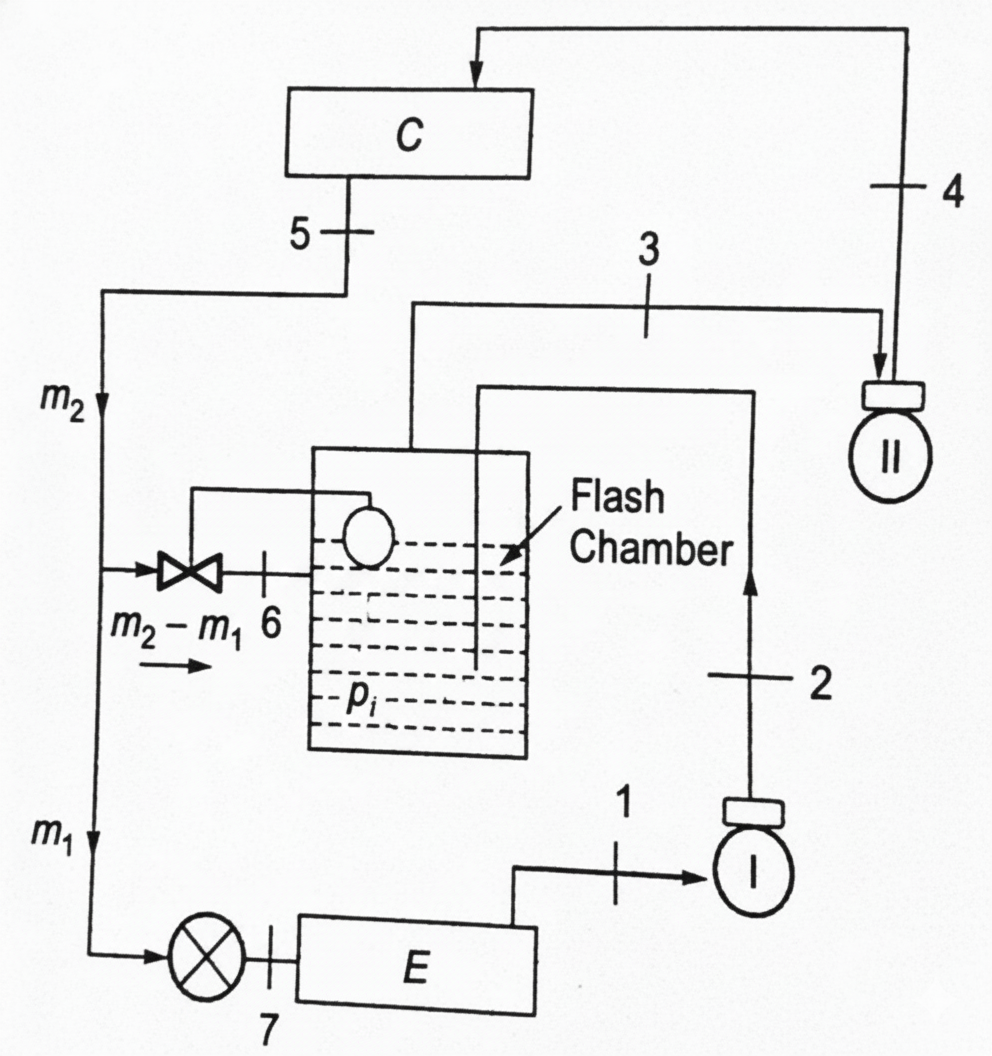
This is achieved by installing a flash chamber (flash intercooler or flash separator) between the expansion device and evaporator.
Working of Flash Gas Removal System
High-pressure liquid refrigerant from the condenser is throttled.
The low-pressure mixture enters a flash chamber.
Flash vapour rises to the top and is drawn to the compressor suction.
Remaining pure liquid at evaporator pressure flows into the evaporator.
The evaporator now receives mostly liquid refrigerant for effective cooling.
Components Used
Flash chamber (separator vessel)
Piping to compressor suction line
Expansion valve before the chamber
Sometimes an additional expansion valve after the chamber
Thermodynamic Advantage
With flash gas removed:
Enthalpy of refrigerant entering evaporator is lower (more liquid fraction).
Refrigerating effect per kg increases.
Mass flow rate required for same cooling reduces.
Compressor power per ton of refrigeration decreases.
This leads to higher COP and better system performance.
Relation to Multi-Stage and Industrial Systems
Flash gas removal is commonly used in:
Large industrial ammonia refrigeration plants
Two-stage compression systems
Low-temperature refrigeration systems
Systems using economizers and intercoolers
It is often integrated with flash intercooling, where the flash chamber also cools refrigerant between compressor stages.
Benefits of Flash Gas Removal
Benefit | Effect |
|---|---|
Increased liquid fraction to evaporator | Higher cooling capacity |
Reduced compressor vapour load | Lower power consumption |
Improved evaporator heat transfer | Better performance |
Higher COP | Energy savings |
Better control in low-temperature systems | Stable operation |
Applications
Cold storage plants
Ice plants
Food processing refrigeration
Chemical industry refrigeration
Ammonia-based industrial refrigeration systems
Difference Between Simple Throttling and Flash Gas Removal
Aspect | Simple Throttling | With Flash Gas Removal |
|---|---|---|
Refrigerant to evaporator | Liquid + vapour | Mostly liquid |
Cooling effect | Lower | Higher |
Compressor load | Higher | Lower |
COP | Lower | Higher |
System efficiency | Moderate | Improved |
Practical Considerations
Added equipment cost and space
Requires proper piping and control
Justified mainly in medium to large systems
Not economical for small domestic units

 Oct 2, 2026