

Article details
Primary secondary pumping solved a real problem, protecting chillers from variable flow while still letting the building side respond to actual demand, but it did so with real cost, two separate sets of pumps, more equipment, more space, more wiring and piping. Variable primary flow eliminates that redundancy entirely, using one set of pumps to do what two sets used to do. The savings are genuine. So is the added control risk, and understanding exactly where that risk comes from is what separates a variable primary system that actually works from one that quietly underperforms or nuisance trips chillers on a regular basis.
What Variable Primary Flow Actually Removes
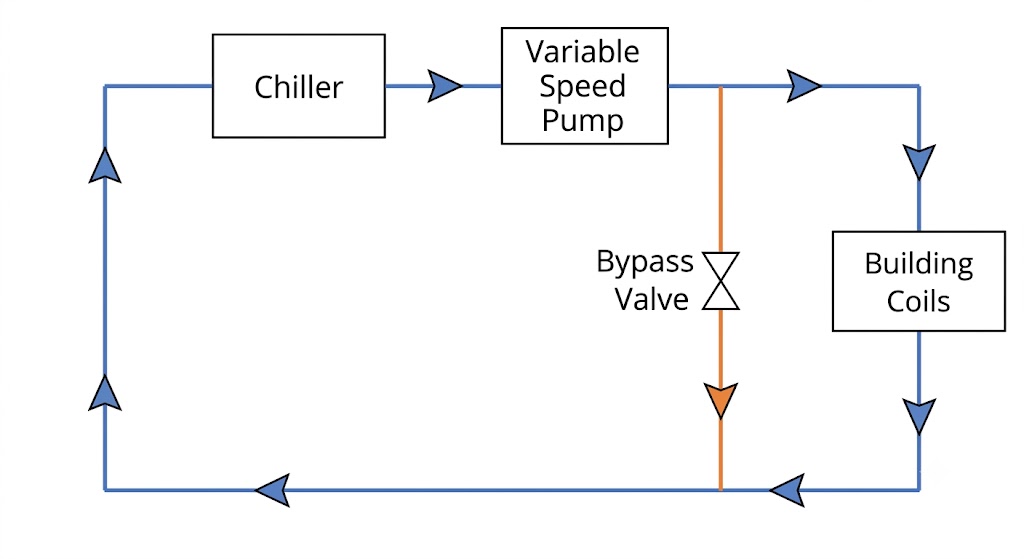
As covered in primary secondary pumping explained, a traditional system uses dedicated primary pumps to maintain constant flow through each chiller, and a separate secondary pump to serve the building's actual variable load, with a decoupler connecting the two loops. Variable primary flow removes the separate primary pumps entirely. Instead, variable speed pumps serve both jobs at once, pushing water directly through the chillers and out to the building's cooling coils, with pump speed varying continuously to match actual building demand.
This is a genuinely significant simplification. No dedicated primary pumps means less installed equipment, less pump energy consumed overall, and meaningfully lower first cost, exactly the appeal that's made variable primary flow the increasingly common choice for new chiller plant design.
The Trade Off: The Chiller's Flow Protection Now Has to Be Actively Managed
Here's the genuine complexity variable primary flow introduces. In a traditional primary secondary system, the dedicated primary pump inherently protects the chiller, that pump's entire job is maintaining constant evaporator flow, and it does so regardless of what the secondary side is doing. In a variable primary system, there's no dedicated pump doing that job anymore, the same variable speed pump serving the whole system has to somehow ensure the chiller never sees flow drop below its minimum requirement, even while that pump is actively varying speed to respond to building demand that has nothing to do with the chiller's own requirements.
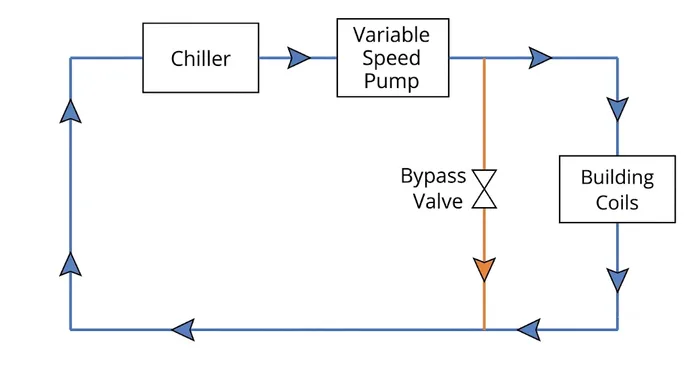
This is solved through a bypass line with a control valve, positioned to allow water to flow directly from supply to return, bypassing the building's cooling coils entirely, whenever the system's actual flow demand drops below what the operating chiller or chillers require as a minimum. When building demand is low enough that the variable pumps would otherwise reduce flow below the chiller's minimum, the bypass valve opens just enough to make up the difference, ensuring the chiller still sees adequate flow even though the building itself isn't actually asking for that much.
Why This Bypass Control Is Genuinely Harder Than It Sounds
A few specific technical challenges make getting this bypass control right meaningfully more difficult than it might first appear.
Accurate flow measurement or proof of flow is essential, and easy to get wrong. The control system needs to genuinely know how much flow is actually passing through each operating chiller at any given moment, not just infer it, since protecting the chiller depends on knowing its real flow condition, not an assumed one. Differential pressure alone is not automatically a reliable stand in for actual flow, using it that way depends on having a genuinely accurate evaporator resistance relationship or manufacturer flow versus pressure data, something that's easy to get approximately right and genuinely wrong in the specific details that matter during a real low flow event.
Control lag between flow sensing and valve response creates a real risk window. If the bypass valve doesn't open quickly enough in response to falling flow, there's a genuine window where the chiller can see flow drop below its minimum before the bypass corrects it, exactly the condition that trips a chiller's low flow safety protection. Minimizing this lag is a genuine commissioning and control tuning challenge, not something that simply works correctly by default once the equipment is installed.
Bypass line and valve sizing has to be genuinely correct, not just adequate on paper. A bypass valve that lacks sufficient rangeability, stable control at low flow, or adequate capacity cannot reliably protect a chiller no matter how well tuned the control logic around it is. This is a case where undersizing or oversizing the bypass equipment itself undermines the entire protection strategy, regardless of how sophisticated the surrounding controls are.
Multiple chillers with different minimum flow requirements compound the problem. When a plant has more than one chiller staged together, especially dissimilar chillers with different individual minimum flow limits, the control system has to calculate and maintain adequate flow for every actively operating chiller simultaneously, under every permitted staging combination, a genuinely more complex calculation than protecting a single chiller in isolation.
Why the Bypass Line Should Never Be Value Engineered Out
This is a specific, genuinely important warning that shows up repeatedly in technical literature on variable primary flow design, the bypass line and its control valve are not optional cost saving opportunities. Removing or undersizing the bypass to reduce first cost doesn't eliminate the chiller's genuine minimum flow requirement, it just removes the mechanism that was protecting against violating that requirement. A plant with an inadequate or missing bypass doesn't become more efficient, it becomes prone to nuisance chiller trips whenever building demand drops low enough, exactly the operational reliability problem the entire control strategy exists to prevent in the first place.
Retrofit Considerations Are Genuinely Different From New Construction
Variable primary flow is generally considered ideal for new chiller plant design, where the entire system, chillers, valves, and building automation controls, can be designed together around this control strategy from the start. Retrofitting an existing plant to variable primary flow is genuinely more difficult, since it requires properly sized valves and controls, plus a building automation system genuinely capable of monitoring optimal pressure throughout the building, layered onto equipment and piping that may not have been designed with this control strategy in mind. A partial retrofit, replacing only the chiller, only the controls, or only the air handling units, without addressing the full system together, is specifically identified as a poor application of this approach, precisely because variable primary flow's success depends on the coordination between all these elements working correctly together, not any single component in isolation.
The Practical Takeaway
Variable primary flow offers genuine, real savings, less equipment, lower first cost, reduced pump energy, by eliminating the dedicated primary pumps a traditional primary secondary system requires. But it does this by transferring the chiller protection job that a dedicated pump used to handle inherently onto an actively managed bypass control strategy instead, one that depends on accurate flow measurement, minimal control lag, correctly sized bypass equipment, and genuinely correct handling of multiple, possibly dissimilar chillers staged together. Getting this right is a genuine engineering and commissioning challenge, not an automatic byproduct of simply choosing the modern approach, and treating the bypass control system as a minor detail rather than the core of what makes variable primary flow actually work safely is exactly how plants end up with the nuisance trips and inefficient operation this design pattern was supposed to avoid.
EveryEng. For everyone in Engineering.