


Article details
Go with the Flow: Inside the Venturimeter
If you’ve ever wondered how water companies know exactly how many liters of water are pumping into a neighborhood, or how a carburetor blends fuel into an engine's airstream, you’ve crossed paths with the Venturimeter.
Invented by American engineer Clemens Herschel and named in honor of Giovanni Battista Venturi (the physicist who discovered the underlying principle), a venturimeter is a highly accurate mechanical device used to measure the flow rate (discharge) of a fluid passing through a pipeline.
How It Works: The Venturi Effect
The magic of a venturimeter relies entirely on a thermodynamic and fluid dynamic rule: when fluid velocity increases, fluid pressure must decrease.
Imagine a steady stream of traffic moving down a three-lane highway. Suddenly, construction narrows the highway down to a single lane. To prevent a complete gridlock, the cars have to speed up significantly as they pass through the narrow bottleneck.
A venturimeter forces fluid to do the exact same thing. By compressing the fluid into a tight throat, it forces the fluid to accelerate. Because energy must be conserved, that spike in kinetic energy (speed) causes an instantaneous drop in potential energy (pressure). By measuring this pressure drop, we can calculate exactly how fast the fluid is moving.
The Anatomy of a Venturimeter
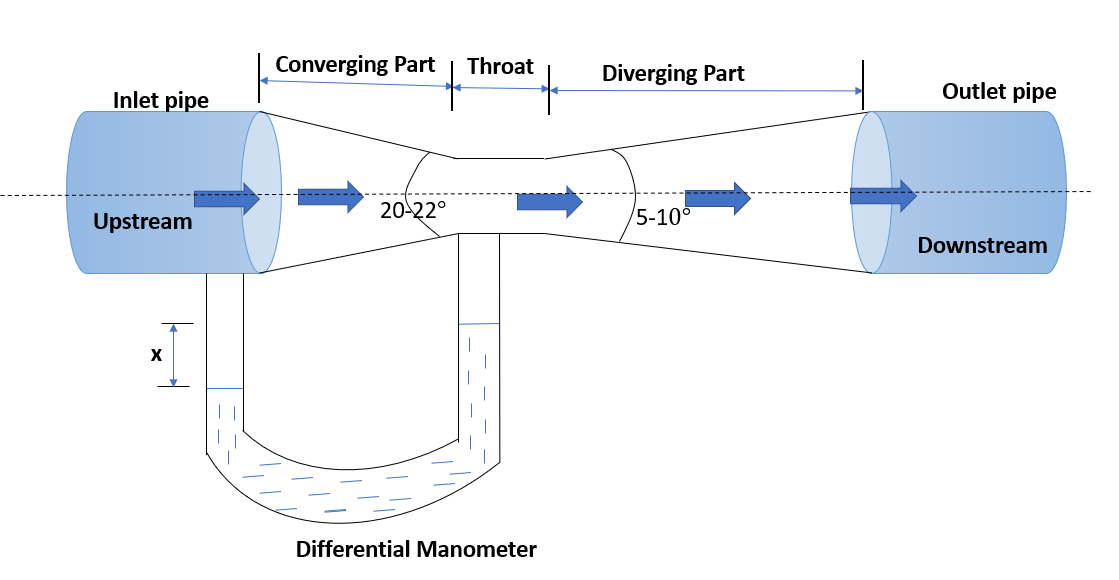
A standard venturimeter is spliced directly into a pipeline and consists of three distinct, carefully engineered sections:
1. The Converging Cone
The pipe diameter gradually tapers down from its original size (d_1) to a much smaller size (d_2). The angle of this cone is relatively steep (usually around 20 degree to 22 degree). As the fluid enters this cone, it smoothly accelerates, and its pressure begins to plummet.
2. The Throat
This is the narrowest, bottleneck section of the meter. The diameter remains completely constant here for a short length. At this exact spot, the fluid reaches its maximum velocity and its minimum pressure.
3. The Diverging Cone
After the throat, the pipe widens back out to its original diameter. Crucially, this cone is much longer and opens up at a very shallow, gentle angle (typically 5 degree to 7 degree).
Why is it so long? If the pipe widened out too quickly, the fluid would separate from the walls, creating wild eddies, turbulence, and massive energy losses. The gentle slope allows the fluid to slow down safely and recover up to 90% of its original pressure.
The Mathematics of Flow
To find the actual discharge (Q), engineers tap two pressure gauges (or a differential U-tube manometer) into the device: one at the wide inlet (Section 1) and one at the narrow throat (Section 2).
By combining Bernoulli’s Equation (conservation of energy) and the Continuity Equation (mass conservation), we derive the ideal flow rate formula:

Where:
a_1: Cross-sectional area of the inlet pipe.
a_2: Cross-sectional area of the throat.
g: Acceleration due to gravity.
h: The differential pressure head (the difference in fluid height shown on the manometer).
The Real-World Reality: Coefficient of Discharge (C_d)
In a perfect, frictionless world, the formula above would be flawless. But because real fluids suffer from minor friction against the pipe walls, the actual flow is always slightly less than the ideal math predicts.
To correct for this, we introduce the Coefficient of Discharge (C_d):

Because the venturimeter is so beautifully aerodynamic, it suffers very little energy loss. Its C_d value is exceptionally high—usually between 0.95 and 0.99.
Pros vs. Cons: Is it Worth It?
Like any engineering tool, the venturimeter is a balance of compromises.
Advantages:
Minimal Power Loss: Because of the gentle diverging cone, it doesn't permanently choke the line pressure like an orifice plate does.
High Accuracy: Highly reliable for both clean liquids and fluids carrying suspended solids (slurry), as the smooth design prevents debris from getting trapped.
Longevity: No moving parts to wear out or recalibrate over time.
Disadvantages:
Massive Footprint: Because the diverging cone must be long and gradual, a venturimeter takes up a lot of physical space in a piping layout.
Expensive: Machining the precise, smooth internal curves makes them significantly more expensive to manufacture and install compared to simple, flat orifice plates.