

Article details
Introduction
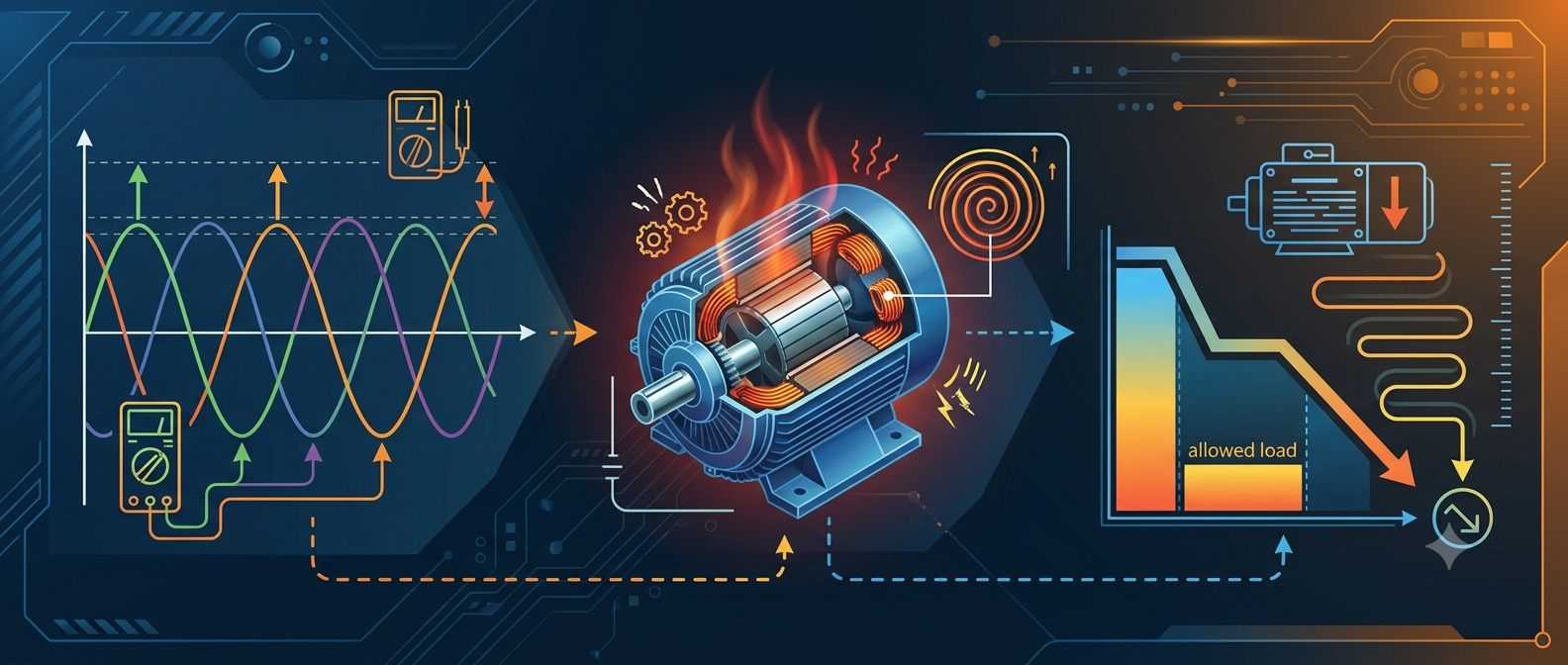
Voltage unbalance is a common electrical power quality problem that can significantly affect the performance, efficiency, and service life of three-phase induction motors. It occurs when the voltage levels across the three phases of an electrical supply are unequal. Although the difference between phase voltages may appear small, even a slight imbalance can cause excessive motor heating, increased current, reduced efficiency, and unexpected equipment failure.
Three-phase motors are widely used in manufacturing plants, pumping systems, HVAC equipment, compressors, conveyors, and industrial machinery. Maintaining a balanced voltage supply is essential for ensuring reliable operation and reducing maintenance costs.
Understanding the causes, effects, measurement methods, and prevention techniques of voltage unbalance helps electrical engineers and maintenance professionals protect motors and improve overall system performance.
What Is Voltage Unbalance?
Voltage unbalance, also called voltage imbalance, refers to a condition in which the voltage magnitudes across the three phases of a three-phase electrical system are not equal.
In an ideal three-phase power supply, all three phase voltages have equal magnitudes and are separated by an electrical angle of 120 degrees. This arrangement creates a balanced rotating magnetic field inside an induction motor, allowing it to operate smoothly.
When the supply voltage becomes unbalanced, the magnetic field inside the motor is affected. This can result in unequal phase currents, additional losses, overheating, and reduced operating efficiency.
Voltage unbalance is generally expressed as a percentage. A lower percentage indicates a more balanced supply, while a higher percentage indicates a more serious imbalance.
How to Calculate Voltage Unbalance
Voltage unbalance can be calculated by comparing the individual phase voltages with their average value.
The commonly used calculation method is:
[ text{Voltage Unbalance (%)}= frac{text{Maximum Deviation from Average Voltage}} {text{Average Voltage}}times100 ]
Calculation Steps
Measure the three line-to-line voltages: \(V_{AB}\), \(V_{BC}\), and \(V_{CA}\).
Calculate the average voltage.
Find the absolute difference between each measured voltage and the average.
Identify the largest difference.
Divide the maximum deviation by the average voltage and multiply by 100.
Example Calculation
Consider a three-phase supply with the following measured voltages:
Phase AB: 400 V
Phase BC: 392 V
Phase CA: 408 V
The average voltage is:
[ V_{text{avg}}=frac{400+392+408}{3}=400text{ V} ]
The deviations from the average are 0 V, 8 V, and 8 V. Therefore, the maximum deviation is 8 V.
[ text{Voltage Unbalance}=frac{8}{400}times100 ]
[ boxed{text{Voltage Unbalance}=2%} ]
This result indicates a 2% voltage unbalance using the maximum-deviation method. For detailed motor assessments, the symmetrical-component method may also be used because it accounts for the negative-sequence voltage component.
Main Causes of Voltage Unbalance
Voltage unbalance can originate from the power supply network, electrical distribution system, or connected equipment. Identifying the source is the first step toward correcting the problem.
1. Unequal Distribution of Electrical Loads
When single-phase loads are distributed unevenly across a three-phase electrical system, the phase voltages may become unequal. This is common in facilities with lighting, office equipment, small motors, and other single-phase electrical devices.
Proper load balancing helps reduce voltage variations and improves the reliability of the electrical supply.
2. Loose or Damaged Connections
Loose terminals, corroded contacts, damaged cables, and deteriorated electrical connections can increase resistance in one phase. This may cause voltage drops and contribute to unequal voltage levels at the motor terminals.
Regular inspection and tightening of electrical connections, following the manufacturer's specifications and safety procedures, can help prevent this problem.
3. Uneven Transformer or Supply Voltages
Voltage unbalance may originate from the utility supply or a distribution transformer. Unequal transformer impedances, supply-side faults, and variations in the distribution network can contribute to the problem.
In such cases, the electrical supply should be investigated before changes are made to the motor or its control system.
4. Faulty Electrical Components
Damaged fuses, defective circuit breakers, worn contactors, and failing switchgear can create abnormal voltage conditions. A poor connection in one phase may cause a significant voltage drop when the motor is operating under load.
Inspecting protective devices and switching equipment is an important part of electrical maintenance.
5. Unequal Cable Impedance
Differences in cable length, conductor size, connection quality, or conductor condition can produce unequal voltage drops across the three phases. This is especially important in installations with long cable runs or high-current motor loads.
Correct cable sizing and consistent installation practices help maintain balanced voltage at the motor terminals.
Effects of Voltage Unbalance on Three-Phase Motors
Voltage unbalance can have a greater effect on motor performance than the percentage difference between the supply voltages might suggest. Its impact depends on the degree of imbalance, motor design, loading conditions, and operating duration.
1. Excessive Motor Heating
One of the most serious effects is increased motor temperature. Voltage unbalance creates an additional negative-sequence magnetic field that rotates opposite to the normal magnetic field.
This produces additional rotor and stator losses, increasing heat generation. Excessive temperature can damage winding insulation and shorten the motor's service life.
2. Unequal Phase Currents
A small voltage imbalance can produce a considerably larger current imbalance. As a result, one or more motor windings may carry more current than expected, even when the motor appears to be operating normally.
Higher current increases copper losses and can cause localized overheating. Measuring current in all three phases is therefore useful when investigating suspected voltage unbalance.
3. Reduced Motor Efficiency
Voltage unbalance increases electrical losses and can reduce the amount of useful mechanical output obtained from the electrical energy supplied to the motor.
The motor may consume more energy to perform the same task, increasing operating costs. In continuously operating industrial facilities, these additional losses can accumulate over time.
4. Reduced Available Motor Output
A motor operating under unbalanced voltage conditions may need to operate at a reduced load to prevent overheating. This is known as motor derating.
Derating reduces the usable mechanical power available from the motor. If the equipment continues to demand its original output, the motor may experience excessive heating or repeated protective trips.
5. Increased Vibration and Noise
Voltage unbalance can disturb the motor's magnetic forces and contribute to abnormal vibration and noise. These symptoms may become more noticeable under certain load conditions.
However, vibration and noise can also result from bearing damage, misalignment, rotor defects, or mechanical imbalance. Electrical measurements should be combined with mechanical inspections to identify the actual cause.
6. Unexpected Shutdowns
Motor protection devices may trip when excessive current or temperature develops. Repeated shutdowns can interrupt production, reduce equipment availability, and increase maintenance expenses.
If the underlying voltage problem remains unresolved, replacing the motor or resetting the protection device may not provide a lasting solution.
Acceptable Voltage Unbalance Levels
Voltage unbalance should be kept as low as reasonably achievable, particularly in industrial facilities operating sensitive or heavily loaded motors.
A commonly cited NEMA recommendation is to limit voltage unbalance at the motor terminals to approximately 1% for normal operation at rated load. This is a useful engineering benchmark, but applicable standards, motor specifications, and manufacturer recommendations should always be checked.
A voltage unbalance greater than 1% may require investigation and, depending on the motor and operating conditions, load reduction.
The important point is that a motor should not be assumed safe simply because the average supply voltage is within its rated range. The imbalance between phases must also be considered.
How to Measure Voltage Unbalance
Accurate measurement helps engineers determine whether voltage unbalance is affecting motor performance.
1. Measure Voltage at the Motor Terminals
Use a suitable, properly rated digital multimeter or power quality analyzer to measure all three line-to-line voltages. Measurements should be taken at the motor terminals under representative operating conditions, following appropriate electrical safety procedures.
Comparing the readings helps identify differences between the phases and determine whether the motor is receiving a balanced supply.
2. Measure Current in All Three Phases
Measure the current flowing through each phase using a suitable clamp meter or power analyzer. Significant differences between the phase currents may indicate voltage unbalance or another electrical problem.
Current imbalance alone does not confirm voltage unbalance, so both voltage and current measurements should be evaluated.
3. Inspect Electrical Connections
Check terminals, cables, contactors, fuses, and circuit breakers for loose connections, corrosion, discoloration, or overheating. Any inspection inside electrical equipment must be performed by qualified personnel using the required isolation and safety procedures.
4. Use a Power Quality Analyzer
For persistent or intermittent problems, a power quality analyzer can record voltage, current, phase relationships, and other electrical parameters over time.
This helps engineers identify whether the imbalance occurs continuously, during motor starting, or when particular equipment is switched on.
Methods to Prevent and Correct Voltage Unbalance
Corrective measures should address the underlying cause rather than treating only the symptoms.
1. Balance Electrical Loads
Review the distribution of single-phase loads across the three phases. Redistributing loads can reduce unequal voltage drops and improve the balance of the electrical system.
Load balancing is particularly useful in facilities with many single-phase circuits connected to a common three-phase supply.
2. Maintain Electrical Connections
Inspect and maintain electrical connections, switchgear, terminals, and protective devices according to established maintenance procedures.
Replace damaged components and correct defective connections. Proper maintenance reduces resistive losses and helps prevent phase-specific voltage drops.
3. Check the Power Supply
If voltage unbalance remains present at the motor terminals despite healthy internal connections, investigate the upstream distribution system.
The issue may involve the transformer, feeder cables, distribution panel, or utility supply. Coordination with the electrical maintenance team or utility provider may be necessary.
4. Apply Appropriate Motor Derating
When voltage unbalance cannot be eliminated immediately, reducing the motor load may help control temperature and prevent damage.
The required derating should be determined using the applicable motor manufacturer's guidance or relevant industry standards. The motor's operating temperature and protection settings should also be reviewed.
5. Install Suitable Monitoring and Protection
Voltage monitoring relays and motor protection systems can detect abnormal supply conditions and initiate an alarm or shutdown when necessary.
For critical equipment, continuous monitoring can help identify developing problems before they result in motor failure. Protection settings must be selected according to the motor rating and system requirements.
Voltage Unbalance vs. Voltage Variation
Voltage unbalance and voltage variation are related but different electrical conditions.
Feature | Voltage Unbalance | Voltage Variation |
|---|---|---|
Meaning | Unequal voltages across the three phases | Voltage differs from its nominal value |
Main concern | Unequal phase loading and additional motor heating | Overvoltage or undervoltage |
Common causes | Unequal phase loads, faulty connections, supply problems | Supply fluctuations, load changes, transformer settings |
Possible effects | Unequal currents, overheating, reduced motor life | Reduced performance, overheating, starting difficulties |
Corrective action | Identify and balance the affected phases | Investigate and correct the voltage level |
Both conditions can occur simultaneously. Therefore, engineers should assess the overall power supply rather than considering voltage unbalance in isolation.
Practical Example in an Industrial Plant
Consider a three-phase induction motor driving an industrial pump. During routine maintenance, an engineer measures the phase voltages and finds that they are not equal.
Further testing reveals that one phase has a poor connection at a contactor, creating an additional voltage drop under load. The motor also shows a noticeable difference in phase currents and an elevated operating temperature.
After safely isolating the equipment, qualified maintenance personnel repair the defective connection. The engineer then repeats the voltage and current measurements under comparable operating conditions.
If the voltage balance and motor temperature improve, this supports the conclusion that the defective connection contributed to the problem. If the imbalance remains, additional investigation of the supply and distribution system is required.
This example demonstrates why accurate measurements and root-cause analysis are more effective than simply resetting a tripped motor or replacing components without investigation.
Conclusion
Voltage unbalance is an important power quality issue that can reduce the efficiency, reliability, and service life of three-phase induction motors. Even a relatively small difference between phase voltages can produce disproportionate current imbalance, excessive heating, additional electrical losses, and reduced available motor output.
Electrical engineers and maintenance professionals can minimize these risks by measuring phase voltages, monitoring current, inspecting connections, balancing electrical loads, and investigating supply-side problems. Appropriate motor protection and derating practices provide additional safeguards when imbalance cannot be corrected immediately.
Maintaining balanced voltage at motor terminals is essential for reliable industrial operation, lower maintenance costs, and longer equipment life. Regular monitoring and timely corrective action help prevent avoidable failures and support efficient operation of industrial electrical systems.
