

Article details
Introduction
Water is one of the most important substances in our daily lives and in the engineering industry. It is used in power plants, chemical industries, cooling systems, water supply networks, boilers, heat exchangers, and many other applications.
Although water may look simple, its physical properties change with temperature and pressure. Understanding these changes is important for designing safe and efficient engineering systems.

Three important properties of water are density, specific weight, and the coefficient of thermal expansion. These properties help engineers calculate the mass of water, understand the load it creates, estimate pressure, and predict how its volume changes when heated or cooled.
In this article, we will explain these properties in simple language, explore useful formulas and temperature-wise values, and understand their importance in real-world applications.
1. What Is the Density of Water?
Density is the mass of a substance per unit volume. In simple terms, it tells us how much matter is present in a particular space.
For example, imagine two containers of the same size, one filled with water and the other filled with oil. Even though both containers hold the same volume, their masses may be different because their densities are different.
Formula for Water Density
The density of water can be calculated using the following formula:
Density = Mass ÷ Volume
Mathematically:
ρ = m / V
Where:
ρ (rho) = density of water
m = mass of water
V = volume of water
The standard SI unit of density is kilograms per cubic metre (kg/m³). It can also be expressed in grams per cubic centimetre (g/cm³).
What Is the Density of Pure Water?
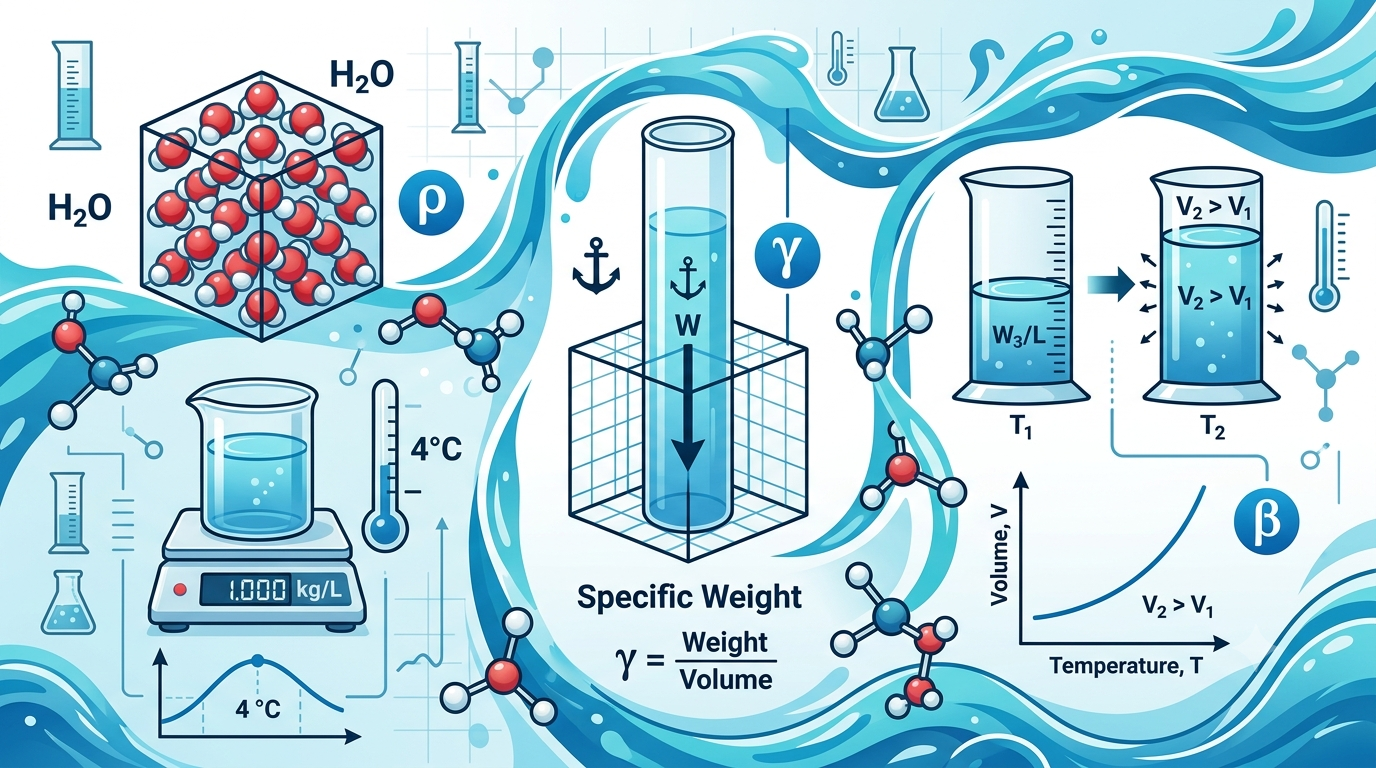
The density of pure water reaches its maximum at approximately 4°C under normal atmospheric pressure.
At this temperature, its density is approximately 1,000 kg/m³, or 1 g/cm³.
This means that one cubic metre of water has a mass of approximately 1,000 kilograms. Similarly, one litre of water has a mass of approximately one kilogram under these conditions.
However, water density is not constant. It changes with temperature and pressure, so engineers should use the appropriate value for their calculations.
2. How Does Water Density Change with Temperature?
Water behaves differently from many other liquids. Most liquids expand when heated and contract when cooled, but water has an unusual property near its freezing point.
As water is heated from 0°C to approximately 4°C, it contracts slightly and becomes denser. Above 4°C, it expands as the temperature increases, causing its density to decrease.
This special behaviour is known as the anomalous expansion of water.

Water Density at Different Temperatures
The following table shows approximate density values for pure liquid water at atmospheric pressure.
Temperature (°C) | Density (kg/m³) |
|---|---|
0 | 999.84 |
4 | 999.97 |
10 | 999.70 |
20 | 998.21 |
30 | 995.65 |
40 | 992.22 |
50 | 988.04 |
60 | 983.20 |
80 | 971.79 |
100 | 958.35 |
Note: Values are approximate and may vary slightly with the reference data and calculation method.
The table shows that water density gradually decreases as its temperature rises above approximately 4°C.
For example, water at 20°C has a density of about 998.21 kg/m³, while water at 100°C has a density of about 958.35 kg/m³ at atmospheric pressure.
This difference becomes important in industrial systems where water is heated, cooled, pumped, or stored.
Why Is Water Most Dense at 4°C?
Water molecules form hydrogen bonds with one another. These bonds influence how the molecules arrange themselves.
As water cools towards 4°C, the molecules become more closely packed overall. Below this temperature, the molecular arrangement begins to create more open space, increasing the volume and reducing the density.
When water freezes, it forms an open crystalline structure. This makes ice less dense than liquid water, which is why ice floats.
This behaviour is important for lakes, rivers, and aquatic life during winter.
3. What Is the Specific Weight of Water?
Specific weight is the weight of a substance per unit volume. While density describes mass, specific weight describes how much gravitational force that mass produces in a given volume.
The two terms are related, but they are not the same.
Formula for Specific Weight
The formula is:
Specific Weight = Density × Gravitational Acceleration
Mathematically:
γ = ρ × g
Where:
γ (gamma) = specific weight
ρ (rho) = density of water
g = gravitational acceleration
The SI unit of specific weight is newtons per cubic metre (N/m³). It is also commonly expressed in kilonewtons per cubic metre (kN/m³).
Specific Weight of Water at 4°C
At approximately 4°C, the density of water is about 1,000 kg/m³. Using gravitational acceleration of 9.80665 m/s²:
γ = 1,000 × 9.80665
γ = 9,806.65 N/m³
Therefore, the specific weight of water is approximately 9.81 kN/m³ at this temperature.
This value is widely used in fluid mechanics and engineering calculations.
Difference Between Density and Specific Weight
Density and specific weight are closely related, but they measure different things.
Density measures mass per unit volume.
Specific weight measures weight per unit volume.
Density is expressed in kg/m³.
Specific weight is expressed in N/m³ or kN/m³.
Density is independent of gravity, while specific weight depends on gravitational acceleration.
Understanding this difference helps prevent mistakes when calculating fluid pressure, structural loads, and hydraulic system requirements.
4. What Is the Thermal Expansion of Water?
Thermal expansion is the tendency of a substance to change its dimensions or volume when its temperature changes.
When most liquids are heated, their molecules move more actively and the liquid expands. When cooled, they generally contract.
Water follows this general pattern above approximately 4°C. However, between 0°C and 4°C, its behaviour is unusual: it contracts as it warms and expands as it cools towards freezing.
Why Does Thermal Expansion Matter?
When water is heated inside a closed or restricted system, its volume can increase. If there is insufficient space to accommodate this expansion, pressure may rise significantly.
This is particularly important in boilers, hot-water pipelines, storage tanks, cooling systems, and heat exchangers.
Engineers must account for thermal expansion when selecting equipment, designing piping systems, and providing suitable expansion arrangements.
5. What Is the Coefficient of Thermal Expansion of Water?
The coefficient of thermal expansion describes how much a substance's volume changes in response to a change in temperature.
For liquids such as water, the volumetric thermal expansion coefficient is commonly represented by the Greek letter β.
It can be expressed as:
β = (1/V) × (dV/dT)
Where:
β = volumetric thermal expansion coefficient
V = original volume
dV = small change in volume
dT = small change in temperature
The unit is generally expressed as per degree Celsius (°C⁻¹) or per kelvin (K⁻¹).
For a temperature change over a small range, engineers often use the approximate relationship:
Change in Volume ≈ Original Volume × β × Change in Temperature
Mathematically:
ΔV ≈ V × β × ΔT
This approximation is useful when the expansion coefficient remains reasonably constant over the temperature range being considered.
For a large temperature range, the coefficient should be evaluated at the relevant temperatures, and a more accurate calculation may be required.
Does the Thermal Expansion Coefficient of Water Remain Constant?
No. The thermal expansion coefficient of water changes with temperature.
Near 4°C, the coefficient is approximately zero because water reaches its maximum density. Below this temperature, the coefficient can be negative. Above it, the coefficient becomes positive and generally increases with temperature.
For example, the local volumetric expansion coefficient is approximately 2.07 × 10⁻⁴ K⁻¹ at 20°C and about 7.03 × 10⁻⁴ K⁻¹ at 100°C under atmospheric-pressure conditions.
These values show why a single expansion coefficient should not be used for every water temperature.
6. Practical Example: Calculating Water Density and Mass
Let us consider a simple example.
Suppose a storage tank contains 2 m³ of water at approximately 20°C. The density of water at this temperature is about 998.21 kg/m³.
Using the density formula:
Mass = Density × Volume
Mass = 998.21 × 2
Mass ≈ 1,996.42 kg
Therefore, the water in the tank has a mass of approximately 1,996.42 kg.
This calculation helps engineers estimate the mass of water that equipment, tanks, and supporting structures must accommodate.
The actual design load must also account for the tank, piping, equipment, operating conditions, and applicable safety requirements.
7. Practical Example: Calculating the Specific Weight of Water
Suppose water has a density of 998.21 kg/m³ at 20°C.
Using the formula:
Specific Weight = Density × Gravitational Acceleration
γ = 998.21 × 9.80665
γ ≈ 9,789 N/m³
Therefore, the specific weight is approximately 9.79 kN/m³.
This value can be used in preliminary fluid mechanics calculations, including hydrostatic pressure and fluid loading.
8. Practical Example: Estimating Thermal Expansion
Consider a water storage system containing 1,000 litres of water at 20°C. Suppose the water temperature rises by 10°C.
For a simplified estimate, assume an average volumetric expansion coefficient of 2.5 × 10⁻⁴ K⁻¹ over this temperature range.
The approximate volume change is:
ΔV ≈ V × β × ΔT
ΔV ≈ 1,000 × 2.5 × 10⁻⁴ × 10
ΔV ≈ 2.5 litres
The estimated increase in volume is 2.5 litres.
This is an illustrative approximation, not an exact property calculation. For accurate engineering design, use water-property data at the initial and final temperatures and calculate the volume change using the corresponding densities.
9. How Do Pressure and Temperature Affect Water Density?
Temperature is not the only factor that influences water density. Pressure also plays a role.
Under normal conditions, water is only slightly compressible. Increasing pressure generally increases its density, while reducing pressure can allow it to expand.
At higher temperatures, water density decreases substantially. However, the effect of pressure becomes more significant in high-pressure systems, including boilers, power plants, and industrial process equipment.
For this reason, engineers working with pressurised water should use property values that match both the operating temperature and pressure.
At temperatures above the normal boiling point, liquid water can exist when sufficient pressure is maintained. The density values for such conditions should not be treated as ordinary atmospheric-pressure values.
10. Applications of Water Density, Specific Weight and Thermal Expansion
These properties are useful across several engineering fields.
Fluid Mechanics and Hydraulic Systems
Water density is used in calculations involving mass flow rate, momentum, fluid movement, and pressure relationships. Specific weight is useful in hydrostatic pressure calculations and in understanding how the height of a water column affects pressure.
Pump Design and Selection
Pump engineers consider water properties when calculating hydraulic performance, power requirements, and operating conditions. Temperature-related changes can influence density and other fluid properties, so the actual operating conditions should be considered.
Piping and Pipeline Design
Water temperature changes can affect the volume of fluid inside a pipeline. Engineers must consider thermal expansion, operating pressure, pipe material, supports, and expansion arrangements to reduce the risk of excessive stress or damage.
Boilers and Heat Exchangers
Boilers and heat exchangers operate with changing temperatures and, often, changing pressures. Accurate water-property data supports calculations related to heat transfer, fluid flow, and equipment performance.
Water Storage Tanks and Reservoirs
Density helps engineers calculate the mass of stored water and the resulting loads on tanks and foundations. Thermal expansion must also be considered where water temperature changes significantly.
Environmental and Scientific Research
Water's unusual density behaviour plays an important role in lakes, oceans, and aquatic ecosystems. Water near 4°C is denser than slightly warmer or colder water at atmospheric pressure, influencing seasonal circulation and the distribution of heat in natural water bodies.
11. Common Mistakes to Avoid
When working with water properties, engineers and students should avoid the following mistakes:
Assuming water density is always 1,000 kg/m³: This is a useful approximation, but actual density depends on temperature and pressure.
Confusing density with specific weight: Density measures mass per volume, while specific weight measures weight per volume.
Using the wrong units: Always check whether values are expressed in kg/m³, g/cm³, N/m³, or kN/m³.
Treating thermal expansion as constant: Water's expansion coefficient varies with temperature and changes sign below approximately 4°C.
Ignoring operating pressure: High-pressure applications require suitable property data for the actual operating conditions.
Using simplified formulas for detailed design: Approximate equations are useful for learning and preliminary estimates, but critical engineering calculations require accurate property data and applicable design standards.
Checking these factors helps improve calculation accuracy and supports safer engineering decisions.
12. Frequently Asked Questions (FAQs)
What is the density of water?
The density of pure water is approximately 1,000 kg/m³ near 4°C at atmospheric pressure. It changes with temperature and pressure.
What is the density of water at 20°C?
The density of pure water at 20°C is approximately 998.21 kg/m³ at atmospheric pressure.
What is the specific weight of water?
The specific weight of water near 4°C is approximately 9.81 kN/m³ under normal gravitational conditions.
Why is water most dense at 4°C?
Water molecules form hydrogen bonds that affect their arrangement. Near 4°C, the overall molecular packing produces the highest density. Below this temperature, the molecular structure creates more space, reducing the density.
What is the coefficient of thermal expansion of water?
It describes the fractional change in water volume for a change in temperature. Its value depends on temperature and is approximately zero near 4°C.
Why is water density important in engineering?
Water density is important for calculating mass, flow behaviour, hydrostatic pressure, pump performance, storage loads, and other fluid-system parameters.
Does water expand when heated?
Generally, yes. Water expands when heated above approximately 4°C. However, between 0°C and 4°C, it contracts as it warms.
Conclusion
Water density, specific weight, and thermal expansion are fundamental properties that influence both everyday applications and advanced engineering systems.
Density helps determine the mass of water in a given volume, while specific weight relates that volume to its gravitational force. The coefficient of thermal expansion explains how water volume changes with temperature.
Water's unusual behaviour near 4°C makes it especially interesting. Its density reaches a maximum near this temperature, and its expansion behaviour differs from that of many other liquids.
For engineers, understanding these properties is essential for accurate calculations in fluid mechanics, pump design, piping systems, heat exchangers, boilers, and storage equipment.
By using the correct formulas, units, and temperature- and pressure-dependent data, engineers can make better design decisions and improve the safety and efficiency of water-based systems.