

Article details
Comfort cooling asks a fairly narrow question, does a space feel pleasant to occupy. Occupational heat safety asks a genuinely different question, is a person doing physical work in this environment at real risk of heat related illness. Both questions rely on psychrometrics, the relationship between temperature, humidity, and how the body actually experiences heat, but they use different measurements because they're solving different problems. Wet bulb globe temperature, commonly abbreviated WBGT, is the measurement built specifically for the second question.
Why Simple Air Temperature Isn't Enough for Heat Safety
Air temperature alone is a poor predictor of actual heat stress risk, for reasons that connect directly back to how the body cools itself. The body's primary cooling mechanism under physical exertion is evaporative, sweat evaporating from skin and carrying heat away in the process. That evaporation depends heavily on humidity, since sweat evaporates far less effectively into already humid air than into dry air, which is exactly the same underlying principle covered in the distinction between sensible and latent heat, just applied to human physiology rather than a building's air handling system.
Two environments at the identical air temperature can present dramatically different real heat stress risk if their humidity levels differ significantly, because the humid environment meaningfully impairs the body's evaporative cooling while the dry environment doesn't. A safety measurement based purely on air temperature misses this entirely, which is exactly the gap WBGT was designed to close.
What WBGT Actually Measures
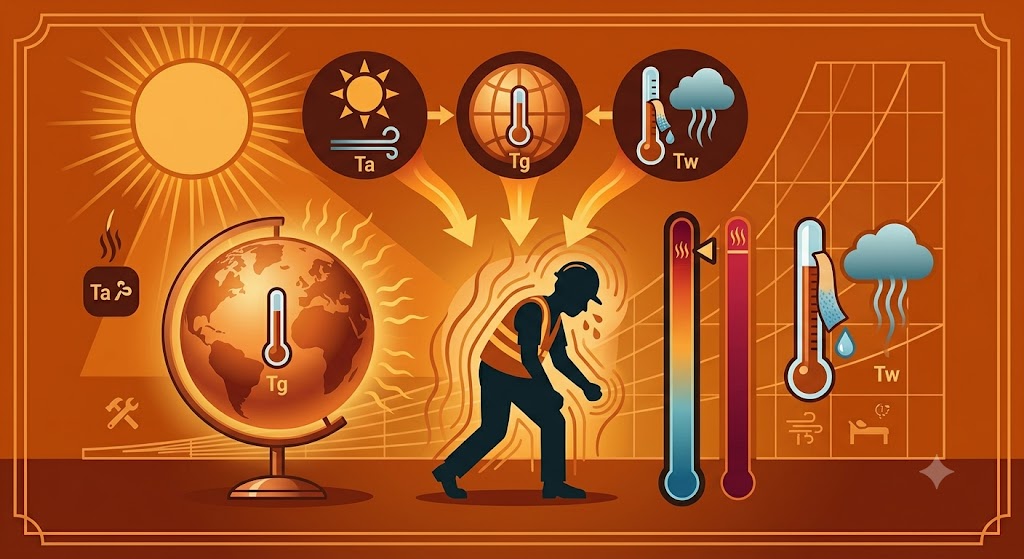
WBGT combines three separate temperature readings into a single composite value, each capturing a different environmental factor relevant to real heat stress.
Natural wet bulb temperature is measured using a thermometer with a wetted wick exposed to natural air movement, capturing the cooling effect of evaporation under actual ambient humidity and airflow conditions, directly relevant to how effectively a person's sweat can actually evaporate in that same environment.
Globe temperature is measured using a thermometer inside a blackened metal sphere, capturing the effect of radiant heat, direct sunlight or heat radiating from hot equipment and surfaces, that a simple air temperature reading doesn't account for at all, but that a person standing near a hot surface or in direct sun genuinely experiences.
Dry bulb temperature is the standard air temperature measurement most people are already familiar with, capturing straightforward ambient air temperature independent of humidity or radiant effects.
These three readings are combined using a weighted formula, with wet bulb temperature carrying the heaviest weight, reflecting how dominant humidity's effect on evaporative cooling actually is to overall heat stress risk, followed by globe temperature, with dry bulb temperature contributing the least weight of the three. This weighting itself reflects something genuinely important, that humidity and radiant heat both matter more to real heat stress risk than simple air temperature does on its own.
Why This Matters for Occupational Settings
WBGT is specifically used to assess heat stress risk for people performing physical work in hot environments, industrial facilities, outdoor construction, agricultural work, kitchens, and similar settings where workers are exerting real physical effort while exposed to heat, rather than simply occupying a conditioned space.
Recommended work and rest cycles, hydration guidance, and activity limitations are commonly established based on WBGT readings combined with the actual physical intensity of the work being performed, since a given WBGT reading presents meaningfully different risk to someone performing light work versus someone performing heavy physical labor. This is a genuinely different application from comfort cooling design, which is typically concerned with maintaining a pleasant, low exertion environment rather than managing acute physiological risk during sustained physical exertion.
Why This Is Distinct From Comfort Cooling Psychrometrics
Comfort cooling design generally targets a fairly narrow, moderate range of temperature and humidity, conditions where a seated or lightly active person feels comfortable, and the psychrometric calculations behind comfort design, sensible and latent load, cooling coil selection, humidity control, are all oriented around maintaining that moderate, comfortable range reliably.
WBGT and occupational heat stress assessment operate at a genuinely different end of the psychrometric picture entirely, environments that are hot, sometimes extremely so, where the actual goal isn't comfort but preventing acute physiological harm to people performing real physical work in that environment. The underlying physics, evaporative cooling, humidity's effect on that evaporation, radiant heat's contribution beyond simple air temperature, are the same physics comfort cooling design relies on. But the application, the acceptable ranges, and the consequences of getting it wrong are genuinely different, which is exactly why WBGT exists as its own distinct measurement rather than simply extending comfort cooling metrics into hotter conditions.
The Practical Takeaway
WBGT exists because air temperature alone badly underrepresents real heat stress risk, missing both humidity's effect on evaporative cooling and radiant heat's direct contribution to how hot an environment actually feels to a person working in it. Understanding WBGT, and recognizing it as a genuinely distinct application of psychrometrics from comfort cooling design, matters for anyone working on industrial ventilation, outdoor work environments, or any setting where occupational heat exposure is a real, ongoing consideration rather than simply a matter of keeping a space pleasant to sit in.
EveryEng. For everyone in Engineering.