

Article details
In this article, we will learn what is enthalpy, along with the definition, meaning, equation, formula, units, and changes to understand the basic concept. Let’s explore.
What is Enthalpy? Definition & Meaning
Definition of Enthalpy
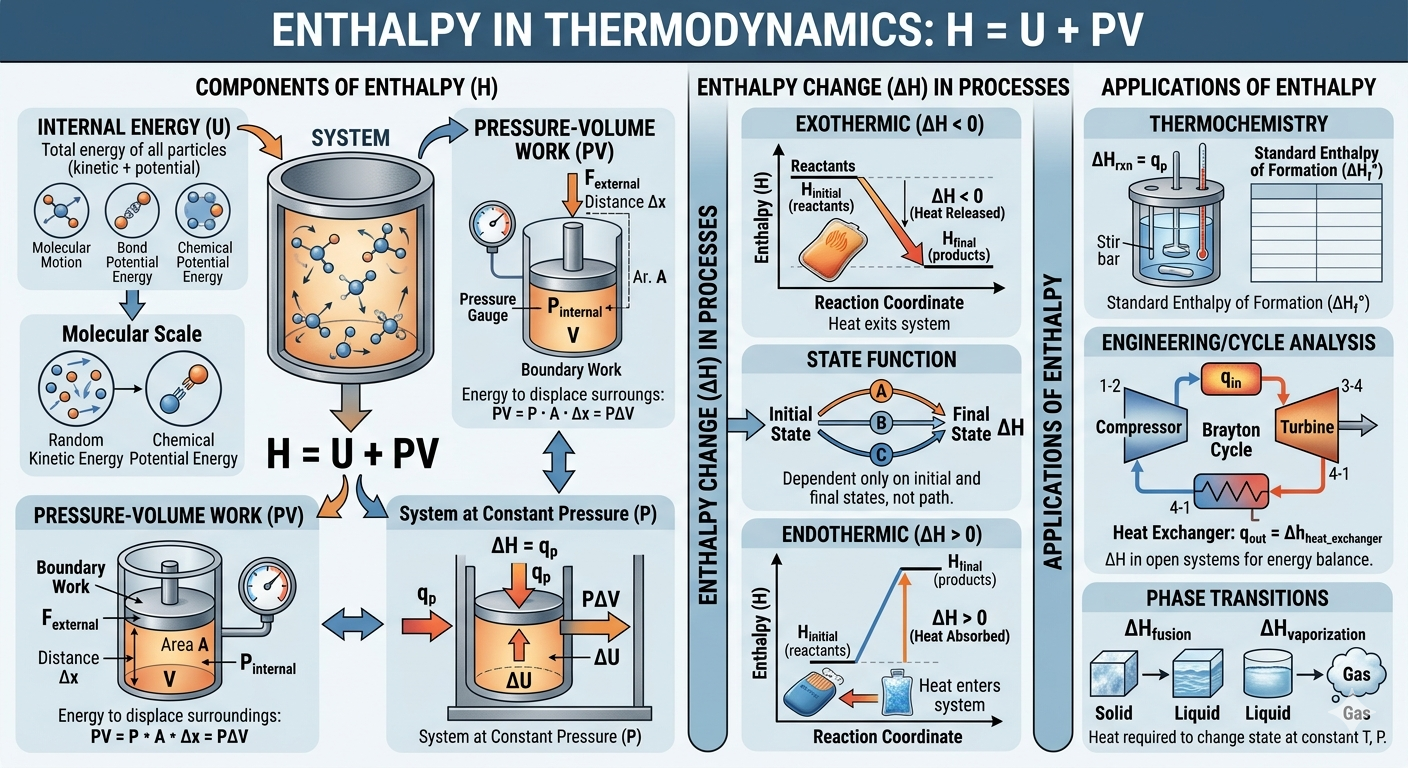
The sum of internal energy and the product of volume and pressure of a thermodynamic system is termed enthalpy. It is a point function (doesn’t depend on the path followed), that’s why enthalpy is a thermodynamic property of a system. In simple words, enthalpy represents the total heat content of the system. It is represented by H and specific enthalpy as h.
Rather than calculating enthalpy, change in enthalpy is calculated for a system because it is impossible to know the absolute zero point. Hence, the difference of enthalpy of the two states is measured under constant pressure conditions.
Meaning of Enthalpy
The quantity of internal energy and pressure–volume output of a thermodynamic system is referred to as enthalpy. It is characterized as an energy-like state function having energy dimensions.
As a state function, its value depends only on the initial and final states of the system. It is an extensive property, meaning it depends upon the mass.
- Measuring the enthalpy or heat of different chemical processes is related to the first law of thermodynamics, also known as the law of conservation of energy.
- All chemical processes are associated with a specific amount of enthalpy received by the system from the surroundings.
- For convenience, enthalpy change characterizes reactions occurring at constant pressure.
Equation or Formula & Units of Enthalpy
Enthalpy Units
According to the law of conservation of energy, the change in internal energy of a system is equal to the heat transferred to the system minus the work done by the system.
If the work performed is due to a change in volume at constant pressure, the change in enthalpy is equal to the heat transferred to the system. The SI unit of enthalpy is joule per mole (J/mol). Other units such as calorie and British Thermal Unit (BTU) are also used.
Equation or Formula of Enthalpy
The enthalpy equation is:
H = E + PV
Where enthalpy H is the sum of internal energy E and the product of pressure P and volume V.
Role of Enthalpy in Thermodynamic System
Enthalpy is a property unique to a thermodynamic system. Energy and enthalpy are closely related and play a crucial role in thermodynamics, which studies the relationship between heat and other forms of energy.
The first law of thermodynamics for a closed system is expressed as:
ΔU = Q – W
- U = total energy of the system
- Q = heat
- W = work done
For pressure–volume work:
ΔU = Q – PΔV
Enthalpy for Chemical Reactions
The enthalpy change for a chemical reaction is given by:
ΔH = ΣpHp − ΣrHr
If ΔH is negative, the reaction is exothermic. If ΔH is positive, the reaction is endothermic.
| CH4(g) + 2O2(g) → CO2(g) + 2H2O(l) | ΔH = −890 kJ/mol (Exothermic) |
| H2(g) + I2(g) → 2HI(g) | ΔH = +52.2 kJ/mol (Endothermic) |
Enthalpy Changes
Enthalpy change (ΔH) is the heat absorbed or released during a reaction at constant pressure. At constant pressure:
- ΔH = ΔU + PΔV
- ΔH = qP
Types of Enthalpy Change
Heat of Formation
The heat of formation (ΔHf) is the enthalpy change when one mole of a compound is formed from its elements.
Fe(s) + S(s) → FeS(s), ΔHf = −24.0 kcal
Heat of Combustion
The heat of combustion (ΔHc) is the enthalpy change when one mole of a substance burns completely in oxygen.
CH4(g) + 2O2(g) → CO2(g) + 2H2O(l), ΔHc = −21.0 kcal
Heat of Neutralization
This is the enthalpy change when an acid and a base react in dilute solution.
HNO3(aq) + NaOH(aq) → NaNO3(aq) + H2O(l), ΔH = −13.69 kcal
Heat of Solution
The enthalpy change when one mole of a substance dissolves in a solvent.
MgSO4(s) + H2O(l) → MgSO4(aq), ΔH = −20.28 kcal
Heat of Transition
The enthalpy change when one mole of an element changes from one allotropic form to another.
Latent Heat of Vaporization
The heat required to convert one mole of liquid into vapor at its boiling point under atmospheric pressure.
Molar Heat of Sublimation
The enthalpy change when one mole of a solid changes directly into vapor.
I2(s) → I2(v), ΔH = +62.42 kJ
Hess’s Law
Statement
The total enthalpy change of a reaction is independent of the path taken.
Explanation
Whether a reaction occurs in one step or multiple steps, the overall enthalpy change remains the same.
Importance of Enthalpy
- Helps determine whether reactions are exothermic or endothermic.
- Used to calculate heat of reaction.
- Commonly applied for processes occurring at constant pressure.
Applications
- Thermal engineering calculations
- Compressor power estimation
- Calorimetry and heat flow measurement
- Refrigeration and heat pumps
- Calorific value of fuels and food
Conclusion
Enthalpy is the sum of internal energy and pressure–volume work of a system. Represented by H, it is a fundamental thermodynamic property widely used in engineering and chemistry.


 Oct 2, 2026