

Article details
The same economizer control strategy can save a building real money in one city and quietly make it less comfortable and less efficient in another. Nothing about the equipment changes. What changes is the air outside, and specifically how much moisture and heat that air carries at the moments the control logic decides it is "cool enough" to use. That is why building energy standards do not treat the choice of economizer control as a matter of taste, and why the climate zone a building sits in shapes which strategies are even allowed.
What the Control Is Actually Protecting Against
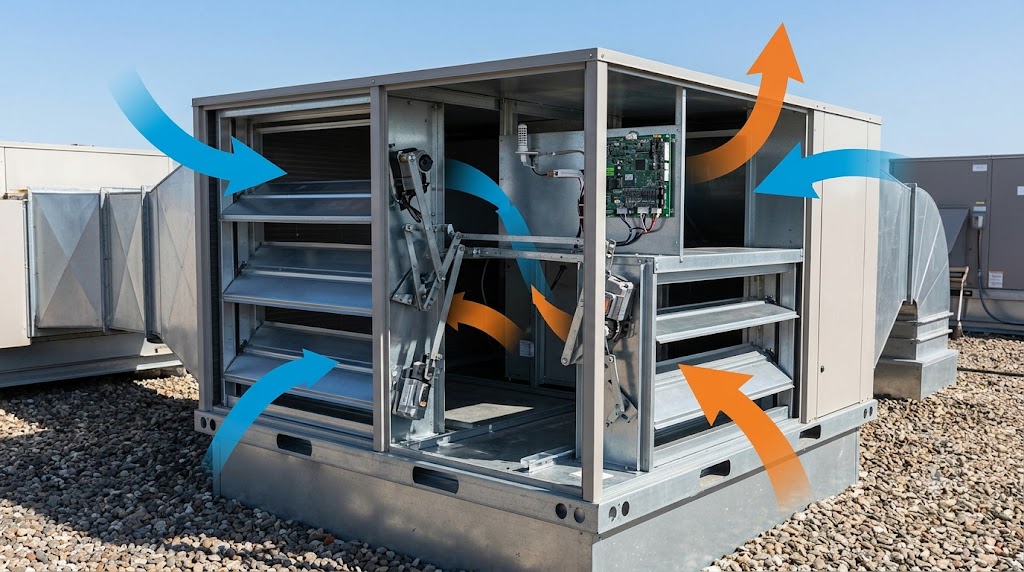
An economizer brings in extra outdoor air to cool a building for free. The control that decides when to stop doing this, known as the high limit shutoff, exists to prevent one specific mistake: continuing to bring in outdoor air after it has stopped helping and started adding to the cooling load.
Outdoor air stops helping for two different reasons. It can be too warm, adding sensible heat the building then has to remove. Or it can carry too much moisture, adding latent load the cooling coil has to condense out. A control strategy that only watches for one of these will be fooled by the other, and which one shows up more often depends entirely on the climate.
Why Temperature Alone Misleads in Humid Climates
A fixed dry bulb strategy looks only at outdoor temperature. In a dry climate, that is usually a perfectly good proxy, because cool outdoor air is also dry outdoor air, and bringing it in carries very little moisture burden.
In a humid climate, the proxy breaks down. Outdoor air at a comfortable looking temperature can still hold a large amount of moisture, which means a large amount of total heat. A temperature only control sees a number below its setpoint and allows the economizer to operate, while the cooling coil quietly absorbs a heavy latent load it would not have faced otherwise.
The consequence goes beyond wasted energy. Industry analysis of economizer limits has pointed out that some permitted high limit methods can allow space humidity to drift above the design level, which for many comfort applications sits somewhere between fifty and sixty percent relative humidity. A strategy that technically keeps the space at its temperature setpoint can still leave it damp, which connects directly to the sensible versus latent heat distinction covered elsewhere in this library. This is the core reason humid climates call for strategies that account for moisture, whether through enthalpy based control or a combination of dew point and dry bulb limits.
Why Enthalpy Control Can Misfire in the Opposite Climates
It would be tempting to conclude that enthalpy based control is simply the better answer everywhere, since it captures both temperature and moisture in one number. It is not, and the reason is instructive.
A fixed enthalpy limit compares outdoor air's total heat content to a single cutoff value. In a dry, marine, or very cold climate, outdoor air can be quite warm and still carry very little moisture, which keeps its total heat content below the cutoff. The control then reads that air as acceptable, even though air that warm is not actually helping a building that wants cool supply air. The strategy that solves the humid climate problem can create a warm air problem in a dry one.
This is why many climate based requirements pair or substitute strategies by zone rather than naming one universal winner. Dry bulb limits, which handle the hot but dry case correctly, are generally the better fit for drier and colder zones. Humidity aware strategies are the safer choice where moisture is the dominant risk.
Elevation Quietly Matters Too
Climate zone is not the only location variable. Standard enthalpy cutoffs are written around conditions near sea level, and the standard itself adjusts the fixed enthalpy limit for sites at substantially different elevations, since thinner air changes the relationship between temperature, moisture, and total heat content. A frequently cited example adjusts the cutoff to roughly thirty and a half Btu per pound at around six thousand feet, compared with twenty eight at lower elevations. A control copied from a sea level project to a high altitude one, without this adjustment, is working from the wrong threshold.
How Standards Encode This
Energy standards handle this by including tables that list which high limit control types are allowed or prohibited in each climate zone, along with the required settings for each type. Two details are worth knowing.
First, the list of permitted strategies has not stayed constant between editions. Newer editions of the standard narrowed the options compared with older ones, and the exemptions that once excused many warm, humid zones from needing an economizer at all have also been tightened over time.
Second, local codes can be stricter than the national standard. Some jurisdictions restrict enthalpy based strategies entirely in their compliance guidance, which is a reminder that the right reference is always the edition and amendments actually adopted where the building sits, not a general rule of thumb carried from a previous project.
The Case for Simplicity
Choosing the most sophisticated strategy is not automatically the right call either. Analysis comparing options has found that, in suitable climates, a fixed dry bulb limit set sensibly can capture energy savings close to those of a differential enthalpy strategy, while costing less to install and being easier to maintain. A differential enthalpy setup needs two humidity sensitive sensors, and as noted in the first article of this series, sensors that drift or fail can turn a theoretically superior strategy into a worse one in practice.
A Practical Way to Choose
Rather than starting with a favorite strategy, start with the climate and ask three questions. How many hours of the year does outdoor air fall in the temperature range where economizing would normally be allowed, and how humid is it during those hours? How often is outdoor air warm but dry enough to fool a moisture only limit? And is the added accuracy of a more complex strategy worth the sensors, calibration, and maintenance it brings in this specific location? A psychrometric look at the building's design condition against the local weather is what turns these questions into a defensible choice.
The Practical Takeaway
Economizer control type depends on climate zone because the two ways outdoor air can fail to help, too much heat or too much moisture, show up in very different proportions in different places. Temperature only strategies work well where cool air is dry air and fail where it is not. Enthalpy based strategies fix that problem and can introduce a different one in dry, warm conditions. The right choice comes from matching the strategy to the failure mode that actually dominates locally, then confirming it against the code edition adopted for that site.
EveryEng. For everyone in Engineering.