


Article details
Most dehumidification in HVAC happens as a byproduct of cooling, air passes over a cold coil, moisture condenses out, and the system moves on. This works well across a wide range of conditions, which is exactly why it's the default approach in most comfort cooling applications. But this same mechanism has a real, physical limit, and understanding that limit is what explains why desiccant systems exist at all, rather than simply being a more complicated alternative to something refrigeration already does well.
How Refrigeration-Based Dehumidification Actually Works
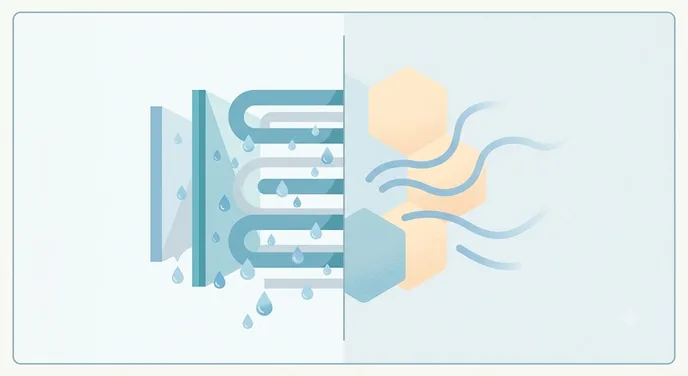
A refrigeration-based dehumidifier, whether it's a direct expansion coil, a chilled water coil, a glycol cooled coil, or the indoor coil in a VRF system, all rely on the same underlying principle, cooling air below its dew point, the temperature at which the air's moisture content begins condensing into liquid water on the coil surface. Moisture leaves the air stream as condensate, and the air that continues past the coil is both cooler and drier than it was going in.
This approach is genuinely effective under one important condition, that there's enough moisture actually present in the air, at a high enough concentration, to condense meaningfully once the air is cooled below its dew point.
Why This Breaks Down at Low Relative Humidity
Here's the physical limit that matters. As relative humidity drops, the air simply contains less moisture in absolute terms, even at the same dry bulb temperature, and that lower moisture content becomes progressively harder to condense out efficiently, because the dew point itself drops correspondingly lower. To pull meaningful additional moisture out of already dry air, a refrigeration-based system has to cool that air to an increasingly low temperature, closer to and eventually approaching the coil's own operating temperature limits, before condensation becomes significant enough to matter.
This creates a genuinely inefficient situation. The system ends up expending real cooling capacity and energy chasing a small, diminishing amount of moisture removal, often over cooling the air far below what's actually needed for comfort or process temperature control, purely to extract the last portion of moisture the space's process actually requires removed. In many low humidity applications, this over cooling then requires a separate reheat step to bring the air back up to an acceptable supply temperature, adding yet another real energy cost on top of the inefficient cooling that was already happening.
Why Desiccants Don't Share This Limitation
A desiccant works through an entirely different mechanism, adsorption, a hygroscopic material's molecular attraction directly to water vapor, rather than depending on cooling air below its dew point at all. This means a desiccant's ability to remove moisture doesn't fundamentally depend on how much moisture is present in the same way refrigeration based condensation does, a well designed desiccant system can continue pulling moisture out of already quite dry air effectively, without needing to drive air temperature down toward an increasingly extreme, energy intensive limit to do it.
This is the real answer to why desiccant systems exist alongside refrigeration based dehumidification rather than simply replacing it everywhere, they solve a problem refrigeration based systems are physically, fundamentally poor at solving, effective moisture removal at low relative humidity, precisely because their underlying mechanism doesn't depend on the same dew point driven condensation limit at all.
Where This Distinction Actually Matters in Practice
This isn't a purely theoretical distinction. It shows up directly in which applications favor which technology.
Process environments with genuinely low target humidity, pharmaceutical manufacturing, certain electronics assembly, specific food and beverage processes, often require humidity levels that would demand extremely low, energy intensive over cooling if pursued through refrigeration-based dehumidification alone, exactly the kind of requirement desiccant systems handle far more efficiently.
Cold storage and refrigerated environments present a related challenge, since introducing outdoor air or managing infiltration moisture at already low space temperatures leaves very little dew point margin for refrigeration-based dehumidification to work with efficiently, another genuine desiccant strength.
Applications where the latent load genuinely exceeds the sensible cooling requirement are a recurring theme in desiccant system literature specifically because this mismatch is exactly where refrigeration based systems, which remove moisture as an inherent byproduct of cooling rather than as an independently controllable function, run into trouble, they simply can't remove more moisture than their cooling capacity happens to produce as a side effect, without introducing the over cooling and reheat penalty already covered.
Comfort cooling in moderate climates, by contrast, is exactly where refrigeration-based dehumidification continues to make the most sense, since moisture levels typically stay high enough that condensation-based moisture removal happens efficiently as a natural byproduct of cooling that the space needs anyway, without requiring any specialized desiccant equipment at all.
Why This Isn't Simply "Desiccants Are Better"
None of this means desiccant systems are a universally superior choice. Desiccant systems introduce their own real costs and complexity, a genuine energy requirement to regenerate the desiccant material itself, additional equipment, and generally higher first cost and more complex control compared to a straightforward cooling coil already present in most systems. As covered in total cost of ownership for HVAC equipment, the right technology choice depends on genuinely comparing the actual cost, energy and otherwise, of each approach for the specific application's actual humidity and cooling requirements, not defaulting to either technology out of habit.
The genuinely useful takeaway is narrower and more specific than "desiccants are better," it's that refrigeration-based dehumidification has a real, physical performance ceiling at low relative humidity, and recognizing where an application's actual requirements cross that ceiling is what should drive the decision to consider a desiccant based approach, rather than treating dehumidification technology selection as an arbitrary preference.
The Practical Takeaway
Refrigeration based dehumidification works by cooling air below its dew point, a mechanism that becomes progressively less efficient as relative humidity drops and there's simply less moisture available to condense out without extreme, energy intensive over cooling. Desiccant systems sidestep this limitation entirely through adsorption rather than condensation, which is exactly why they show up specifically in low humidity process environments, cold storage, and high latent load applications, situations where refrigeration-based dehumidification's fundamental mechanism genuinely stops being the efficient answer.
EveryEng. For everyone in Engineering.