

Article details
Introduction
The cross-sectional area of an electrical wire is an important factor in electrical system design. It determines how much current a conductor can carry safely and influences voltage drop, electrical resistance, heat generation, and overall system performance. Selecting the correct wire size is essential for residential wiring, industrial installations, electrical panels, motor connections, and power distribution systems.
An undersized wire may overheat, cause excessive voltage drop, damage connected equipment, or create a fire hazard. On the other hand, choosing a wire that is unnecessarily large can increase installation costs and make cable routing more difficult.
Understanding how to calculate wire cross-sectional area helps engineers, electricians, technicians, and students select suitable conductors for different electrical applications.
What Is Wire Cross-Sectional Area?
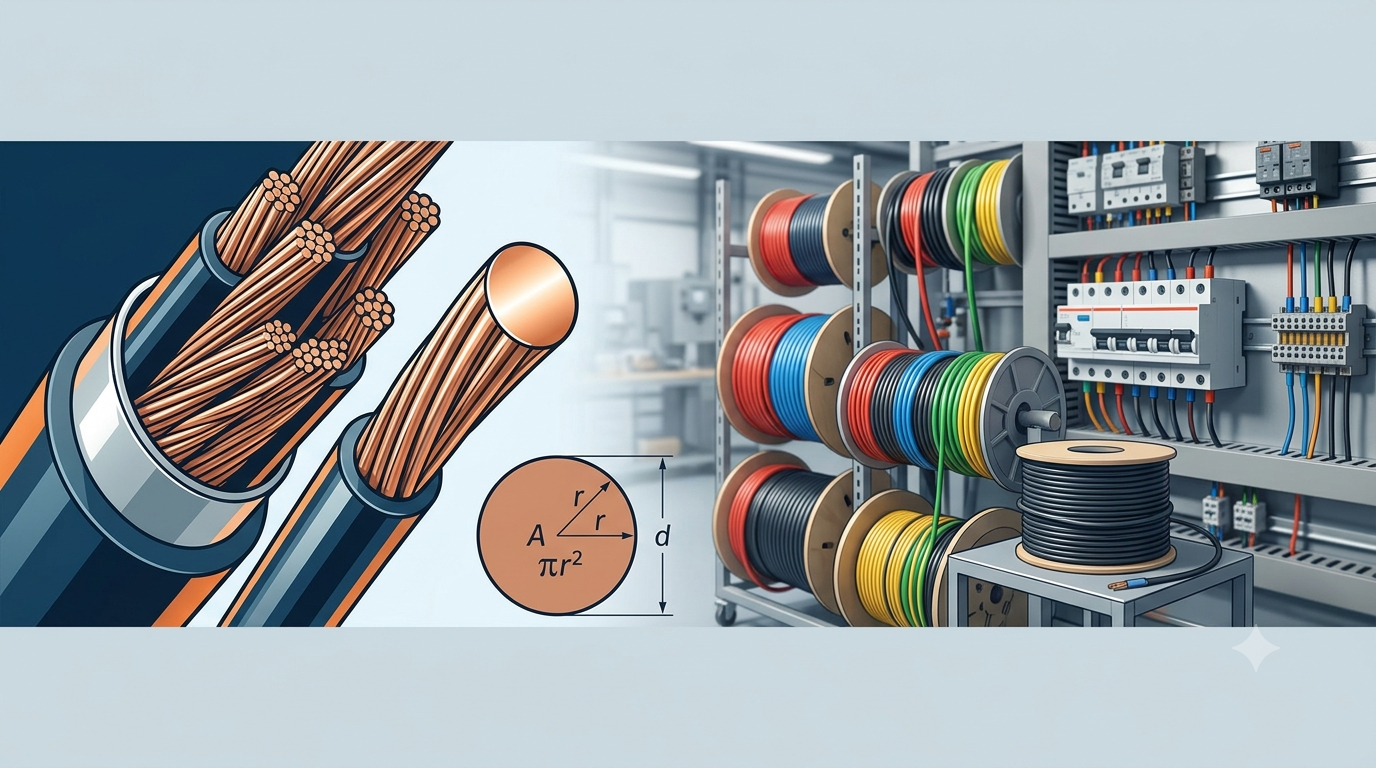
Wire cross-sectional area is the area of the conductor measured perpendicular to its length. It represents the amount of conductive material available to carry electrical current.
The cross-sectional area is generally expressed in square millimetres (mm²) for electrical cables. In some countries and applications, wire size is also specified using the American Wire Gauge (AWG) system.
A larger cross-sectional area generally means lower electrical resistance and a greater potential current-carrying capacity, provided that other conditions remain the same.
Wire cross-sectional area should not be confused with the external diameter of a cable. The outer diameter includes insulation and protective layers, whereas the cross-sectional area used for electrical calculations refers to the conductive material.
Formula for Calculating Wire Cross-Sectional Area
For a solid, circular conductor, the cross-sectional area can be calculated using the following formula:
[
A=\frac{\pi d^2}{4}
]
Where:
(A) = cross-sectional area of the conductor
(d) = conductor diameter
(\pi) = mathematical constant, approximately 3.1416
The diameter must be measured in millimetres to obtain the area in square millimetres.
Example of Wire Area Calculation
Consider a solid copper wire with a conductor diameter of 2 mm.
Using the formula:
[
A=\frac{\pi\times 2^2}{4}
]
[
A=\frac{3.1416\times4}{4}
]
[
A\approx3.14\text{ mm}^2
]
Therefore, the conductor has a cross-sectional area of approximately 3.14 mm².
This calculation determines the geometric area of the conductor. It does not, by itself, establish the safe current rating of the wire.
Calculating the Diameter from Cross-Sectional Area
Sometimes, the required cross-sectional area is known, but the conductor diameter needs to be determined. The formula can be rearranged as follows:
[
d=\sqrt{\frac{4A}{\pi}}
]
For example, if a solid conductor has a cross-sectional area of 6 mm²:
[
d=\sqrt{\frac{4\times6}{3.1416}}
]
[
d\approx2.76\text{ mm}
]
The calculated diameter is approximately 2.76 mm. This result applies to a solid circular conductor and does not represent the overall diameter of an insulated cable.
Cross-Sectional Area of Stranded Wires
Many electrical cables contain several smaller wires twisted or grouped together to form a flexible conductor. These are known as stranded wires.
For a stranded conductor made of circular strands of equal diameter, the total metallic cross-sectional area can be calculated by multiplying the area of one strand by the number of strands.
[
A_{\text{total}}=n\times\frac{\pi d^2}{4}
]
Where:
(A_{\text{total}}) = total metallic cross-sectional area
(n) = number of strands
(d) = diameter of each strand
For example, a conductor containing 19 strands, each with a diameter of 0.5 mm, has a total geometric area of:
[
A_{\text{total}}=19\times\frac{\pi\times0.5^2}{4}
]
[
A_{\text{total}}\approx3.73\text{ mm}^2
]
In practical applications, the manufacturer's specified nominal conductor area should be used whenever available because strand dimensions, construction tolerances, and conductor standards can affect the final specification.
Why Wire Cross-Sectional Area Matters
1. Current-Carrying Capacity
The cross-sectional area affects how much electrical current a conductor can carry without exceeding its permitted temperature. Larger conductors generally have greater current-carrying capacity.
However, the allowable current also depends on the conductor material, insulation temperature rating, ambient temperature, installation method, cable grouping, and applicable electrical standards.
2. Electrical Resistance
A wire's resistance depends on its length, material, temperature, and cross-sectional area. For a uniform conductor, resistance can be estimated using:
[
R=\rho\frac{L}{A}
]
Where:
(R) = electrical resistance in ohms
(\rho) = resistivity of the conductor material
(L) = conductor length
(A) = cross-sectional area
For the same material and length, increasing the cross-sectional area reduces electrical resistance.
Lower resistance can reduce energy losses and heat generation during operation.
3. Voltage Drop
When current flows through a conductor, a voltage drop occurs because of its electrical resistance and, in some circuits, reactance.
A cable with an insufficient cross-sectional area may produce excessive voltage drop, particularly over long distances or in high-current applications. This can affect the performance of motors, lighting systems, control equipment, and other electrical loads.
4. Electrical Safety
Correct conductor sizing helps prevent overheating and supports safe operation. The selected cable must work with suitable overcurrent protection, insulation, terminals, and installation conditions.
A larger wire alone does not guarantee a safe installation if the circuit protection or termination system is unsuitable.
Factors to Consider When Selecting a Wire Size
Choosing the correct cross-sectional area requires more than measuring a wire's diameter. Several electrical and installation factors must be considered.
Operating current: Determine the expected continuous and starting current, especially for motors and other inductive loads.
Cable length: Longer conductors generally produce greater resistance and voltage drop. Long cable runs may require a larger cross-sectional area.
Conductor material: Copper and aluminium have different electrical resistivities. Aluminium conductors generally require a larger area than copper conductors for comparable resistance under similar conditions.
Installation environment: Ambient temperature, enclosure conditions, cable grouping, and installation methods influence the permissible current rating.
Insulation and temperature rating: The insulation material determines the permitted operating temperature and must be compatible with the installation.
Applicable standards: Cable selection should comply with relevant electrical codes, local regulations, manufacturer specifications, and project requirements.
Mechanical requirements: Flexibility, vibration, bending radius, terminal compatibility, and physical protection can also influence cable selection.
How to Select the Correct Cable Cross-Sectional Area
The following steps provide a practical approach to cable sizing for electrical installations.
Step 1: Determine the Load Current
Calculate or identify the current required by the connected equipment. For a single-phase load, current can be estimated using the electrical power, supply voltage, and power factor where applicable.
For a three-phase load, the relationship between power, voltage, current, and power factor must also be considered.
Step 2: Check the Current-Carrying Capacity
Refer to approved cable-sizing tables or manufacturer specifications to identify a conductor size capable of carrying the required current under the actual installation conditions.
Step 3: Calculate the Voltage Drop
Check whether the selected cable maintains the voltage drop within the limits permitted by the applicable electrical standard or project specification. Increase the conductor size if necessary.
Step 4: Verify the Installation Conditions
Account for temperature, cable grouping, installation method, insulation rating, and other correction factors that may reduce the allowable current.
Step 5: Confirm Protection and Compatibility
Verify that the conductor is compatible with the circuit protection, terminals, equipment connections, and relevant electrical requirements before installation.
Common Mistakes in Wire Area Calculation
Several mistakes can lead to incorrect cable selection.
Measuring the insulated cable diameter: Only the conductive portion is used to calculate conductor cross-sectional area.
Confusing diameter with area: The area increases with the square of the diameter, not in direct proportion to it.
Ignoring voltage drop: A wire may carry the required current but still produce excessive voltage drop over a long distance.
Overlooking installation conditions: Ambient temperature and cable grouping can significantly affect current-carrying capacity.
Using the wrong units: Ensure that diameter is expressed in millimetres when calculating area in mm².
Relying only on the geometric calculation: The area formula does not replace electrical cable-sizing calculations or code requirements.
Applications of Wire Cross-Sectional Area Calculations
Wire area calculations are useful in several engineering fields.
Industrial electrical systems: Selecting conductors for motors, pumps, compressors, and production machinery.
Building installations: Sizing cables for lighting, socket outlets, distribution boards, and other electrical loads.
Power distribution: Evaluating conductors used in feeders, control panels, and electrical distribution networks.
Renewable energy systems: Selecting suitable cables for solar installations, battery connections, and associated power equipment.
Electrical equipment design: Determining suitable conductor dimensions for control circuits, wiring harnesses, and machine connections.
These applications require consideration of the complete electrical design, including load characteristics, protection, and operating conditions.
