Skip to main contentEngineering Courses, Mentoring & Jobs | EveryEng
8D Problem Solving banner
Live Online Class Beginner

8D Problem Solving

4(14)
182 views
$ 150
18 hrs
Next month
English
182 views

Enggenious (SAN Techno Mentors)
  • 7-day money-back guarantee
  • Session recordings included
  • Foundational Learning
  • Access to Study Materials

Why enroll

Upon completion of this course the participant will be able to:

⚫ Accumulate, organize the data and analyze for identifying the problem and getting the solution to the problem.

⚫ Improvise productivity and efficiency.

⚫ Excel the knowledge towards Lean tools used in Quality Management.

⚫ Empower with few Statistical Theories and techniques.

⚫ Streamline the work procedures.

Is this course for you?

You should take this if

  • You work in Manufacturing & Industrial or Automotive
  • You're a Quality & Management Standards / Industrial Engineering professional
  • You want to build skills in Drawing, Electrical Maintenance
  • You prefer live, instructor-led training with Q&A

You should skip if

  • You need a different specialisation outside Quality & Management Standards
  • You need fully self-paced, on-demand content

Course details

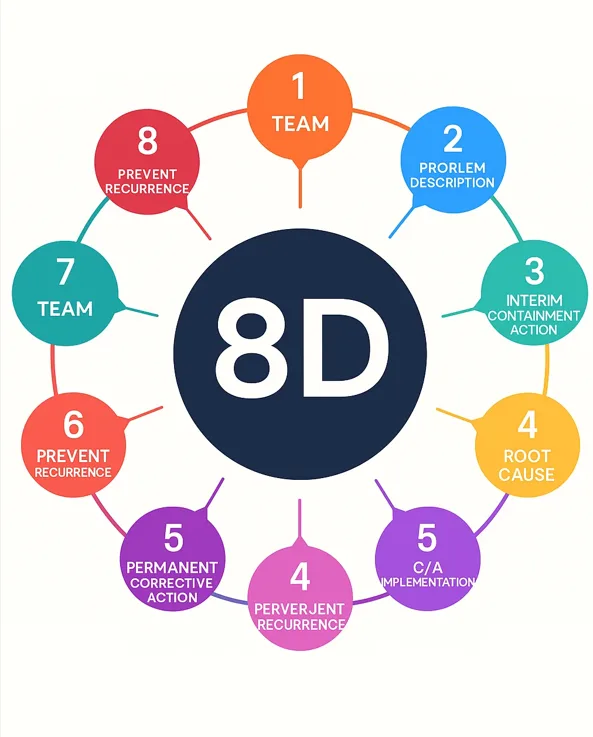
8D problem solving methodology; originated at Ford; involves 8 hierarchy stages (Disciplines)

It starts with establishing the team and ends with rewarding the success.

(8D- disciplines) is a method used to approach and to resolve problems, typically faced by quality engineers or other professionals. Its purpose is to identify, correct and eliminate recurring problems, and it is useful in product and process improvement. It establishes a permanent corrective action based on statistical analysis of the problem and focuses on the origin of the problem by determining its root causes.

Course suitable for

Key topics covered

• Recognize the problem- Structure of problem, Classification of problem, Symptoms.

• Tools to learn- Kano model, Trend chart, Check sheet, Histogram

• Team formation- Team Organization and Roles. Characteristics, Team roles,

• Tools and concepts to learn- Employee enrichment, Autonomous Maintenance, TPM

• Describe the Problem- Problem statement, Visual presentation, Making the Project Charter

• Tools to learn- 4 W and 1 H, VSM, Benchmarking,

• Containment action- Short term or first aid treatments

• Tools to learn- Brain storming, NGT, Expert analysis

• Identify potential causes- Cause and Effect diagram

• Verify Corrective Action- Affinity diagram, Scatter diagram, Correlation analysis

• Implement Permanent Corrective Action- Kaizen, 5 S, Poka Yoke

• Prevent Recurrence- Control the process

• Tools to learn and revise- Control charts, trend charts, And-on boards, Visual factory

• Congratulate Your Team-Felicitation, KT (Knowledge Transfer), Rewards

• Interactive discussions, Case problems and Games.

Opportunities that await you!

Career opportunities

Training details

This is a live course that has a scheduled start date.

Why people choose EveryEng

Industry-aligned courses, expert training, hands-on learning, recognized certifications, and job opportunities-all in a flexible and supportive environment.

$150

$0 Early bird

Coming in Next Month

Questions and Answers

A: A feels conservative but it's targeted containment: you protect the customer and preserve evidence while D5 is still open. B looks tidy from a documentation mindset, but it bakes an unapproved change into the system and erases the signal you're trying to study. C is a classic first-instinct move; it quiets scrap today while driving thread yield and joint fatigue tomorrow. D sounds safety-first, yet 8D containment isn't a production shutdown unless there's an immediate hazard; here it just burns launch without learning.

A: A catches the documentation break: D2 must tie to a controlled characteristic. B sounds like something you've heard on the shop floor, but MMC bonus doesn't create a flatness requirement. C is tempting when you're annoyed with paperwork, yet the GA is still a contractual reference here. D mixes functional thinking with GD&T; they address different error modes and aren't swappable.

A: B follows the chain: one bad out of 5,000 is 0.02%, and sampling 10% gives a similar escape order. A flips the logic by treating sample rate as defect rate. C feels cynical but ignores basic probability. D shows real math effort yet invents a cycle basis that isn't stated, a common D3 mistake.

A: A removes human variability and closes the cause. B feels responsible but relies on memory and compliance. C improves detection, not prevention, so it's still containment. D reduces symptoms on paper while the physics stay the same, a DFMEA red flag.