
Preview this course
Self-paced Advanced
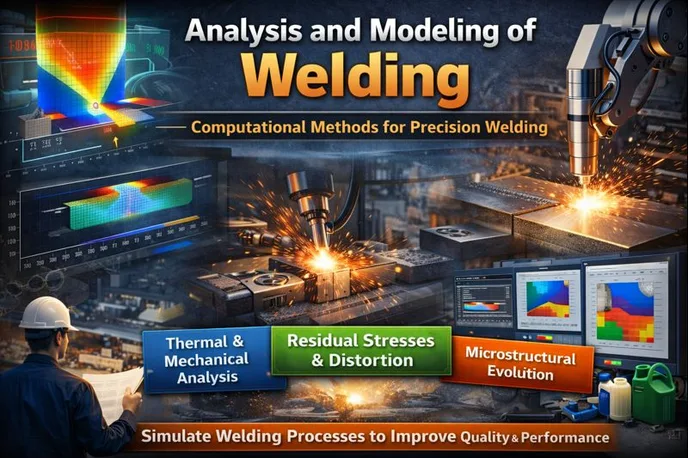
Analysis and Modeling of Welding
4(117)
220 views
FREE
726 min
Anytime
English
220 views
Engineering AcademyLearn Without Limits: Free Engineering Courses
- Lifetime access
- Anytime Learning
- Learn from Industry Expert
- Career Option Guideline
Why enroll
Is this course for you?
You should take this if
- You work in Manufacturing & Industrial
- You're a Manufacturing Engineering / Mechanical Engineering professional
- You have 3+ years of hands-on experience in this field
- You prefer self-paced learning you can revisit
You should skip if
- You're new to this field with no prior experience
- You need a different specialisation outside Manufacturing Engineering
- You need live interaction with an instructor
Course details
Course suitable for
Key topics covered
Course content
The course is readily available, allowing learners to start and complete it at their own pace.
20 lectures12 hr 6 min
- Introduction to fusion welding processes: part 1/232 min
- Introduction to fusion welding processes: part 2/231 min
- Heat sources part 1/230 min
- Heat sources part 2/240 min
- Heat removal29 min
- Thermal Modeling Part 1/243 min
- Thermal Modelling - Part 2/246 min
- Zones in a weldment42 min
- Analytical Solutions to Weld Thermal Field29 min
- Conduction to Keyhole mode27 min
- Fluid flow modelling - part 1/241 min
- Fluid flow modelling - part 2/237 min
- Solute transfer modelling - part 1/224 min
- Solute transfer modelling - part 2/237 min
- Solute segregation profile - part 1/225 min
- Solute segregation profile - part 2/221 min
- Microstructure Formation in Fusion Welds39 min
- Numerical Solutions to Thermal Field and Fluid Flow in Welding - Part 144 min
- Numerical Solutions to Thermal Field and Fluid Flow in Welding - Part 252 min
- Dissimilar Welding57 min
Opportunities that await you!
Career opportunities
Why people choose EveryEng
Industry-aligned courses, expert training, hands-on learning, recognized certifications, and job opportunities-all in a flexible and supportive environment.