Skip to main contentEngineering Courses, Mentoring & Jobs | EveryEng
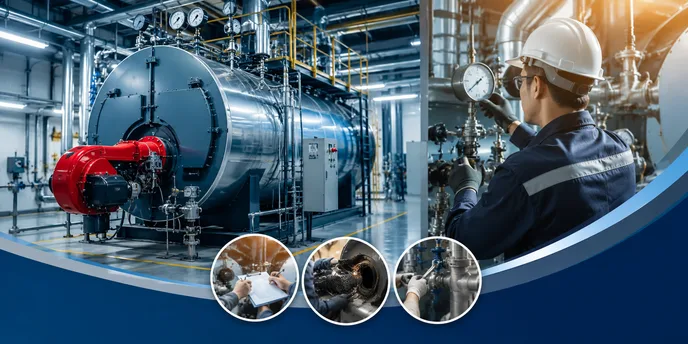
Boiler Operations and Maintenance banner

Boiler Operations and Maintenance

Boiler Operations and Maintenance banner
Live online Intermediate

Boiler Operations and Maintenance

4(14)
27 views
₹ 16000
10 hrs
Next month
English
27 views
Enggenious (SAN Techno Mentors)
  • 7-day money-back guarantee
  • Session recordings included
  • Certificate of completion

Why enroll

Participants join this course to develop practical skills in safe, efficient boiler operation, inspection, maintenance, and troubleshooting. It helps them improve equipment reliability, reduce downtime, enhance energy efficiency, and strengthen their technical knowledge for better career opportunities.

Is this course for you?

You should take this if

  • You work in Energy & Utilities
  • You're a Power Plant Engineering professional
  • You have some foundational knowledge in the subject
  • You prefer live, instructor-led training with Q&A

You should skip if

  • You're looking for an introductory overview course
  • You need a different specialisation outside Power Plant Engineering
  • You need fully self-paced, on-demand content

Course details

This course provides practical knowledge of boiler operations, monitoring, control, and maintenance in industrial and power generation environments. It explains the basic working principles of boilers, major components, and different boiler systems used in industry. Participants learn safe boiler start-up, shutdown, operation, and load management procedures. The course covers combustion systems, fuel handling, steam generation, water treatment, and boiler feedwater systems. It focuses on monitoring important parameters such as pressure, temperature, water level, steam flow, and efficiency. Participants gain an understanding of routine inspection, preventive maintenance, troubleshooting, and performance improvement techniques. The course also covers boiler safety systems, alarms, interlocks, pressure relief devices, and emergency operating procedures. Common boiler problems such as scaling, corrosion, leakage, tube failure, and poor combustion are discussed. Practical maintenance practices help participants improve boiler reliability, efficiency, and equipment life. The course supports engineers, operators, and maintenance professionals in achieving safe, efficient, and reliable boiler operation.

Course suitable for

Key topics covered

  • Boiler Fundamentals and Types

  • Boiler Components and Working Principles

  • Boiler Start-up and Shutdown Procedures

  • Boiler Operation and Load Management

  • Combustion and Fuel Management

  • Boiler Feedwater and Water Treatment

  • Steam Generation and Distribution

  • Boiler Performance and Efficiency Monitoring

  • Preventive and Predictive Maintenance

  • Boiler Inspection and Troubleshooting

  • Corrosion, Scaling, and Tube Failure

  • Boiler Safety Systems, Alarms, and Interlocks

  • Emergency Operating Procedures

  • Energy Efficiency and Performance Improvement

Opportunities that await you!

Career opportunities

Training details

This is a live course that has a scheduled start date.

Why people choose EveryEng

Industry-aligned courses, expert training, hands-on learning, recognized certifications, and job opportunities-all in a flexible and supportive environment.

What learners say about this course

Ved Naik
Ved Naik Engineering
May 3, 2026

This mapped pretty closely to the kind of PRs I’m skimming between standups, just framed around physical equipment instead of code. The intermediate level felt right; it assumes you know the basics and jumps into how maintenance decisions play out in prod-like conditions. The bit that stuck was the section on condition-based maintenance, specifically the example where a bearing’s vibration trend crosses the alert threshold but temp stays flat, and how they decide not to intervene yet. some of the early safety refreshers were a bit slow if you’ve worked around equipment before. Still, tying failure modes back to monitoring and obs habits made it easy to relate to infra work and energy utilities contexts. I wasn’t sold on the checklist format in Chapter 2, but the later edge cases around false positives and deferred fixes are where it separates itself.

ANU VARGHESE
ANU VARGHESE Fresher
Feb 25, 2026

Initially, I wasn’t sure what to expect from this course. The material stayed fairly grounded, especially when walking through open-loop versus closed-loop control beyond the textbook definitions. Examples tied well to things seen in chemical and pharmaceutical plants, like temperature control on a batch reactor and level control on a distillation column, rather than abstract blocks alone. There was also enough overlap with oil & gas and energy utilities to be useful, such as discussing pressure control on separators and basic boiler control logic. One challenge was mentally translating the simplified examples to real systems with dead time, sensor drift, and valve stiction. That gap is where junior engineers usually struggle, and it would have helped to explicitly call out those edge cases earlier. Still, the discussion on why open-loop control occasionally makes sense (maintenance modes, analyzer-based control) matched actual industry practice better than most courses. A practical takeaway was being more systematic about identifying the true process variable and disturbance before defaulting to a PID loop. Thinking at the system level—how one loop affects upstream and downstream units—was reinforced throughout. The content felt aligned with practical engineering demands.

Tarun Kumar Rajak
Tarun Kumar Rajak Piping Engineer
Feb 25, 2026

This course turned out to be more technical than I anticipated. The treatment of open- and closed-loop control went beyond block diagrams and actually tied into situations seen in chemical and oil & gas facilities. Examples around distillation column temperature control and refinery feed flow control felt familiar, especially when discussing interactions between loops rather than treating them in isolation. One challenge was translating the clean theoretical models into messy plant realities. Dead time, sensor drift, and valve stiction were touched on, but it still took effort to mentally map those concepts to something like boiler drum level control in energy utilities, where safety margins dominate tuning decisions. That gap is real in industry, and it showed up here. What worked well was the emphasis on understanding process behavior before jumping to controllers. A practical takeaway was the reminder to question whether a loop even needs to be closed, particularly for slow-moving pharmaceutical batch processes where manual intervention can be more robust. Compared with common industry practices, the course leaned more analytical than procedural, which is useful for system-level thinking. The content felt aligned with practical engineering demands.

Nupurkumar Prajapati
Nupurkumar Prajapati supervisor
Feb 25, 2026

This course turned out to be more technical than I anticipated. The coverage of open-loop versus closed-loop control was straightforward, but the real value came from how those ideas were tied to actual industrial examples. The sections on PID control and feedback loops lined up well with issues seen on chemical and pharmaceutical projects, especially around reactor temperature control and maintaining consistent product quality. Examples around distillation column control also felt familiar from oil and gas work, where small tuning errors can ripple through the whole unit. One challenge was mentally translating the clean block diagrams into what actually happens in a live DCS environment, with noisy signals and slow valves. The course didn’t hide that gap, which was helpful, but it did take some effort to connect theory to practice. A practical takeaway was a clearer approach to choosing control strategies and tuning priorities, especially balancing stability versus responsiveness. That’s already been useful on an energy utilities project dealing with boiler feedwater control. Overall, it felt grounded in real engineering practice.

₹16000

₹0 Early bird

Coming in Next Month

Questions and Answers

Empty state icon

No questions yet - Be the first one to ask!