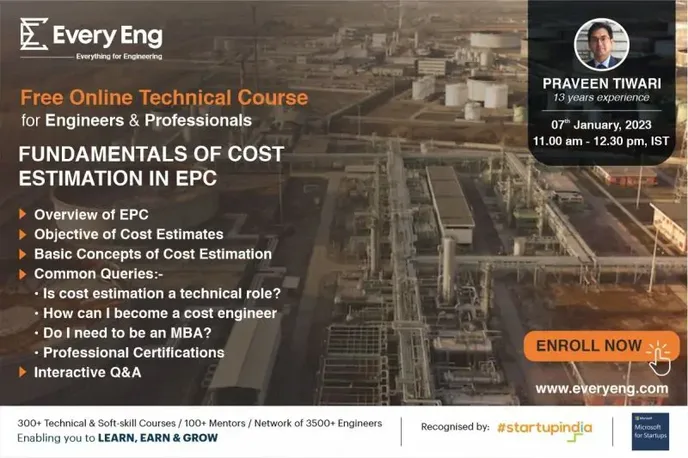
Career in EPC Cost Estimation by Praveen Tiwari
Career in EPC Cost Estimation by Praveen Tiwari
Tell us and we’ll notify you when the next batch is scheduled.

- Session recordings included
- Certificate of completion
What enrolled engineers say
Straight talk on the messy parts of EPC estimating, without hand-waving. The contingency build‑up walk‑through in the Class 3 estimate chapter stuck, especially the piping takeoff drift example and how small arch assumptions snowball under escalation math. From a TeamLead lens, it helped me review cost PRs with the same rigor as a repo check before prod, which matters in energyutilities budgets. mostly good, though I wasn't sold on the light touch around schedule risk; still, mining the anti‑patterns section alone justifies the time.
Module 3's WBS-to-BOQ takeoff example clarified EPC cost drivers; it's practical, though I wasn't sold on contingency math.
Came to this while trying to see how the estimating approach scales once projects move past small bids into nine‑figure EPC work. The chapter on Class III vs Class II estimates stuck, especially the piping MTO example where he walks the contingency math and why it shifts by maturity; I paused and checked it against a repo of old estimates at work. It’s pragmatic about WBS to BOQ mapping, vendor quotes, and escalation assumptions, not theory, and that tracks with how things break in prod when scope creeps. I wasn't sold on the tooling angle though—there’s light mention of spreadsheets, but I wished for more on review cadence or PR‑style checks before numbers go external. Context fits oilgas EPC and infra pretty well, less so for pure owners‑engineer roles. I wrapped up with notes to tweak our internal estimate arch and a short list of follow‑ups for the next bid cycle.
Your instructor
Team EveryEng
Engineer
Mechanical Engineering
Is this course for you?
You should take this if
- You work in Oil & Gas Upstream or Energy & Utilities
- You're a Chemical & Process / Electrical Engineering professional
- You prefer live, instructor-led training with Q&A
You should skip if
- You need a different specialisation outside Chemical & Process
- You need fully self-paced, on-demand content
Course details
Course suitable for
Key topics covered
Opportunities that await you!
Career opportunities
Training details
This is a live course that has a scheduled start date.
Live session
Starts
Sun, Oct 20, 2024
Duration
1 hour per day
Why people choose EveryEng
Industry-aligned courses, expert training, hands-on learning, recognized certifications, and job opportunities-all in a flexible and supportive environment.


 Aug 29, 2026