Skip to main contentEngineering Courses, Mentoring & Jobs | EveryEng
Casting banner
Preview this course

Casting

Casting banner
Preview this course
Self-paced Beginner

Casting

4(1579)
9 enrolled
974 views
FREE
492 min
Anytime
English
Team EveryEng
Team EveryEngMechanical Engineering
  • Lifetime access
  • Certificate of completion
  • Foundational Learning
  • Access to Study Materials
Volume pricing for groups of 5+

Why enroll

Participants join this casting course to gain practical knowledge of how complex metal components are designed and manufactured in real industries. They learn essential techniques, defect analysis, and process optimization to improve quality and efficiency. The course helps build strong foundational and hands-on skills that are highly valued in industries like automotive and aerospace. It also enhances career opportunities by equipping learners with in-demand manufacturing expertise.

Is this course for you?

You should take this if

  • You work in Manufacturing
  • You're a Mechanical Engineering / Production Engineering professional
  • You prefer self-paced learning you can revisit

You should skip if

  • You need a different specialisation outside Mechanical Engineering
  • You need live interaction with an instructor

Course details

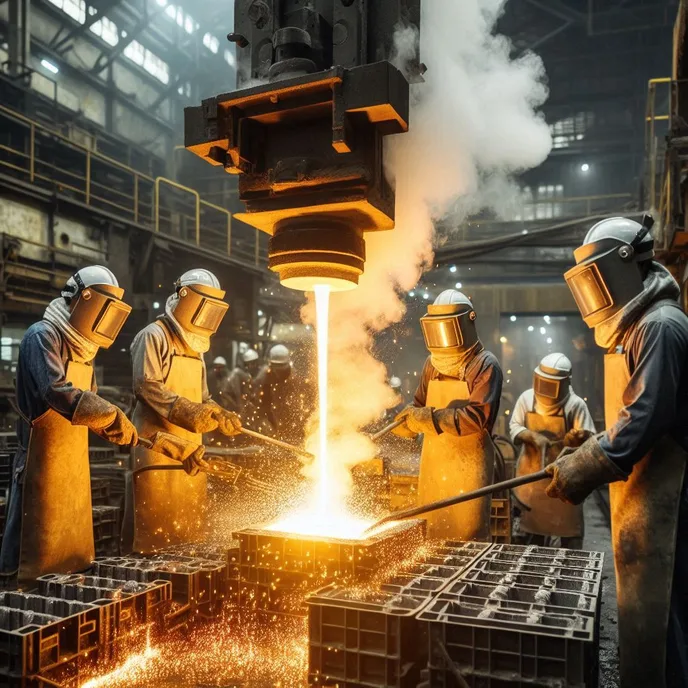
Casting is a manufacturing process that involves pouring molten metal into a mold to create a desired shape or design. This ancient technique has been refined over centuries and is widely used in various industries, including aerospace, automotive, medical, and industrial applications. The casting process begins with creating a pattern or replica of the desired shape, followed by preparing the mold cavity. The molten metal is then poured into the mold, allowed to solidify, and removed once cooled. The resulting product, called a casting, can be made from a range of materials, including ferrous and non-ferrous metals, superalloys, and composites.

The versatility of casting lies in its ability to produce complex geometries and intricate designs, making it an ideal method for creating components such as engine blocks, cylinder heads, gearboxes, and turbine blades. Additionally, casting enables high-volume production through techniques like die casting and continuous casting. However, casting also presents challenges, including material limitations, defects, dimensional accuracy, and surface finish. To overcome these issues, foundries employ various techniques, such as gravity casting, pressure casting, vacuum casting, and squeeze casting.

The benefits of casting are numerous, including cost-effectiveness, reduced machining and assembly costs, and the ability to produce complex shapes. Casting also allows for material versatility, enabling the use of various metals and alloys. With advancements in technology and simulation software, casting has become increasingly precise, enabling the production of high-quality components with improved mechanical properties. As a result, casting remains a vital manufacturing process, driving innovation and productivity across diverse industries.

Source: (Youtube Channel - NPTEL)

Course suitable for

Key topics covered

  • Introduction of Casting

  • Casting Terminology

  • Pattern Allowances

  • Sand Moulding

  • Gating system

  • Shell Mould Casting


Course content

The course is readily available, allowing learners to start and complete it at their own pace.

15 lectures8 hr 12 min

Opportunities that await you!

Career opportunities

FREE

Access anytime

Questions and Answers