<link href="https://fonts.googleapis.com/css2?family=Caveat:wght@500;700&family=JetBrains+Mono:wght@400;500;600&family=Plus+Jakarta+Sans:wght@600;700;800&display=swap" rel="stylesheet" /> Skip to main contentEngineering Courses, Mentoring & Jobs | EveryEng
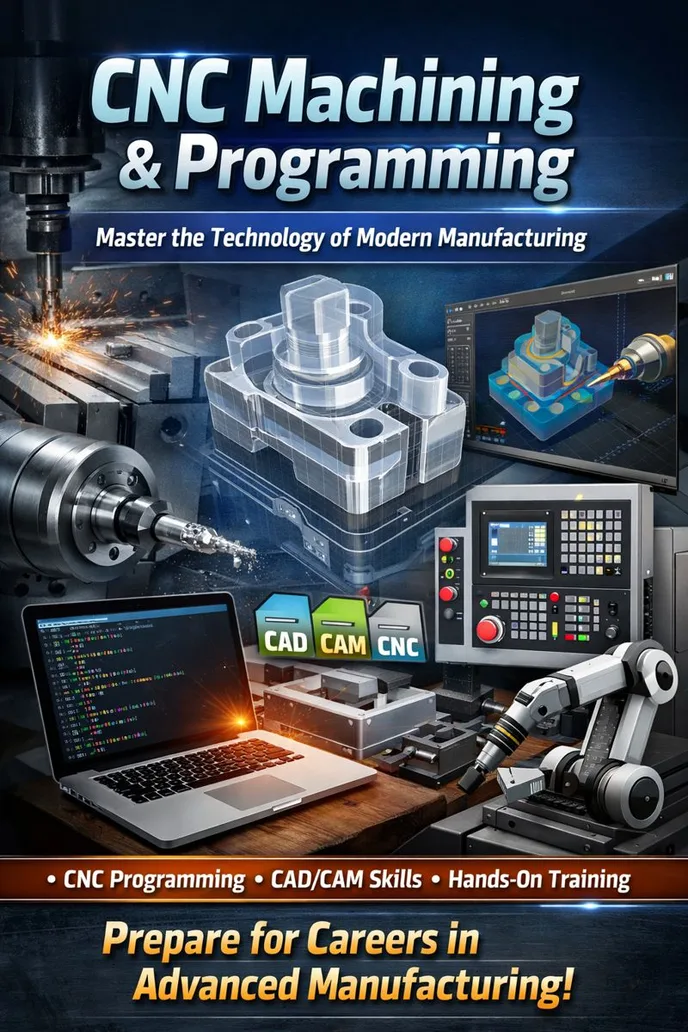
Computer numerical control machine tools and processes banner
Preview this course

Computer numerical control machine tools and processes

Computer numerical control machine tools and processes banner
Preview this course
Self-paced Advanced

Computer numerical control machine tools and processes

3(115)
1 enrolled
132 views
FREE
633 min
Anytime
English
132 views
Engineering Academy
Engineering AcademyLearn Without Limits: Free Engineering Courses
  • Lifetime access
  • Certificate of completion
  • Anytime Learning
  • Learn from Industry Expert
Volume pricing for groups of 5+

Why enroll

Participants join this program to gain a strong understanding of CNC machine tools and machining processes that are essential in modern manufacturing environments. The course helps learners develop practical knowledge of CNC programming, machine operation, and process planning, enabling them to translate design data into accurate and efficient machining operations. By understanding CNC technology, participants enhance their ability to work with precision components, complex geometries, and automated production systems.

The program is particularly valuable for students and professionals seeking to improve their technical competence, employability, and industry readiness. It provides insights into current industrial practices, productivity improvement, and quality control in CNC machining. Participants also benefit from learning how CNC systems improve consistency, reduce manufacturing time, and support advanced applications across automotive, aerospace, and general engineering industries.

Is this course for you?

You should take this if

  • You work in Mechanics & Turbomachinery
  • You're a Mechanical Engineering / Production Engineering professional
  • You have 3+ years of hands-on experience in this field
  • You prefer self-paced learning you can revisit

You should skip if

  • You're new to this field with no prior experience
  • You need a different specialisation outside Mechanical Engineering
  • You need live interaction with an instructor

Course details

Computer Numerical Control (CNC) machine tools are automated manufacturing systems in which the movements and operations of machine tools are controlled by a computer program. These programs, typically written in G-code and M-code, define parameters such as tool paths, cutting speeds, feed rates, and sequencing of operations. CNC technology enables high precision, repeatability, and consistency in the production of complex components, making it a cornerstone of modern manufacturing.

CNC machine tools include a wide range of equipment such as CNC lathes, milling machines, machining centers, drilling machines, grinding machines, and multi-axis systems. These machines are capable of performing multiple operations—turning, milling, drilling, tapping, boring, and contouring—often in a single setup. Advanced CNC systems integrate automatic tool changers, pallet changers, probing systems, and real-time process monitoring to enhance productivity and reduce setup and cycle times.

CNC machining processes involve the removal of material from a workpiece using controlled cutting tools to achieve the desired shape, dimensions, and surface finish. The process begins with part design using CAD software, followed by toolpath generation through CAM software. The generated CNC program is then executed on the machine, where servo motors and feedback systems ensure precise positioning and motion control. Depending on the application, CNC processes can be used for prototyping, batch production, or high-volume manufacturing.

Source : Youtube [ NPTEL]

Course suitable for

Key topics covered

  • introduction to computer control of computers in automation

  • classification of computer numeric control

  • tutorial involving simple calculations on different aspects of CNC controls

  • stepper motors, permanent magnet DC motors

  • computer aided offline programming

Course content

The course is readily available, allowing learners to start and complete it at their own pace.

20 lectures10 hr 33 min
  1. Introduction to computer control role of computers in automation
    28 min
  2. Introduction Cotd. binary logic and logic gates
    25 min
  3. Classification of Computer numerical control (CNC) Point to point and continuous control Dubbed
    28 min
  4. Classification Cotd. : Closed loop and open loop control
    31 min
  5. Tutorial involving simple calculations on different aspects of CNC controls
    31 min
  6. Questions, MCQ Discussions on Motors, Encoders, Decoders and Programming Practice
    34 min
  7. Stepper motors, Permanent magnet DC motors
    32 min
  8. Binary circuits and decoders
    34 min
  9. Tachogenerator, printed circuit motors, Encoders
    31 min
  10. Programming Practice - I
    38 min
  11. Programming Practice -II
    37 min
  12. Computer Aided Offline Programming
    35 min
  13. Interpolators - Linear
    30 min
  14. Interpolators - Curvilinear
    32 min
  15. Questions on Programming and Interpolation
    32 min
  16. 3-D Machining - Basic Concepts
    34 min
  17. Curved Surface Geometry
    32 min
  18. Cutter Path Generation for Curved Surfaces
    28 min
  19. Cutter Path Generation (Concluding Part) and Current Status - CNC Machining and Related Processes
    30 min
  20. Questions and Discussions on Curved Surface Machining
    31 min

Opportunities that await you!

Career opportunities

FREE

Access anytime

Questions and Answers

A: 0.01 mm on a spindle bore is already tight. Changing a datum surface changes the entire tolerance stack, not just inspection labeling. If B moved from a cast face to a ground face in Rev C, concentricity relative to the bearing seats shifts, and preload scatter shows up even if every individual dimension is in spec.

A: Below about 30% radial engagement, cutting forces drop fast. Full axial depth keeps tool engagement consistent, which matters more than spindle speed when walls are this thin. The others feel safer but stack heat and force right where the rib wants to move.

A: A few microns per 100 mm is the giveaway. Linear growth with travel, independent of tool and program, points to geometry drift along the ways. Ballscrew thrust wear usually shows direction change error, not a clean taper.

A: Feed is rpm × teeth × chip load: about 1,200 mm/min. Engagement is 5 mm wide and, say, 10 mm axial, giving 50 mm². Multiply and convert: 1,200 × 50 ≈ 60,000 mm³/min, or 60 cm³/min. Push a bit for real-world, and 600 cm³/min is the defensible bucket.