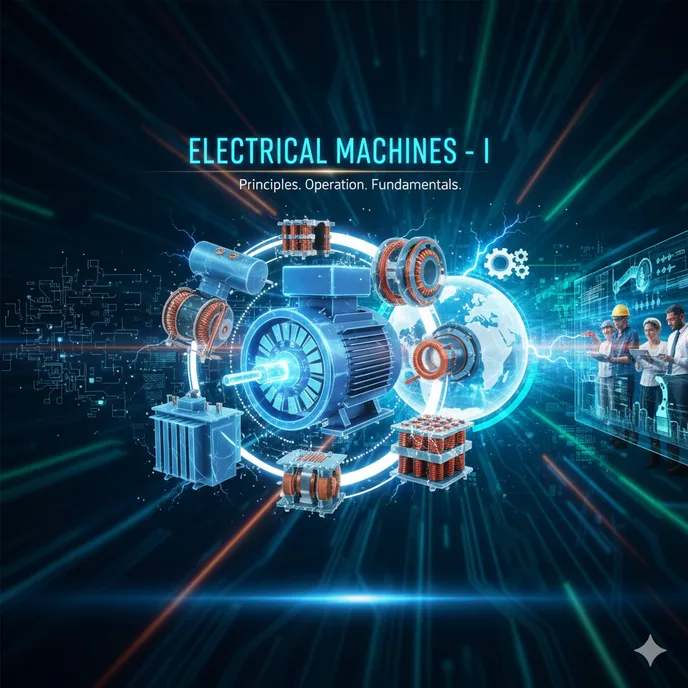
Preview this course
Electrical Machines - I
Self-paced Advanced
Electrical Machines - I
3(115)
206 views
FREE
3158 min
Anytime
English
206 views
Engineering AcademyLearn Without Limits: Free Engineering Courses
- Lifetime access
- Certificate of completion
- Anytime Learning
- Learn from Industry Expert
Why enroll
Is this course for you?
You should take this if
- You work in Electronics & Instrumentation
- You're a Electrical Engineering professional
- You have 3+ years of hands-on experience in this field
- You want to build skills in Engineering & Design, Research & Developmnet
You should skip if
- You're new to this field with no prior experience
- You need a different specialisation outside Electrical Engineering
- You need live interaction with an instructor
Course details
Course suitable for
Key topics covered
Course content
The course is readily available, allowing learners to start and complete it at their own pace.
95 lectures52 hr 38 min
- Electrical Machines18 min
- Lecture 01: Magnetic Circuit and Transformer33 min
- Lecture 02: Magnetising Current from B-H Curve31 min
- Lecture 03: Ideal Transformer, Dot Convention and Phasor Diagram30 min
- Lecture 04: Operation of Ideal Operation with Load Connected30 min
- Lecture 05: Equivalent Circuit of Ideal Transformer30 min
- Lecture 06: Rating of Single Phase Transformer: Rated Current and Rated Voltage with Example31 min
- Lecture 07: Transformer with Multiple Coils34 min
- Lecture 08: Modelling of Practical Transformer - I36 min
- Lecture 09: Modelling of Practical Transformer - II29 min
- Lecture 10: Modelling of Practical Transformer - III27 min
- Lecture 11: Core Loss - Eddy Current Loss36 min
- Lecture 12: Factors on Eddy Current Loss Depends38 min
- Lecture 13: Hysteresis Loss32 min
- Lecture 14: Exact Equivalent Circuit31 min
- Lecture 15: Approximate Equivalent Circuit30 min
- Lecture 16: Determination of Equivalent Circuit Parameters - No Load Test40 min
- Lecture 17: Short Circuit Test32 min
- Lecture 18: Choosing Sides to Carry Out O.C / S.C Test34 min
- Lecture 19: Efficiency of Transformer - Losses34 min
- Lecture 20: Efficiency (Contd.)30 min
- Lecture 21: Condition for Maximum Efficiency When Load Power Factor Constant29 min
- Lecture 22: Family of Efficiency Curve at Various Power Factor and Energy Efficiency36 min
- Lecture 23: Load Description and Energy Efficiency28 min
- Lecture 24: Regulation: its Expression31 min
- Lecture 25: Regulation: its Expression (Contd.)35 min
- Lecture 26: Auto Transformer - Introduction32 min
- Lecture 27: AutoTransformer versus Two Winding Transformer30 min
- Lecture 28: AutoTransformer versus Two Winding Transformer (Contd.)34 min
- Lecture 29: Numerical Problems on Ideal Auto Transformer33 min
- Lecture 30: Two Winding Transformer Connected as Auto Transformer31 min
- Lecture 31: Practical Auto Transformer36 min
- Lecture 32 : Equivalent Circuit of an Auto Transformer32 min
- Lecture 33: Polarity Test and Sumpner Test33 min
- lecture 34: 3 Phase Transformer Using 3 Single Phase Transformer33 min
- Lecture 35: Various Connections of 3-Phase Transformer - I35 min
- Lecture 36: Various Connections of 3-Phase Transformer - II33 min
- Lecture 37: Vector Group of 3-Phase Transformer34 min
- Lecture 38 : Vector Group (Contd.)33 min
- Lecture 39: Open Delta Connection36 min
- Lecture 40: 3-Phase Core Type and Shell Type Transformer46 min
- Lecture 41: Zig Zag Connection33 min
- Lecture 42: Effect 3rd Harmonic Exciting Current and Flux32 min
- Lecture 43: Choosing Transformer Connection35 min
- Lecture 44: Choosing Transformer Connection (Contd.)34 min
- Lecture 45: Phase Conversion using Transformer: Scott Connection42 min
- Lecture 46: Scott Connection (Contd.)34 min
- Lecture 47: 3 Phase to 6 Phase Conversion O.C / S.C Test on 3 Phase Transformer33 min
- Lecture 48: Parallel Operation of Transformers - I38 min
- Lecture 49: Parallel Operation of Transformers - II30 min
- Lecture 50: Parallel Operation of Transformers - III27 min
- Lecture -51 mod0640 min
- Lecture 52: Cooling of Transformer and Fillings of Transformer43 min
- Lecture 53: Output Equation of 3- Phase Transformer35 min
- Lecture 5432 min
- Lecture 5543 min
- Lecture 5625 min
- Lecture 5729 min
- Lecture 5834 min
- Lecture 5938 min
- Lecture 6030 min
- Lecture 6131 min
- Lecture 6236 min
- Lecture 6334 min
- Lecture 6438 min
- Lecture 6531 min
- Lecture 66 - mod0830 min
- Lecture 67 - mod0838 min
- Lecture 68 - mod0836 min
- Lecture 69 - mod0831 min
- Lecture 70 - mod0834 min
- Lecture 7136 min
- Lecture 7230 min
- Lecture 7339 min
- Lecture 74 - mod0935 min
- Lecture 75 - mod0932 min
- Lecture 76 - mod0929 min
- Lecture 77 - mod0935 min
- Lecture 78 - mod0930 min
- Lecture 79 - mod1038 min
- Lecture 80 - mod1035 min
- Lecture 81 - mod1035 min
- Lecture 82 - mod1032 min
- Lecture 83: Field Control (Contd.)32 min
- Lecture 84: D.C Motor Braking31 min
- Lecture 85: Introduction to Series Motor37 min
- Lecture 8634 min
- Lecture 87: Series Motor Speed Control32 min
- Lecture 8831 min
- Lecture 8931 min
- Lecture 9032 min
- Lecture 9130 min
- Lecture 9232 min
- Lecture 9335 min
- Lecture 94: Wave Winding (Contd.)33 min
Opportunities that await you!
Skills & tools you'll gain
Career opportunities
Why people choose EveryEng
Industry-aligned courses, expert training, hands-on learning, recognized certifications, and job opportunities-all in a flexible and supportive environment.


 Aug 29, 2026