
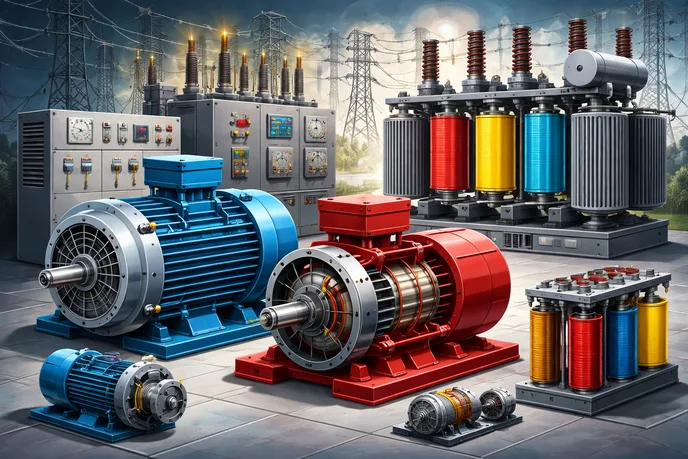
Preview this course
Electrical Machines - II
Self-paced Advanced
Electrical Machines - II
3(115)
161 views
FREE
714 min
Anytime
English
161 views
Engineering AcademyLearn Without Limits: Free Engineering Courses
- Lifetime access
- Certificate of completion
- Anytime Learning
- Learn from Industry Expert
Why enroll
Is this course for you?
You should take this if
- You work in Automotive
- You're a Electrical Engineering professional
- You have 3+ years of hands-on experience in this field
- You want to build skills in Engineering & Design, Project Management
You should skip if
- You're new to this field with no prior experience
- You need a different specialisation outside Electrical Engineering
- You need live interaction with an instructor
Course details
Course suitable for
Key topics covered
Course content
The course is readily available, allowing learners to start and complete it at their own pace.
25 lectures11 hr 54 min
- Electrical Machines - II9 min
- Inductance, Self and Mutual28 min
- Relationship of Inductances in Transformer28 min
- Equivalent Circuit from Circuit KVL Equations31 min
- Co-efficient of Coupling , Energy Stored in Coupled Coils29 min
- A Single Conductor Generator and Motor29 min
- Analysis of Single Conductor Generator and Motor31 min
- Analysis of Single Conductor Generator and Motor (Contd.)29 min
- Flux Density Distribution in Space and Nature emf28 min
- Flux Density Distribution in Space and Nature emf (Contd.)30 min
- From Linear to Rotating Machine28 min
- From Linear to Rotating Machine (Contd.)27 min
- Basic Underlying Principle of Operation of Rotating Machine31 min
- Basic Underlying Principle of Operation of Rotating Machine (Contd.)28 min
- Flux Density Distribution along the Air Gap28 min
- Flux Density Distribution along the Air Gap (Contd.)30 min
- Induced Voltage in a Coil in a Rotating Machine28 min
- Induced Voltage in a Coil in a Rotating Machine (Contd.)29 min
- Induced Voltage in a Coil in a Rotating Machine (Contd.) I33 min
- Induced Voltage due to Fundamental and Harmonic Components of Flux Density Distribution29 min
- Distributed Coils Connected in Series Resultant Voltage29 min
- Distribution Factor31 min
- Pitch Factor and Winding Factor29 min
- How to decide about Short Pitch Angle ϵ29 min
- Double Layer 3-phase Winding - An Introduction33 min
Opportunities that await you!
Skills & tools you'll gain
Career opportunities
Why people choose EveryEng
Industry-aligned courses, expert training, hands-on learning, recognized certifications, and job opportunities-all in a flexible and supportive environment.

 Oct 2, 2026