Skip to main contentEngineering Courses, Mentoring & Jobs | EveryEng
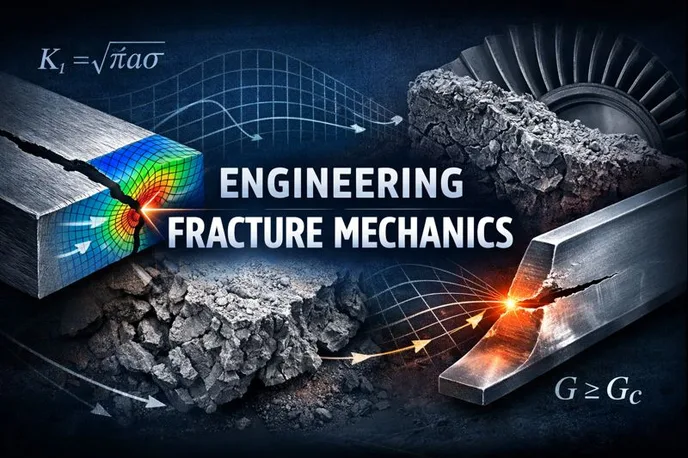
Engineering Fracture Mechanics banner
Preview this course
Engineering Fracture Mechanics banner
Preview this course
Self-paced Advanced

Engineering Fracture Mechanics

4(117)
285 views
FREE
2096 min
Anytime
English
285 views

Engineering Academy
Engineering AcademyLearn Without Limits: Free Engineering Courses
  • Lifetime access
  • Anytime Learning
  • Learn from Industry Expert
  • Career Option Guideline

Why enroll

People enroll in an Engineering Fracture Mechanics course to understand how and why materials fail under real-world conditions. The course equips engineers with tools to predict crack initiation and growth, improve the safety and reliability of structures, and prevent catastrophic failures in fields like aerospace, civil, mechanical, and materials engineering. It also helps bridge theory with practical design, enabling better material selection, damage tolerance analysis, and compliance with engineering standards.

Is this course for you?

You should take this if

  • You work in Mechanics & Turbomachinery or Manufacturing & Industrial
  • You're a Mechanical Engineering / Metallurgy & Material Science professional
  • You have 3+ years of hands-on experience in this field
  • You prefer self-paced learning you can revisit

You should skip if

  • You're new to this field with no prior experience
  • You need a different specialisation outside Mechanical Engineering
  • You need live interaction with an instructor

Course details

Engineering Fracture Mechanics is a branch of mechanical and materials engineering that focuses on understanding, predicting, and preventing the initiation and growth of cracks in structures and components. It combines principles of solid mechanics, materials science, and structural analysis to evaluate the strength, durability, and failure behavior of materials under static, dynamic, and cyclic loading conditions. The discipline is widely applied in the design, safety assessment, and life prediction of engineering systems in industries such as aerospace, automotive, civil, and energy engineering.

Source: NPTEL [nptelhrd youtube channel]

Course suitable for

Key topics covered

1. Spectacular lessons

2. LEFM and EPFM

3. Fracture mechanics is holistic

4. Fatigue crack growth model

5. Fracture strength by giffith

6. Elastic strain energy

7. Pop-in phenomenon

Course content

The course is readily available, allowing learners to start and complete it at their own pace.

41 lectures34 hr 56 min
  1. course outline
    48 min
  2. Spectacular failures
    48 min
  3. lessons from spectacular failures
    50 min
  4. LEFM and EPFM
    49 min
  5. Fracture mechanics is Holistic
    51 min
  6. Fatigue crack model
    50 min
  7. crack growth and fracture mechanism
    53 min
  8. Elastic strain energy
    48 min
  9. Fracture strength by giffith
    50 min
  10. Energy release rate
    50 min
  11. Utility of energy release rate
    52 min
  12. Pop-in phenomenon
    51 min
  13. Displacement and stress formulation
    51 min
  14. forms of stress functions
    52 min
  15. airy's stress function model - 1
    51 min
  16. Westergaard Solution of Stress Field for Mode-I
    51 min
  17. Displacement Field for Mode-I
    51 min
  18. Relationship between KI and GI
    53 min
  19. Stress Field in Mode-II
    51 min
  20. Generalised Westergaard Approach
    53 min
  21. William's Eigen Function Approach
    46 min
  22. Multi parameter stress field equations
    51 min
  23. validation of multi parameter stess field equation
    47 min
  24. Discussion Session-I
    54 min
  25. Evaluation SIF for various geometries
    49 min
  26. SIF for embedded cracks
    47 min
  27. SIF for surface cracks
    53 min
  28. modeling pf plastic deformation
    53 min
  29. Irwin's model
    52 min
  30. Dugdale model
    52 min
  31. Fracture toughness testing
    52 min
  32. plane strain fracture toughness testing
    50 min
  33. plane stress fracture toughness testing continued
    51 min
  34. Paris law and sigmoidal curve
    51 min
  35. Crack closure
    51 min
  36. crack growth models
    52 min
  37. J- Integral
    54 min
  38. HRR fiels and CTOD
    52 min
  39. FAD and mixed mode fracture
    54 min
  40. Crack arrest and repair methodologies
    53 min
  41. Discussion Session - II
    59 min

Opportunities that await you!

Career opportunities

Why people choose EveryEng

Industry-aligned courses, expert training, hands-on learning, recognized certifications, and job opportunities-all in a flexible and supportive environment.

FREE

Access anytime

Questions and Answers

A: A: Sy matters, but API 579 doesn’t let you bypass toughness degradation by leaning on yield alone. B: This is the point of the method — trend and temperature shift drive KIc margin. C: Joint efficiency caps stress, it doesn’t speak to crack driving force. D: Corrosion allowance is a thickness issue, not a toughness trend issue.

A: A: Hydrogen issues usually show delayed cracking or outliers, not a clean downward slope. B: Higher constraint drops apparent CTOD while still passing — that fits the geometry revision error. C: Scatter doesn’t line up test-to-test in one direction like this. D: Overmatching tends to help CTOD, not erode it.

A: A: Certs and NDT don’t fix a wrong joint shape already being welded. B: Briefings after the fact don’t undo constraint changes. C: Stop, align WPS and geometry, then recheck fracture inputs — that blocks the failure path. D: Parallel work saves hours but risks locking in the wrong detail.

A: A: Stress formulas never assume infinite toughness; that’s a misread. B: This is the gap — brittle fracture ignores your stress margin. C: PWHT effects are real but not the driver here. D: Corrosion allowance still applies, temperature doesn’t cancel it.