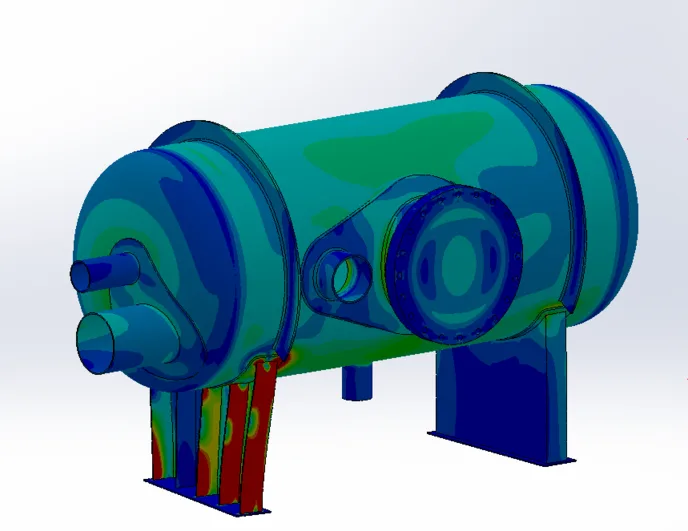
What is Finite element analysis? Difference between analytical, finite element , finite difference and boundary element methods.
The two approaches- Galerkin and Principle of minimum potential energy. How governing equations are developed for FEA?
Displacement based approaches and other approaches of finite element analysis for structural mechanics.
Element formulation- linear and higher order displacement functions.
Different element types including their higher order versions- beam elements, triangular, quadrilateral, 3D elements, plate and shell elements,
How to choose elements for an application?
Mesh generation, mesh grading, element distortions, their allowable limits. Their effect on analysis results.
Solutions of FE equations. Integration orders, reduced and full integration. Their effects. Brief overview of shear and membrane locking., rigid body modes, phantom modes, hourglass modes.
Averaging vs non-averaging, convergence check.
Post processing of FE results for piping and pressure vessel analysis.
A brief overview of FE analysis for thermal/heat transfer problems.
A brief overview of design by analysis rule of ASME SEC VIII D2 Part 5.
How FE theory is incorporated in ASME SEC VIII D2 Part 5.
Element of theory of plasticity, its incorporation in ASME SEC VIII D2 Part 5 and its FE implementation. Brief overview of Riks algorithm.
FE analysis of bucking/elastic/elastic-plastic instability problems and its implementation in the framework of ASME SEC VIII D2 Part 5.
So, basically, This course will have
1. In depth ( won't compare it with one or two semester university courses as that cannot be encapsulated in courses like these ) theoretical coverage of the two key approaches to FEM- Galerkin and Principle of minimim potential energy . It will cover basics of element formulations for linear and quadratic elements , in 1D, 2D and 3D spaces.
2. This course will cover different element types, their strengths and weaknesses and areas of application.
3. A high level overview of meshing and mesh grading .
4. Numerical integration like Gauss.
5. Full vs reduced integration.
6. Concepts of convergence, completeness of polynomials, h and p refinement.
7. Application of FEM in piping applications as per B31.3.
8. Application of FEM in pressure vessel code like sec viii d2 part 5.
9. Regarding point 8 I would recommend any interested candidate for this course to kindly review my free course on solid mechanics as I will cover plate n shell theory and non linear mechanics including plasticity in context of Application of sec viii d2. .
10. There will be screenshots from abaqus but no live demonstrations.
11. This course like my other courses will be maths heavy in the theoretical section .
12. This course will not be simple " how to do type" but why to do followed by how to do.
13. This course cannot teach you about operating a specific software. Key points from Abaqus will be there .
14. This course will give you an understanding of the theoretical minimum and to see their application in the space of piping and pressure vessels. Some key learning outcomes will be understanding of background theory to confidently do FEA and critically review and challenge any FEA report.
15. Currently I have not included any thermal analysis in the slides. If potential candidates want I can add the same .