<link href="https://fonts.googleapis.com/css2?family=Caveat:wght@500;700&family=JetBrains+Mono:wght@400;500;600&display=swap" rel="stylesheet" /> Skip to main contentEngineering Courses, Mentoring & Jobs | EveryEng
Fundamentals of operation research banner
Preview this course

Fundamentals of operation research

Fundamentals of operation research banner
Preview this course
Self-paced Advanced

Fundamentals of operation research

3(115)
107 views
FREE
1233 min
Anytime
English
107 views
Engineering Academy
Engineering AcademyLearn Without Limits: Free Engineering Courses
  • Lifetime access
  • Certificate of completion
  • Anytime Learning
  • Learn from Industry Expert
Volume pricing for groups of 5+

Why enroll

Participants join this course to develop a structured, analytical approach to solving complex decision-making problems involving limited resources and competing objectives. The course equips learners with proven optimization and modeling techniques that are widely used in engineering, operations management, logistics, finance, and analytics-driven roles.

By joining, participants gain practical skills in formulating real-world problems into mathematical models, applying quantitative methods to identify optimal solutions, and interpreting results for effective managerial and technical decisions. The course strengthens problem-solving capability, improves logical and quantitative reasoning, and provides a strong foundation for advanced studies or professional applications in optimization, systems analysis, and data-driven decision support.

Is this course for you?

You should take this if

  • You work in Mechanics & Turbomachinery
  • You're a Mechanical Engineering / Production Engineering professional
  • You have 3+ years of hands-on experience in this field
  • You prefer self-paced learning you can revisit

You should skip if

  • You're new to this field with no prior experience
  • You need a different specialisation outside Mechanical Engineering
  • You need live interaction with an instructor

Course details

Fundamentals of Operations Research introduces systematic, quantitative methods for analyzing and optimizing complex decision-making problems in engineering, management, and applied sciences. The course focuses on building mathematical models that represent real-world systems and using analytical and computational techniques to obtain optimal or near-optimal solutions under given constraints. Key emphasis is placed on logical problem formulation, objective function development, and interpretation of results for practical decision support.

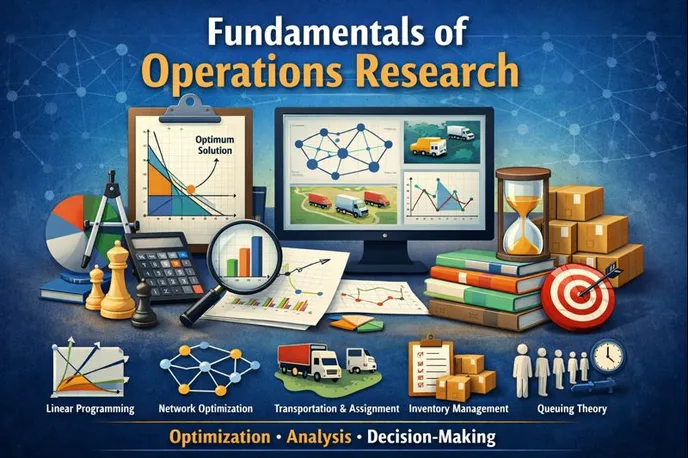
Learners are introduced to core concepts such as linear programming, transportation and assignment models, network optimization, inventory control, queuing theory, and basic decision analysis. Through illustrative examples and problem-solving exercises, the course demonstrates how Operations Research tools improve efficiency, reduce costs, and enhance resource utilization in industrial, service, and organizational settings. This foundation equips participants with the analytical mindset and quantitative skills required for advanced optimization and data-driven decision-making.

source: NPTEL[nptelhrd]

Course suitable for

Key topics covered

  • introduction to linear programming formulations

  • simplex algorithm-minimization problems

  • simplex algorithm terminatiion

  • introduction to duality

  • transportation problems

  • assignment problem- Hungarian algorithm

Course content

The course is readily available, allowing learners to start and complete it at their own pace.

22 lectures20 hr 33 min

Opportunities that await you!

Career opportunities

FREE

Access anytime

Questions and Answers

A: Governing principle: safety availability claims must be conservative and auditable. Applied here: constant-rate Markov models trade some realism for traceability and avoid embedding unproven aging assumptions into SIL decisions. Distractor trap: engineers who know wear-out exists often jump to Weibull, but misapply it where the standard prefers defendable simplicity.

A: Governing principle: Little’s Law links WIP, throughput, and flow time. Applied here: 8 units/day times 6 days lands near 48 units, and rough variability doesn't change the order. Distractor trap: engineers conflate lean targets with physics and undercount WIP by assuming ideal flow.

A: Governing principle: match uncertainty representation to decision needs. Applied here: PERT keeps the same precedence structure while explicitly modeling duration spread. Distractor trap: CPM veterans know the network well and forget that duration uncertainty, not logic, is the problem.

A: Governing principle: EOQ balances ordering and holding via a square root. Applied here: sqrt(2×1200×300 / 20) lands just under 200, even with coarse inputs. Distractor trap: engineers linearize the costs mentally and miss how weakly EOQ reacts to estimation error.