<link href="https://fonts.googleapis.com/css2?family=Caveat:wght@500;700&family=JetBrains+Mono:wght@400;500;600&display=swap" rel="stylesheet" /> Skip to main contentEngineering Courses, Mentoring & Jobs | EveryEng
Fundamentals of Vapor Compression Refrigeration (VCR) Systems: Concepts, Components, and Operation banner
Preview this course

Fundamentals of Vapor Compression Refrigeration (VCR) Systems: Concepts, Components, and Operation

Fundamentals of Vapor Compression Refrigeration (VCR) Systems: Concepts, Components, and Operation banner
Preview this course
Self-paced Beginner

Fundamentals of Vapor Compression Refrigeration (VCR) Systems: Concepts, Components, and Operation

4(160)
86 enrolled
6441 views
FREE
20 min
Anytime
English
6441 views
Md Firan Mondal
Md Firan MondalLead HVAC Engineer | CEng, MIMechE, UK I CEng, KIVI, Europe I B.E (Mechanical) I Oil & Gas I HVAC Wind Platforms I Green Hydrogen I Blogger
  • Lifetime access
  • Certificate of completion
  • Foundational Learning
  • Access to Study Materials
Volume pricing for groups of 5+

Why enroll

People enroll in a Vapor Compression Refrigeration (VCR) systems course to gain knowledge and skills related to refrigeration and air-conditioning technologies that are widely used in homes, industries, and commercial buildings. This course helps students understand the fundamental principles of refrigeration, including heat transfer, thermodynamic cycles, refrigerants, and the working of key components such as compressors, condensers, expansion devices, and evaporators.

What enrolled engineers say

6 verified reviews
  • May 3, 2026

    This course cleared up ambiguity I’d been carrying around recent tweaks to VCR basics, especially where textbook cycles diverge from what shows up in hvacr installs. The pressure‑enthalpy diagram walkthrough in Module 3, right when superheat is added at the evaporator outlet, stuck because the instructor paused to trace compressor work instead of hand‑waving it. That mapped cleanly to how I think about prod obs: small shifts upstream changing RPS and alerts downstream; it’s not k8s, but the causal chain felt familiar. I've already reused the condenser fan cycling example when reviewing an arch note in our repo, which surprised me. I wasn't sold on the expansion valve coverage—mostly wanted more on controls drift and failure modes. still, it nudged how I frame infra tradeoffs in a PR, and I’ll probably annotate assumptions more carefully before CI runs.

    Mohammed Rizvi U. Verified
  • May 3, 2026

    Good beginner pass for HVACR; the P‑h diagram walk-through in Chapter 2, especially tracing evaporator superheat through the TXV example, stuck. It's practical for field conversations, though I wasn't sold on the brief compressor sizing bit and wished there was more on part‑load behavior.

    Rajesh R. Verified
  • May 3, 2026

    The scenarios felt close to what shows up in real plants, not toy diagrams, which kept me engaged between meetings. As a bootcamp grad working near hvacr infra, seeing the Chapter 3 pressure‑enthalpy chart walk-through, especially the moment they pause on flash gas at the expansion valve, finally clicked. I’ve already mirrored that compressor/condenser arch in a quick note for our prod ops doc, because it maps cleanly to how we talk about failure modes and obs. Mostly good pace for a beginner course, though I wasn't sold on the brief controls section and wished there was more on defrost logic and oil management. The examples around startup vs steady-state, and the callout on superheat vs subcooling limits, are practical enough to survive a PR review without hand-waving—sorry, engineer brain. patterns from this are already getting copied into our internal style guide for how we diagram systems and annotate assumptions.

    Yousef M. Verified

Is this course for you?

You should take this if

  • You work in HVAC
  • You're a Mechanical Engineering professional
  • You prefer self-paced learning you can revisit

You should skip if

  • You need a different specialisation outside Mechanical Engineering
  • You need live interaction with an instructor

Course details

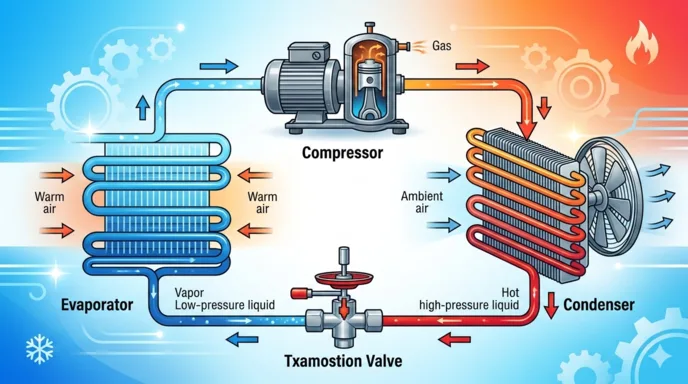
The Vapor Compression Refrigeration (VCR) system is the most commonly used method of refrigeration in domestic and industrial cooling applications such as refrigerators, air conditioners, and cold storage plants. The basic principle of refrigeration is the removal of heat from a space or substance to reduce and maintain its temperature below that of the surroundings. In a VCR system, this is achieved by circulating a refrigerant that undergoes continuous phase changes between liquid and vapor. The system mainly consists of four essential components: the compressor, condenser, expansion device (or throttle valve), and evaporator. The compressor draws low-pressure refrigerant vapor from the evaporator and compresses it to a high-pressure, high-temperature vapor. This vapor then enters the condenser, where it releases heat to the surrounding environment and condenses into a high-pressure liquid. The liquid refrigerant passes through the expansion valve or capillary tube, where its pressure suddenly drops, producing a low-temperature mixture of liquid and vapor. This cold refrigerant then enters the evaporator, where it absorbs heat from the space being cooled and evaporates into vapor again. The vapor returns to the compressor, and the cycle repeats continuously. The efficiency of a VCR system is measured by the Coefficient of Performance (COP), which is the ratio of the refrigeration effect produced to the work input required by the compressor. Due to its high efficiency, reliability, and ability to provide continuous cooling, the vapor compression refrigeration system is widely used in residential, commercial, and industrial refrigeration applications.

Course suitable for

Key topics covered

  • What is refrigeration cycle

  • Refrigeration cycle concept

  • Working philosophy

  • Function of components

  • Practical example

Course content

The course is readily available, allowing learners to start and complete it at their own pace.

7 lectures20 min
  1. What is Refrigeration Cycle
    2 min
  2. Refrigeration Cycle_Parts
    2 min
  3. Refrigeration Cycle Part 1_Evaporator
    5 min
  4. Refrigeration Cycle Part 2_Compressor
    5 min
  5. Refrigeration Cycle Part 3_Condenser
    2 min
  6. Refrigeration Cycle Part 4_Expansion Valve
    2 min
  7. How Does Refrigeration Cycle Work
    2 min

Opportunities that await you!

Career opportunities

FREE

Access anytime

Questions and Answers

Empty state icon

No questions yet - Be the first one to ask!