<link href="https://fonts.googleapis.com/css2?family=Caveat:wght@500;700&family=JetBrains+Mono:wght@400;500;600&family=Plus+Jakarta+Sans:wght@600;700;800&display=swap" rel="stylesheet" /> Skip to main contentEngineering Courses, Mentoring & Jobs | EveryEng
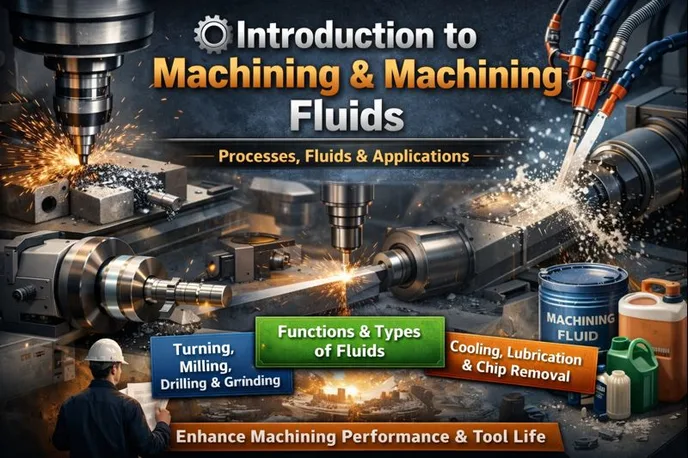
Introduction to machining and machining fluids banner
Preview this course

Introduction to machining and machining fluids

Introduction to machining and machining fluids banner
Preview this course
Self-paced Advanced

Introduction to machining and machining fluids

3(115)
100 views
FREE
1441 min
Anytime
English
100 views
Engineering Academy
Engineering AcademyLearn Without Limits: Free Engineering Courses
  • Lifetime access
  • Certificate of completion
  • Anytime Learning
  • Learn from Industry Expert
Volume pricing for groups of 5+

Why enroll

Participants join this course to build a strong foundation in machining processes and understand the practical importance of machining fluids in achieving efficient and high-quality manufacturing outcomes. The course helps learners grasp how cutting parameters, tool geometry, and the use of appropriate cutting fluids influence tool life, surface finish, and overall productivity.

This program is particularly beneficial for engineering students, technicians, and early-career professionals seeking industry-oriented knowledge of manufacturing practices. By learning fluid selection, application methods, and sustainability considerations, participants enhance their ability to solve real-world machining problems, improve process efficiency, and prepare for roles in production, manufacturing engineering, and quality control.

Is this course for you?

You should take this if

  • You work in Mechanics & Turbomachinery
  • You're a Mechanical Engineering / Production Engineering professional
  • You have 3+ years of hands-on experience in this field
  • You prefer self-paced learning you can revisit

You should skip if

  • You're new to this field with no prior experience
  • You need a different specialisation outside Mechanical Engineering
  • You need live interaction with an instructor

Course details

Introduction to Machining and Machining Fluids provides a foundational understanding of material removal processes and the critical role of machining fluids in modern manufacturing. The course introduces basic machining operations such as turning, milling, drilling, and grinding, with emphasis on cutting mechanics, tool geometry, cutting parameters, and surface generation. Learners gain insight into how machining variables influence productivity, accuracy, tool life, and surface finish.

The course also covers the fundamentals of machining fluids, including their functions, types, properties, and methods of application. Topics such as cooling, lubrication, chip removal, corrosion protection, and environmental considerations are discussed in detail. By integrating machining theory with practical aspects of fluid selection and management, the course equips participants with essential knowledge to improve machining performance, reduce tool wear, and ensure safe, efficient, and sustainable manufacturing practices.

Source : NPTEL [Youtube]

Course suitable for

Key topics covered

  • introduction and importance of machining

  • cutting tools

  • tribology in machining

  • tool wear and tool life

  • eco friendly cutting fluids

  • practical machining process

Course content

The course is readily available, allowing learners to start and complete it at their own pace.

27 lectures24 hr 1 min
  1. Introduction
    25 min
  2. Introduction and Importance of Machining
    48 min
  3. Principles of Machining or Metal cutting
    40 min
  4. cutting tools
    29 min
  5. Forces in machining
    53 min
  6. Tribology in machining
    45 min
  7. Lubrication-Surface roughness in Machining
    56 min
  8. Machinability and Thermal Aspects of Machining
    63 min
  9. Tool Wear and Tool life Part-1
    63 min
  10. Tool Wear and Tool life Part-2
    49 min
  11. Tool Wear and Tool life Part-3
    56 min
  12. Tool Coatings
    70 min
  13. Machining Fluids /Cutting Fluids and its Additives Part 1
    65 min
  14. Machining Fluids / Cutting Fluids and its Additives Part 2
    71 min
  15. Machining Fluids / Cutting Fluids and its Emissions
    55 min
  16. Eco Friendly Cutting Fluids Part 1
    43 min
  17. Eco Friendly Cutting Fluids Part 2
    54 min
  18. Rheology and Thermal Characterization of Machining / Cutting Fluids
    48 min
  19. Biodegradability Studies of Machining /Cutting Fluids
    60 min
  20. Cutting Fluids Application in Machining Region
    70 min
  21. Practical Machining Process Part-1
    54 min
  22. Practical Machining Process Part-2
    58 min
  23. Introduction to Abrasive Process-Grinding
    58 min
  24. Cutting fluids in Grinding Process
    48 min
  25. Unbonded Conventional Abrasive Processes
    51 min
  26. Advances in Metal Cutting/Machining Processes-Part 1
    58 min
  27. Advances in Metal Cutting/Machining Processes-Part 2
    51 min

Opportunities that await you!

Career opportunities

FREE

Access anytime

Questions and Answers

A: Principle: Chatter couples cutting dynamics with lubrication and heat removal. Applied here: Higher speed raised temperature and reduced effective lubrication at the tool–chip interface, so a modest feed trim plus better coolant delivery restores stability while protecting throughput. Trap: Option C sounds confident, but higher viscosity at high speed can starve the interface and raise temperature.

A: Principle: Contractual references control technical compliance unless amended. Applied here: Even if the ISO document is superseded, the cited edition defines acceptance until an MOC or contract change pulls in the new limits. Trap: Option B catches people who assume newer equals mandatory without checking the contract hook.

A: Principle: Flow assurance starts at the source and ends at the point of use. Applied here: Pump health and header pressure come first, then delivery at the tool, with concentration logged after flow is proven. Trap: Option B applies lab logic but skips the physical delivery path.

A: Principle: Machining fluids manage both lubrication and corrosion inhibition. Applied here: Dilution weakens the lubricating film and rust inhibitors, explaining edge damage and part corrosion together. Trap: Option B explains wear but not the rust pattern.