<link href="https://fonts.googleapis.com/css2?family=Caveat:wght@500;700&family=JetBrains+Mono:wght@400;500;600&family=Plus+Jakarta+Sans:wght@600;700;800&display=swap" rel="stylesheet" /> Skip to main contentEngineering Courses, Mentoring & Jobs | EveryEng
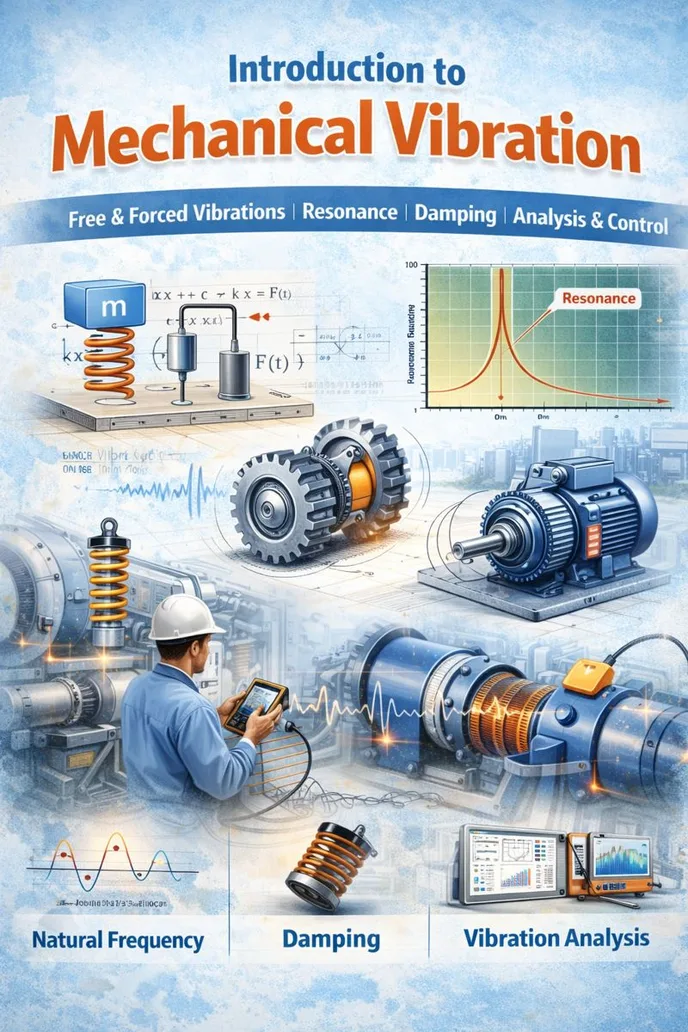
Introduction to Mechanical Vibration banner
Preview this course

Introduction to Mechanical Vibration

Introduction to Mechanical Vibration banner
Preview this course
Self-paced Advanced

Introduction to Mechanical Vibration

3(115)
1 enrolled
326 views
FREE
1261 min
Anytime
English
326 views
Engineering Academy
Engineering AcademyLearn Without Limits: Free Engineering Courses
  • Lifetime access
  • Certificate of completion
  • Anytime Learning
  • Learn from Industry Expert
Volume pricing for groups of 5+

Why enroll

Participants join this course to build a strong foundation in understanding and analyzing vibratory motion in mechanical systems. The course helps learners grasp essential concepts such as natural frequency, damping, resonance, and forced vibrations, which are critical for predicting the dynamic behavior of machines and structures.

The program is particularly beneficial for students and professionals who wish to enhance their analytical and problem-solving skills in dynamics and machine design. By studying vibration modeling and response analysis, participants gain the ability to identify potential vibration-related issues, improve system performance, and ensure the safety and reliability of mechanical components.

This course also prepares participants for advanced studies in vibration control, structural dynamics, condition monitoring, and noise and vibration analysis. It is valuable for careers in automotive, aerospace, manufacturing, and mechanical design, where understanding and controlling vibrations is essential for efficient and durable engineering solutions.

Is this course for you?

You should take this if

  • You work in Mechanics & Turbomachinery
  • You're a Mechanical Engineering / Production Engineering professional
  • You have 3+ years of hands-on experience in this field
  • You prefer self-paced learning you can revisit

You should skip if

  • You're new to this field with no prior experience
  • You need a different specialisation outside Mechanical Engineering
  • You need live interaction with an instructor

Course details

Introduction to Mechanical Vibration is a foundational course in mechanical engineering that focuses on the study of oscillatory motion of mechanical systems and the forces associated with such motion. The course provides a clear understanding of why vibrations occur, how they are modeled, and how their effects can be analyzed and controlled in engineering applications. Vibrations are inherent in machines and structures, and their proper analysis is essential to ensure safety, reliability, performance, and longevity of mechanical systems.

The course begins with basic concepts of vibration, including periodic motion, free and forced vibrations, damping, resonance, and natural frequency. Mathematical modeling of single degree of freedom systems is introduced using mass–spring–damper models, enabling students to derive equations of motion and analyze system responses under different excitation conditions. Both undamped and damped vibrations are studied to understand real-world system behavior.

As the course progresses, it covers forced vibration analysis, harmonic excitation, and resonance phenomena, highlighting their practical significance in machine operation and structural integrity. Methods for vibration measurement and analysis, such as displacement, velocity, and acceleration responses, are introduced. The course also provides an introduction to vibration isolation and control techniques used to reduce unwanted vibrations in mechanical systems.

Overall, this course equips learners with a strong theoretical foundation and analytical skills required to understand, predict, and manage vibration behavior in engineering systems. It serves as a prerequisite for advanced courses in vibration control, machine dynamics, structural dynamics, and condition monitoring, and is highly relevant to applications in automotive, aerospace, manufacturing, and mechanical system design.

source : NPTEL [youtube]

Course suitable for

Key topics covered

  • introduction to mechanical vibration

  • undamped free vibration

  • harmonic excitation

  • motion transmissibility

  • vibrometer

  • tuned absorber

Course content

The course is readily available, allowing learners to start and complete it at their own pace.

40 lectures21 hr 1 min
  1. Introduction_old
    33 min
  2. Addition of two harmonic motions and beat phenomenon
    27 min
  3. Fourier series and harmonic analysis
    41 min
  4. Vibration analysis procedure
    37 min
  5. Numerical problems-1
    32 min
  6. Undamped free vibration-1
    31 min
  7. Energy method
    31 min
  8. Damped free vibration
    33 min
  9. Viscous damped systems and logarithmic decrement
    34 min
  10. Coulomb damping
    34 min
  11. Harmonic excitations
    32 min
  12. Magnification factor and frequency response curve
    32 min
  13. Rotating unbalance
    35 min
  14. Excitation of the support
    37 min
  15. Energy input and dissipation by viscous damping
    32 min
  16. Coulomb damping and equivalent viscous damping
    31 min
  17. Structural damping and equivalent viscous damping
    32 min
  18. Vibration isolation and force transmissibility
    35 min
  19. Motion transmissibility
    29 min
  20. Numerical problems-2
    27 min
  21. Transducers and vibration pickup
    30 min
  22. Vibrometer
    26 min
  23. Accelerometer
    30 min
  24. Velocity pickup or Velometer
    26 min
  25. Phase distortion and frequency measurement
    28 min
  26. Undamped free vibration-2
    28 min
  27. Principal modes of vibration
    26 min
  28. Combined rectilinear and angular modes
    30 min
  29. Damped free vibration-2
    30 min
  30. Undamped forced vibration with harmonic excitation
    27 min
  31. Undamped dynamic vibration absorber
    32 min
  32. Tuned absorber
    30 min
  33. Numerical problems-3
    30 min
  34. Damped dynamic vibration absorber
    56 min
  35. Optimally tuned vibration absorber_old
    32 min
  36. Undamped free vibration-3
    30 min
  37. Eigen values and eigen vectors
    31 min
  38. Flexibility influence coefficients
    29 min
  39. Stiffness influence coefficients
    26 min
  40. Static and dynamic coupling
    29 min

Opportunities that await you!

Career opportunities

FREE

Access anytime

Questions and Answers

A: Option A fits the physics. A vibration trip limits amplitude at a point in time, but with the bypass still in place it won't stop prolonged dwelling near a critical speed, where alternating stress drives fatigue. Option B sounds scary, but resonance damage is cumulative, not a single zero-speed spike. Option C mixes in a real failure mode, yet it's tied to lube system dynamics, not vibration protection. Option D is credible during startups, though it's outside the safeguard's scope and not linked to resonance behavior.

A: Option A matches isolation logic: keep the isolator natural frequency far below the forcing frequency so transmissibility drops. Option B feels safe by avoiding resonance, but placing fn near running speed amplifies response. Option C works for alignment but passes vibration straight into the structure. Option D can isolate well in labs, yet air mounts bring maintenance and lateral instability that clash with a tight industrial skid.

A: Option A lines up cleanly: unbalance produces 1× response with steady phase and amplitude tied to speed. Option B can give 1×, but phase usually shifts and axial vibration grows. Option C explains broadband noise and harmonics, not a clean proportional trend. Option D creates discrete defect frequencies that don't track speed this simply.

A: Option A follows fn = (1/2π)√(k/m). Option B skips the 2π conversion from rad/s. Option C sneaks in a gravity term that belongs to static deflection checks, not dynamics. Option D double-counts stiffness by ignoring that the given value is already combined.